10 Best AI Claims Processing Software Vendors in Healthcare (2026 Guide)
Compare the 10 best AI claims processing software for healthcare in 2026 and find the right solution to automate claims, reduce denials, improve accuracy, and accelerate reimbursements.
Published on:
July 20, 2026


Key Takeaways
• AI claims processing software automates coding, submission, status tracking, and denial resolution to cut denials and speed reimbursement.
• Initial denial rates hit 11.6% in 2025, and manual follow-up can no longer keep pace.
• The strongest AI claims processing tools work claims—not just flag them—and explain every decision.
• CombineHealth runs an autonomous AI agent, Adam, that checks status, calls payers, and resolves claims on its own.
• CombineHealth stands out as the top-rated claims processing software vendor that automates coding, denial analytics, and claim status tracking in one explainable, human-in-the-loop platform.
Roughly 11.6% of medical claims are denied on first submission—care already delivered, now stuck as a denial your team has to investigate, correct, and resubmit before the filing deadline closes the window for good.
Adding headcount seems like the obvious way to keep up as volume grows. But the complexity behind each claim is growing too, and that isn't something adding more hospital staff can fix.
AI claims processing software is built to handle exactly that complexity: applying each payer's rules, producing the documentation to justify medical necessity, and automatically catching gaps at scale.
This guide ranks the 10 best AI claims processing software platforms in healthcare to help you compare your options and choose the one built for how your team works.
Automate Your Healthcare Claims Workflow End to End
CombineHealth automates coding, denial analytics, and claim status tracking, so cleaner claims go out, and fewer denials come back, without adding headcount.
Book a Demo
On this page
What Is AI Claims Processing Software?
AI claims processing software is a tool that automates the preparation, submission, tracking, and correction of healthcare insurance claims to reduce denials and speed up reimbursement.
Most billing teams already run a clearinghouse or a rules-based claims solution. What sets AI claims processing software apart is that it reads clinical documentation, learns each payer's patterns, and uses the outcomes of past claims to code, catch, and fix errors that static rules miss.
How Does an AI Claims Processing Software Work in Healthcare?
An AI claims processing software works across the full claim rather than one step of it:
- Coding: turns clinical documentation into accurate, compliant codes
- Scrubbing & submission: validates claims against payer rules before they go out
- Status tracking: follows claims through payer portals and flags what stalls
- Denial management: finds the root cause of a denial and corrects it for resubmission
What makes healthcare claims processing software worth your investment is its ability to resolve the work, not just surface it.
Every flagged denial still costs your team the time it takes to resolve, so it's important that the software corrects, resubmits, and appeals on its own rather than handing the work back.
We've compiled the list below with exactly this as the criteria.
Recommended reading: Top 10 Healthcare Claims Management Software for 2026
The 10 Best AI Claims Processing Software for Healthcare
1. CombineHealth: AI Claims Processing Software with Coding Automation, Denial Analytics, and Claim Tracking Capabilities
CombineHealth is an AI claims processing platform that automates medical coding, denial analytics, claim resolution, and claim status tracking, all in one system with a human reviewer in control of every complex decision.
It reads documentation from the EHR, applies each payer's rules, and learns from the outcomes of past claims to code accurately, surface where revenue leaks, and drive denied claims to resolution.
Feature #1: Coding automation
CombineHealth’s AI medical coding platform Amy offers payer-outcome-aware coding that combines coding guidelines, specialty rules, and human-review feedback with real claim-outcome data—so your team automates more of its coding with confidence.
Feature #2: Denial analytics
The AI denial analytics platform Adam acts as a revenue cycle intelligence layer that diagnoses where revenue leaks, traces each denial to its root cause, and prioritizes the highest-impact fixes across your coding, billing, and denial workflows.
Feature #3: Claim status tracking
Adam also performs autonomous follow-up by logging into payer portals, checking status, making payer calls, retrieving denial details, and submitting corrections with documentation—driving unpaid claims to resolution without manual chasing.
What Makes CombineHealth Stand Out?
Across all steps of the claims processing workflows, CombineHealth has recorded these results:
- 85% reduction in manual coding
- 98%+ coding accuracy
- 75% reduction in coding-related denials
Best for: Hospitals and multispecialty physician groups that want explainable, end-to-end AI claims automation they can defend to an auditor.
Recommended reading: Top 10 AI Medical Coding Software
2. Inovalon
Inovalon is a cloud-based revenue cycle platform that manages claims from submission through payment across all payers, scrubbing them against current CMS and commercial rules before they go out the door.
Its RCM Intelligence layer adds denial and payer-performance analytics that work across any clearinghouse, with dedicated Medicare workflows for FISS and DDE billing.
- All-payer claim scrubbing and electronic submission
- Real-time claim status tracking, with deep Medicare (FISS/DDE) workflows
- RCM Intelligence denial, payer-performance, and first-pass-yield analytics
- Real-time eligibility verification across payers
- Automated secondary claims and remittance (ERA) posting
Best for: Provider teams wanting scalable, all-payer claims management with strong denial analytics.
3. Experian Health
Experian Health is an enterprise claims and patient-access platform built around ClaimSource, which manages and scrubs claims at scale while its AI Advantage layer predicts and triages denials by recovery potential.
Patient Access Curator cleans eligibility, coverage, and demographic data at registration, preventing many denials before a claim is ever built and submitted to the payer.
- ClaimSource claims management and scrubbing
- AI Advantage denial prediction and triage
- Patient Access Curator for eligibility and demographic accuracy
- Coverage discovery and prior-authorization support
- Claims reporting and analytics
Best for: Health systems focused on front-end accuracy and denial prevention.
4. Athenahealth
Athenahealth delivers athenaOne, a cloud-based EHR, practice management, and revenue cycle suite whose network-driven rules engine updates from denial trends across its network to scrub claims against current payer behavior.
Because billing runs inside the EHR, coding, submission, and follow-up share one workflow, with pricing tied to a percentage of collections rather than a flat fee.
- athenaOne EHR, practice management, and RCM in one system
- Network-informed claim scrubbing and rules engine
- Automated claim submission and denial follow-up
- Real-time eligibility and coverage checks
- Financial performance reporting
Best for: Ambulatory practices wanting billing built into their EHR.
5. Innovaccer Flow
Innovaccer Flow is an agentic revenue cycle suite built on Innovaccer's unified data layer, running AI agents that code encounters autonomously, predict denials, and draft payer-specific appeals across the cycle.
Its Flow Capture module handles autonomous coding with a documented rationale and audit trail, and its agents also manage eligibility, prior authorization, and claim status.
- Agentic automation across intake, coding, and denials
- Flow Capture autonomous coding with rationale and audit trail
- Denial prediction and automated appeal generation
- Eligibility, prior authorization, and claim status workflows
- Analytics on a unified data foundation
Best for: Mid-to-large health systems and value-based care organizations.
6. Oracle Health
Oracle Health is the enterprise EHR and revenue cycle platform built on Cerner, aimed at large hospitals, where patient accounting, claims, and billing sit inside the same system that runs clinical care.
Charges flow from clinical documentation straight into billing, giving large health systems a single environment for care delivery, patient accounting, and claims management.
- Cerner-based EHR with integrated revenue cycle
- Patient accounting, claims, and billing in one system
- Charge capture tied to clinical documentation
- Enterprise revenue cycle reporting
- Built for complex, multi-facility environments
Best for: Large hospitals and health systems standardizing on one enterprise system.
7. Optum
Optum operates one of the largest claims and payments networks in U.S. healthcare, built in part on the Change Healthcare clearinghouse, handling claims management, denial management, and revenue cycle analytics at national scale.
Its national clearinghouse connects providers to payers, with payment integrity, reimbursement, and denial tools increasingly layered with AI across administrative claims workflows.
- Large-scale clearinghouse and claims management
- Denial management and revenue cycle analytics
- Nationwide payer connectivity
- Payment integrity and reimbursement tools
- AI applied across claims workflows
Best for: Large organizations wanting national-scale claims infrastructure.
8. OSPlabs
OSPlabs is a healthcare software development company that builds custom claims and revenue cycle systems rather than an off-the-shelf product, assembling scrubbing, denial management, and A/R automation around your specific payer rules.
It also builds agentic AI modules for payer follow-up and integrates with existing EHR and practice management systems through standard healthcare data interfaces.
- Custom-built claims and RCM software
- Claim scrubbing against payer rules and coding edits
- Denial resolution and A/R automation
- Agentic AI modules for payer follow-up
- Integration with existing EHR and PM systems
Best for: Organizations needing a tailored or legacy-integrated build.
9. Tebra
Tebra is an all-in-one EHR, practice management, and billing platform for independent practices and billing companies, formed from the Kareo and PatientPop merger, with rules-engine scrubbing and claim tracking built in.
Its billing tools run real-time eligibility checks and ERA auto-posting alongside clinical and patient-engagement features, keeping coding, submission, and payment in one connected system.
- Integrated EHR, practice management, and billing
- Rules-engine claim scrubbing and eligibility checks
- Electronic claim submission and status tracking
- ERA auto-posting
- Patient engagement and practice-growth tools
Best for: Independent and small practices and billing companies.
10. PracticeSuite
PracticeSuite is a cloud practice management and billing platform built for small practices and medical billing companies, with a multi-tenant dashboard that handles claims, denials, and payment posting across many client accounts.
It supports mass claim corrections, revenue-leakage alerts, and central billing office workflows with single sign-on, making it well suited to companies managing multiple practices.
- Multi-tenant claims management and scrubbing
- Denial and A/R management with mass corrections
- Payment posting and revenue-leakage alerts
- Central billing office tools with single sign-on
- Support for a wide range of billing specialties
Best for: Billing companies and small multi-specialty practices.
How to Evaluate AI Claims Processing Software in Healthcare
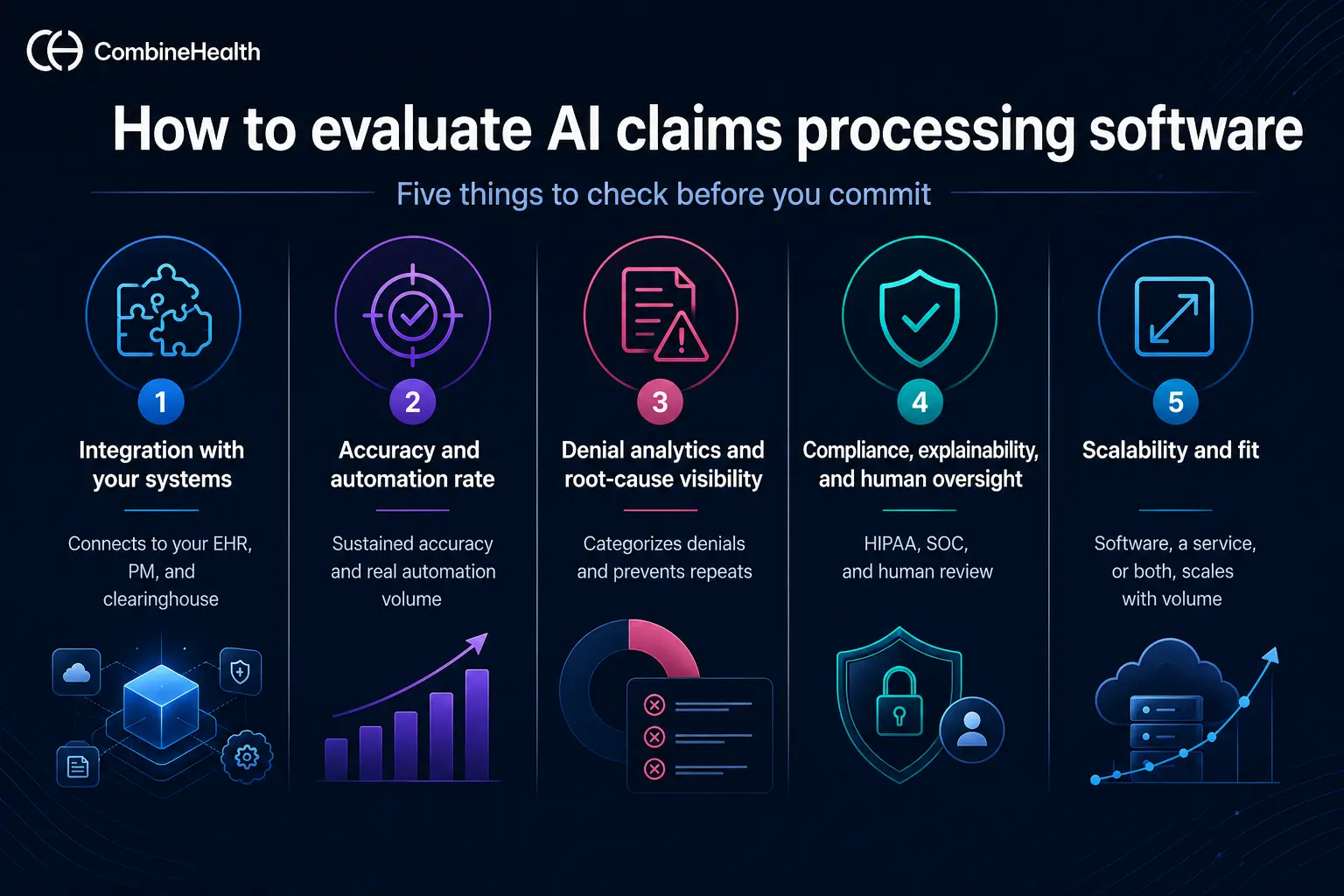
Evaluate AI claims processing software on five criteria: integration with your systems, accuracy and real automation rate, denial analytics and root-cause visibility, compliance and explainability, and whether it scales as your volume grows.
Integration with your systems
Confirm it connects to your EHR, practice management system, and clearinghouse. Without clean integration, you get data silos and the errors that cause denials.
Accuracy and automation rate
Ask what accuracy the vendor sustains and how much volume it truly automates. A tool that clears more claims by lowering its confidence threshold just moves your backlog into your denial rate.
Denial analytics and root-cause visibility
The best AI claims processing software should categorize denials by payer and reason and feed the pattern upstream so the same denial stops recurring.
Compliance, explainability, and human oversight
Payers and auditors question claims, so every code and action needs a rationale you can defend. Look for explainable decisions, HIPAA and SOC 2 compliance, and human review on complex cases.
Scalability and fit
Decide whether you want software, a managed service, or both, and confirm accuracy holds as your volume grows.
Stop Handing Back Earned Revenue with the Best Claims Processing Software
Claims processing is where earned revenue is won or lost. Every claim that stalls or gets denied is money you already earned, getting harder to recover the longer it sits.
The problem was never effort; it is capacity. AI claims processing software changes that by coding cleaner claims, tracking status automatically, and surfacing the denials worth working, so your team handles only the exceptions.
That is what CombineHealth does across coding, denial analytics, and claim status tracking.
Book a demo to see how much of your claims workflow it can take off your plate.
FAQ
What is AI claims processing software?
AI claims processing software automates preparing, submitting, tracking, and correcting healthcare claims so providers get paid faster with fewer denials, spanning coding, scrubbing, status tracking, and denial resolution.
What is the difference between payer-side and provider-side claims processing?
Payer-side software adjudicates claims and decides whether to pay. Provider-side software, covered here, works the revenue cycle to get claims paid: coding, submission, tracking, and denial management.
What's the difference between AI claims processing and traditional claims automation?
Traditional automation follows fixed rules and treats every claim the same. AI claims processing learns from documentation, payer patterns, and past outcomes to catch and fix issues that static rules miss.
Related Blogs







Explore Our
AI Workforce







Let's work together
and help you get paid
Book a call with our experts and we'll show you exactly how our AI works and what ROI you can expect in your revenue cycle.