Top 10 AI Medical Coding Solutions: 2026 Buyer Guide
Compare the top AI medical coding software in 2026. Evaluate automation, EHR integration, auditability, human review, and revenue cycle impact.
Published on:
June 18, 2026
Updated on:
September 14, 2026


Key takeaways:
• AI medical coding software helps analyze clinical documentation and generate or recommend ICD-10, CPT, HCPCS, modifier, and E/M coding outputs.
• Buyers should not evaluate AI coding tools only on automation rate and accuracy. Explainability, auditability, human review controls, payer-policy validation, specialty fit, and integration depth matter just as much.
• The strongest AI coding workflows make AI-generated codes reviewable, policy-aware, and connected to downstream revenue cycle workflows.
• Autonomous coding works best when organizations define which encounters can safely move through automation and which require human review.
• CombineHealth provides explainable medical coding automation for healthcare organizations that need AI-generated codes to be reviewable, policy-aware, and connected to revenue cycle workflows.
AI medical coding software is quickly becoming a priority for healthcare revenue cycle teams.
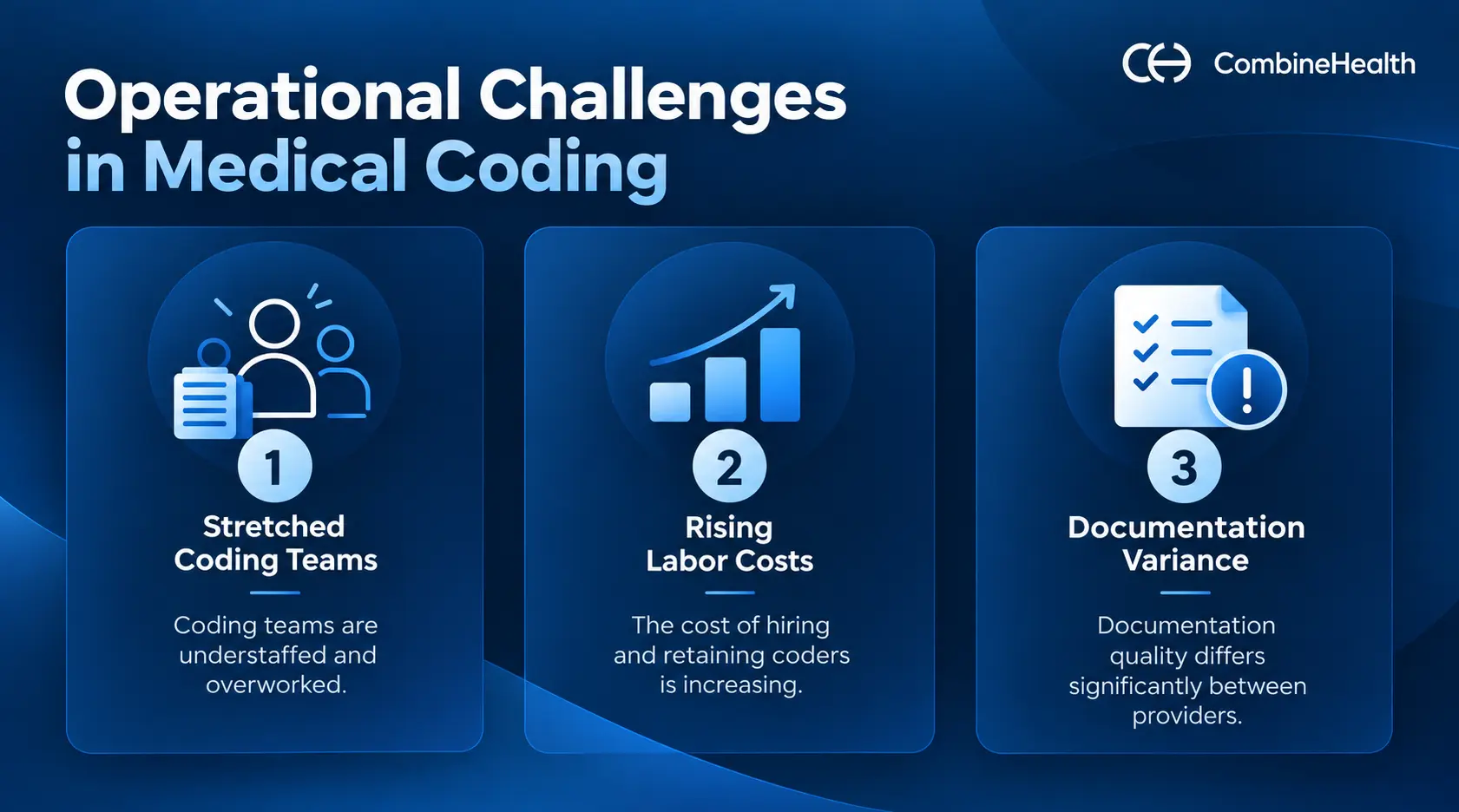
Coding backlogs, frequently changing payer rules, documentation errors, labor constraints, and rising denial rates are pushing hospitals, specialty groups, ASCs, physician practices, and RCM teams to evaluate medical coding solutions.
Healthcare providers are spending upwards of $20 billion to overturn denied claims due to coding inaccuracies, missing documentation, and compliance gaps. The market is now flooded with “AI coding solutions”, all promising unmatched accuracy and automation. But which coding tools actually deliver?
But the market is not simple. Some tools are coding assistants. Some are enhanced computer-assisted coding platforms. Some support autonomous coding for specific encounter types. Others connect coding with billing, denial prevention, appeals, payer-policy review, and analytics.
This guide is designed to help RCM, HIM, compliance, finance, and operations leaders compare AI medical coding software in a practical way.
On this page
- What Is AI Medical Coding Software?
- How we evaluated AI medical coding software for this guide
- Top AI medical coding software and platforms to evaluate in 2026
- 1. CombineHealth: Self-Learning Autonomous Medical Coding with Payer Intelligence
- 2. CodaMetrix — Contextual coding automation
- 3. Fathom — Autonomous medical coding at scale
- 4. Solventum 360 Encompass — Enterprise CAC, CDI, and autonomous coding ecosystem
- 5. Optum Integrity One — Enterprise mid-revenue-cycle coding and compliance
- 6. MDaudit — Coding audit, billing compliance, and revenue integrity
- 7. Nym — Autonomous medical coding engine
- 8. MediCodio — AI coding software with assisted and automated modes
- 9. AGS Health — AI-enabled coding operations and audit support
- 10. Tebra — Practice management and billing software with coding support
- How to Evaluate AI Medical Coding Platforms
- Usability Criteria for AI Medical Coding Software
- How AI Coding Tools Help with Medical Coding Audits
- Where Does CombineHealth Fit In This Medical Coding Software Comparison
- FAQs
- What is AI medical coding software?
- What is the difference between CAC and autonomous coding?
- Will AI replace medical coders?
- How accurate are AI medical coding solutions?
- How does explainable AI build trust in medical coding?
- How does AI medical coding help reduce denials?
- How does AI coding integrate with EHR and billing systems?
- What should buyers ask before choosing an AI medical coding vendor?
- How is an AI coding assistant different from a CPT lookup tool or encoder?
- Which specialties benefit most from AI medical coding?
- Is AI medical coding useful for single-specialty practices?
- Is AI medical coding useful for ASCs?
- What is the best AI medical coding software?
What Is AI Medical Coding Software?
AI medical coding software uses artificial intelligence to analyze clinical documentation and support the assignment of standardized medical codes used for billing, reimbursement, compliance, and reporting.
These codes may include:
- ICD-10 diagnosis codes
- CPT procedure codes
- HCPCS codes
- E/M levels
- Modifiers
- Specialty-specific coding logic
- Documentation and medical necessity checks
How we evaluated AI medical coding software for this guide
For this guide, we evaluated medical coding solutions based on the following criteria:
- Coding workflow coverage: ICD-10, CPT, HCPCS, modifiers, E/M logic, professional coding, facility coding, and specialty-specific requirements where applicable.
- Automation model: AI-assisted coding, autonomous coding, or confidence-based auto-coding.
- Explainability: whether the platform shows the documentation, rule logic, and payer-policy rationale behind each code.
- Audit and compliance controls: audit trails, reviewer actions, override logging, payer-rule checks, and reporting.
- Specialty fit: ability to support high-volume or complex specialties like the Emergency Department without losing coding consistency.
- Integration depth: compatibility with EHR, PMS, billing, clearinghouse, denial-management, and analytics workflows.
- Implementation risk: onboarding effort, data readiness, workflow change, coder training, and governance requirements.
- RCM connection: whether the tool connects coding with downstream billing, denials, appeals, payer-policy review, and analytics.
Note: This guide is not a substitute for an RFP, pilot, or internal compliance review. Buyers should validate vendor claims using their own encounter mix, documentation quality, payer contracts, coding policies, and denial history.
Top AI medical coding software and platforms to evaluate in 2026
1. CombineHealth: Self-Learning Autonomous Medical Coding with Payer Intelligence
CombineHealth is a self-learning autonomous medical coding platform. It uses large language models to read the full clinical encounter, apply coding guidelines and payer-specific rules, and generate explainable, billing-ready codes — ICD-10-CM, CPT, HCPCS Level II, E/M levels, and modifiers.
What sets CombineHealth apart is what happens after submission. The platform continuously evaluates its coding against real claim outcomes — denials, reimbursements, and underpayments — building proprietary payer intelligence that adapts coding strategy for each payer. The result is a measurably lower denial rate, not just accurate codes. And because every code carries a traceable rationale linked to the source documentation, coders, auditors, and compliance teams can see exactly why each code was assigned.
Why CombineHealth Stands Out
Explainable coding automation connected to revenue cycle workflows.
CombineHealth is not positioned only as a standalone autonomous coding engine. Its differentiation is that AI-generated coding outputs are designed to be reviewable, policy-aware, and RCM-connected.
CombineHealth Case Study
At a 400-bed Midwest hospital, CombineHealth reduced coding-related denials by 75% and improved captured revenue by 4% within three months, at 98%+ accuracy. In a separate high-volume ED study, CombineHealth matched expert coders across ~1,000 charts — 98%+ accuracy, ~50% faster turnaround, and 5× more documentation gaps surfaced.
Notable Results of CombineHealth
- 85% medical coding automation
- 98% proven coding accuracy at scale
- 75% reduction in coding-related denials
- 5 times more CDI gaps identified
2. CodaMetrix — Contextual coding automation
CodaMetrix is commonly associated with contextual coding automation for health systems and high-volume coding environments.
Buyers often evaluate CodaMetrix when they want coding automation that uses broader clinical context to support compliant code assignment and reduce manual coding work across professional and facility billing workflows.
Key Features:
- Contextual autonomous coding
- Professional and facility coverage
- Health-system-scale workflows
3. Fathom — Autonomous medical coding at scale
Fathom is commonly associated with autonomous medical coding and medical coding automation at scale.
Healthcare organizations often evaluate Fathom when they are looking to reduce manual coding workload for high-volume, repeatable coding workflows and want to understand how much of their encounter volume can move through autonomous coding.
Key Features:
- High-volume direct-to-billing automation
- Deep EHR integration
- Specialty-specific coding models.
4. Solventum 360 Encompass — Enterprise CAC, CDI, and autonomous coding ecosystem
Solventum 360 Encompass is commonly evaluated by large hospitals, health systems, and enterprise HIM teams that need coding automation within a broader coding, CDI, and mid-revenue-cycle environment.
It is often considered by organizations that already have mature HIM, CDI, and compliance workflows and need coding technology that can support enterprise governance.
Key Features:
- CAC + CDI + autonomous coding
- DRG validation
- Enterprise governance and reporting
5. Optum Integrity One — Enterprise mid-revenue-cycle coding and compliance
Optum Integrity One is commonly evaluated by large healthcare organizations that need structured coding, documentation, compliance, and revenue integrity workflows.
It is often considered by teams that prioritize enterprise governance, documentation review, payer-policy validation, and coding compliance across large operations.
Key Features:
- Enterprise CAC
- Payer-policy validation
- Compliance and revenue-integrity reporting
6. MDaudit — Coding audit, billing compliance, and revenue integrity
MDaudit is commonly evaluated by compliance, revenue integrity, and audit teams.
Unlike platforms that primarily focus on generating or automating codes, MDaudit is more directly associated with billing compliance, coding audit workflows, risk monitoring, and revenue integrity.
Key Features:
- AI-powered coding audits
- Pre-bill coding review
- E/M coding validation
- Coding risk analytics
7. Nym — Autonomous medical coding engine
Nym is commonly associated with autonomous or self-driving medical coding.
Healthcare organizations may evaluate Nym when they are exploring automation for defined clinical workflows and want a system that can interpret records and assign standardized billing codes for supported encounter types.
Key Features:
- Clinical language understanding
- Auditable code rationale
- Autonomous coding for defined workflows
8. MediCodio — AI coding software with assisted and automated modes
MediCodio is commonly evaluated by organizations looking for AI coding software that includes both assisted and automated workflows.
Its positioning is often associated with AI-assisted coding, automated coding modes, human coding support, and coding services.
Key Features:
- Autonomous ICD/CPT coding
- Payer-specific coding rules
- NCCI, MUE & LCD/NCD validation
- AI-assisted CDI
9. AGS Health — AI-enabled coding operations and audit support
AGS Health is commonly evaluated by organizations that need coding technology, coding operations support, and audit workflows.
It is often associated with AI-enabled coding, coding audits, worklist prioritization, coder feedback, and services-backed revenue cycle operations.
Key Features:
- AI-assisted coding
- Certified coding operations
- QA audits and worklist prioritization
10. Tebra — Practice management and billing software with coding support
Tebra is commonly evaluated by small and mid-sized practices that prioritize usability, billing workflow simplicity, and practice management integration.
It is not typically positioned as a standalone autonomous coding platform. Instead, it is more relevant for practices that want coding and claim-scrubbing support inside a broader practice management and billing workflow.
Key Features:
- ICD/CPT/HCPCS code lookup
- Pre-bill claim scrubbing
- Coding & modifier error detection
- AI denial-risk prediction
How to Evaluate AI Medical Coding Platforms
Use these criteria when comparing vendors:
The best AI coding vendor is usually not the one with the highest claimed automation rate. It is the one that can automate safely, explain its outputs clearly, route the right work to humans, and connect coding decisions to the revenue cycle outcomes the organization needs to improve.
Usability Criteria for AI Medical Coding Software
Usability matters because coding workflows are time-sensitive and detail-heavy. A tool that adds extra clicks, creates confusing queues, or requires coders to leave their normal workflow may slow adoption.
How AI Coding Tools Help with Medical Coding Audits
Medical coding audit tools help compliance, revenue integrity, and coding quality teams review whether codes are accurate, supported by documentation, and aligned with payer or regulatory requirements.
The most useful audit capabilities include:
- Encounter-level evidence: documentation, clinical context, and rules used to support each code.
- Audit trails: records of AI recommendations, coder actions, overrides, escalations, and reviewer decisions.
- Confidence scoring: prioritization of low-confidence, high-risk, high-dollar, or unusual encounters for review.
- Risk-based sampling: selection of encounters based on denial risk, payer behavior, specialty, provider, modifier use, or coding variance.
- Payer-policy validation: checks for medical necessity, modifier logic, NCCI edits, LCD/NCD rules, and payer-specific requirements where configured.
- Variance review: comparison of AI outputs, coder decisions, audit findings, payer outcomes, and denial patterns.
- Feedback loops: use of audit findings and denial outcomes to improve future coding, documentation, and billing workflows.
Where Does CombineHealth Fit In This Medical Coding Software Comparison
CombineHealth provides explainable medical coding automation for healthcare organizations.
Its coding workflow is powered by Amy, CombineHealth’s AI medical coding platform, and is designed to help teams generate or review codes with clear rationale, supporting documentation, and payer-policy checks.
CombineHealth is most relevant for organizations that want AI-generated coding outputs to be:
- Reviewable: Coders, auditors, and compliance teams can see the rationale behind coding recommendations.
- Policy-aware: Coding workflows can account for documentation requirements, modifier logic, medical necessity, NCCI edits, LCD/NCD rules, and payer-specific requirements where configured.
- RCM-connected: Coding outputs can connect with billing, denial prevention, appeals, analytics, payer-policy review, and other revenue cycle workflows.
Teams may evaluate CombineHealth when they need:
- Explainable medical coding automation
- AI-generated codes with supporting rationale
- Payer-policy and documentation validation
- Audit-ready coding workflows
- Specialty-specific coding support
- EHR, billing, and clearinghouse workflow integration
- Denial prevention tied to coding and payer-policy issues
- Coding connected with downstream RCM workflows
Book a demo to see how we can help!
FAQs
What is AI medical coding software?
AI medical coding software uses artificial intelligence to analyze clinical documentation and support code assignment for ICD-10, CPT, HCPCS, modifiers, and other billing-related codes.
Depending on the platform, it may suggest codes for review, assign codes autonomously for qualified encounters, or route uncertain cases to human coders.
What is the difference between CAC and autonomous coding?
Traditional computer-assisted coding, or CAC, helps coders by suggesting codes using rules, keywords, and NLP.
Autonomous coding platforms can assign codes automatically for defined encounter types when confidence, documentation, and rules thresholds are met. Strong autonomous coding workflows still include audit trails, human review controls, and exception routing.
Will AI replace medical coders?
No. AI can automate routine work and reduce manual review burden, but coders remain essential for complex cases, compliance review, audit, documentation quality, specialty nuance, and governance.
In many organizations, AI shifts coders toward higher-value review, audit, and exception-handling work.
How accurate are AI medical coding solutions?
Accuracy varies by vendor, specialty, documentation quality, encounter type, payer mix, and implementation maturity.
Buyers should avoid relying only on vendor-wide accuracy claims. The best way to validate accuracy is to run a pilot using your own charts, compare AI outputs with coder decisions and payer outcomes, and review performance by specialty and encounter type.
How does explainable AI build trust in medical coding?
Explainable AI shows why a code was suggested or assigned.
It should highlight the supporting documentation, clinical context, coding guideline, payer rule, modifier logic, or medical necessity rationale. This helps coders, auditors, and compliance teams verify outputs before claims are submitted or defended during audits.
How does AI medical coding help reduce denials?
AI coding can help reduce preventable denials by identifying missing documentation, modifier issues, medical necessity gaps, payer-policy conflicts, and repeated coding patterns before claims are submitted.
The strongest workflows also use denial feedback to improve future coding and documentation processes.
How does AI coding integrate with EHR and billing systems?
Leading platforms read completed documentation directly from the EHR/PMS and return billing-ready codes into existing workflows. CombineHealth works with systems including eClinicalWorks, ModMed, athenahealth, and Tebra, and supports HL7/FHIR and API-based integration for larger environments.
What should buyers ask before choosing an AI medical coding vendor?
Buyers should ask:
- Which specialties and encounter types are supported?
- What can be coded autonomously versus reviewed by humans?
- How does the system explain coding decisions?
- How are payer-policy updates handled?
- What audit trails are available?
- How does the platform integrate with EHR, PMS, billing, and clearinghouse workflows?
- What baseline metrics should be tracked during implementation?
- How are low-confidence or high-risk cases escalated?
- How does denial feedback improve the coding workflow?
How is an AI coding assistant different from a CPT lookup tool or encoder?
A CPT lookup tool or encoder helps users search codes, guidelines, and references.
An AI coding assistant analyzes clinical documentation and suggests or assigns codes based on the encounter context. An autonomous coding platform goes further by coding qualified encounters automatically while routing uncertain or high-risk cases to human review.
Which specialties benefit most from AI medical coding?
High-volume, high-complexity specialties often benefit most.
Examples include anesthesia, emergency medicine, radiology, orthopedics, cardiology, surgery, behavioral health, urgent care, and other specialties with complex documentation, modifier rules, and payer scrutiny.
Is AI medical coding useful for single-specialty practices?
Yes. AI medical coding can be useful for single-specialty practices if the platform supports that specialty’s documentation patterns, payer rules, modifiers, and coding complexity. Single-specialty groups may benefit from faster turnaround, more consistent coding, fewer documentation gaps, and cleaner claims, especially when coding volume is high.
Is AI medical coding useful for ASCs?
Yes. ASCs can benefit from AI coding when the platform supports procedure-heavy workflows, CPT and modifier logic, payer-specific requirements, medical necessity checks, and clean-claim handoffs.
ASCs should validate performance using their own procedure mix and payer contracts.
What is the best AI medical coding software?
Organizations looking for explainable medical coding automation may evaluate CombineHealth. CombineHealth helps make AI-generated codes reviewable, policy-aware, and connected to revenue cycle workflows such as billing, denial prevention, appeals, analytics, and payer-policy review.
Recommended Reads







Explore Our
AI Workforce







Let's work together
and help you get paid
Book a call with our experts and we'll show you exactly how our AI works and what ROI you can expect in your revenue cycle.