Clinical Documentation Improvement (CDI): A Guide for RCM Leaders
Learn how clinical documentation improvement (CDI) closes documentation gaps, reduces denials, and strengthens revenue cycle outcomes for RCM leaders.
Published on:
October 19, 2026


The strongest CDI software doesn't run CDI as a separate review after coding; it evaluates documentation sufficiency while coding, catching missing specificity, unsupported diagnoses, and medical-necessity gaps before the claim is submitted.
CombineHealth is built this way: CDI is part of its autonomous coding workflow, not a bolt-on. As it reads the complete encounter and assigns codes, it flags material documentation gaps as CDI alerts or queries, explains each with an audit trail, and learns from claim outcomes — an approach that surfaced 5× more CDI opportunities and up to 75% fewer coding-related denials at a 400-bed hospital.
Key Takeaways
• Clinical documentation improvement (CDI) is the practice of reviewing clinical records so they accurately, completely, and specifically reflect the care delivered. “Improvement” targets incomplete or unclear records, “integrity” targets a record that stays accurate and trustworthy, and many teams use the two terms interchangeably.
• A CDI alert flags a possible documentation opportunity or recurring pattern without always stopping the chart, while a CDI query formally asks the provider to clarify when missing or conflicting information materially affects the code. A query fits when documentation is conflicting, ambiguous, incomplete, or lacks required specificity, and it may hold coding until the provider responds.
• CDI asks whether the record fully represents the care delivered, while medical coding asks what the record supports and converts it into ICD-10-CM, CPT, HCPCS Level II, E/M, and modifier codes. Running them as one workflow keeps findings tied to the affected code, preserves the best clarification window, and avoids duplicate or low-value provider queries.
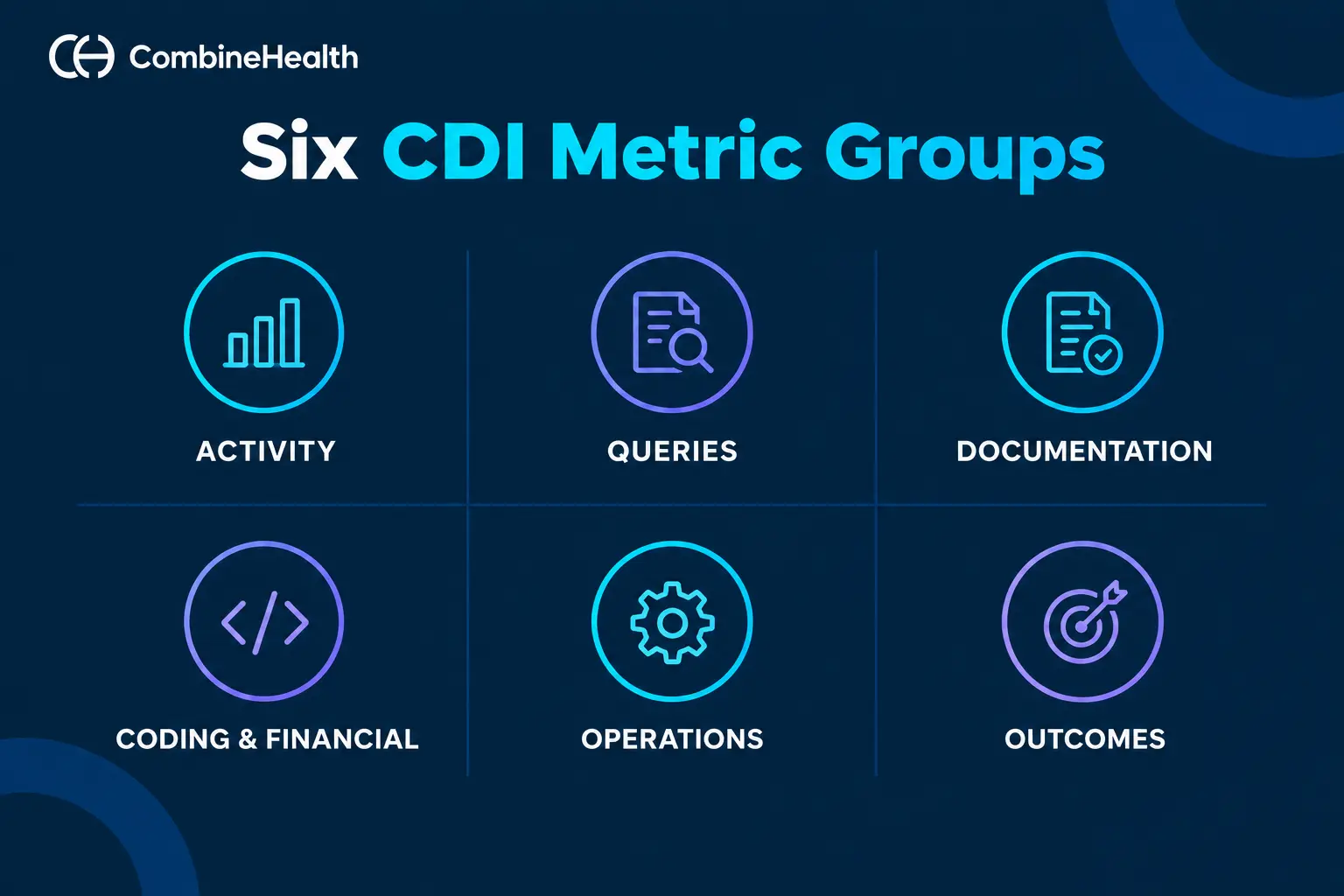
• CDI helps prevent denials by making sure the record supports the diagnosis, procedure, medical necessity, and payer requirements before submission, but it addresses only one denial cause alongside payer error, authorization, eligibility, and contract terms. Track metrics in six groups (activity, query, documentation quality, coding and financial, operational, and outcome), since outcome measures like repeat denial rate show whether documentation actually changed claim results.
A provider examines a patient, orders the right tests, treats the condition, and writes the note between two other appointments. The care is sound, but six weeks later the payer denies the claim, and the details that would settle the dispute live only in a fading memory.
Every revenue cycle management (RCM) leader knows this pattern. The work happened, the note exists, and the record still falls short of what the code, the payer, or the auditor requires. Providers write notes for the next clinician, but payers pay for what the note proves.
Clinical documentation improvement (CDI) closes that gap before the claim goes out. This guide follows CDI from definition to metrics, with a focus on outpatient, professional, and emergency department settings.
On this page
- What Is Clinical Documentation Improvement?
- Why Does CDI Matter for Revenue Cycle Management?
- How Does the Clinical Documentation Improvement Process Work?
- What Is the Difference Between a CDI Alert and a CDI Query?
- When Should a Provider Query Be Issued?
- What Are Common Clinical Documentation Gaps?
- How Are CDI and Medical Coding Different?
- Why Should CDI and Medical Coding Operate as One Workflow?
- How Can AI Improve CDI?
- How Does Explainability Apply to CDI?
- How Can CDI Help Prevent Claim Denials?
- Which CDI Metrics Should RCM Leaders Track?
- How Should RCM Leaders Build or Improve a CDI Program?
- How Should Healthcare Organizations Evaluate CDI Software?
- How CombineHealth Connects CDI With Autonomous Medical Coding
- Frequently Asked Questions
- What Is the Difference Between Clinical Documentation Improvement and Clinical Documentation Integrity?
- What Does a CDI Specialist Do?
- What Is a CDI Query?
- How Does AI Clinical Documentation Improvement Work?
- Does CombineHealth Integrate CDI With Medical Coding?
- Does CombineHealth generate provider queries, or only flag documentation gaps?
- How many more CDI opportunities does CombineHealth surface?
- Can CombineHealth audit charts our team or EHR already coded for documentation gaps?
- Does CombineHealth replace our CDI specialists?
What Is Clinical Documentation Improvement?
Clinical documentation improvement (CDI) is the practice of reviewing clinical records so they accurately, completely, and specifically reflect the care delivered. Clinical documentation integrity names the same discipline with a different emphasis. Improvement targets incomplete or unclear records. Integrity targets a record that stays accurate, complete, and trustworthy.
Many teams use the two terms interchangeably. The word integrity signals that CDI protects the truth of the record, and that revenue follows accuracy.
A record that reflects the encounter documents:
- The conditions evaluated, monitored, or treated
- Diagnosis specificity, severity, and acuity
- The procedures and services performed
- The clinical indicators behind each diagnosis
- The provider's medical decision-making
- Medical necessity
- Complications and comorbidities
- Laterality, anatomical location, and encounter details
- The relationship between diagnoses and treatments
Why Does CDI Matter for Revenue Cycle Management?
CDI matters because coding can reflect only what the record documents, and every downstream revenue cycle outcome inherits the quality of that record.
Documentation shapes five outcomes: medical coding accuracy, claim denials, appropriate reimbursement, quality and risk reporting, and audit defensibility.
Coding Accuracy
A coder can assign only what the provider documented. Missing specificity pushes the code toward unspecified, incomplete, or less representative options.
Claim Denials
Insufficient documentation contributes to several denial types:
- Medical-necessity denials
- Unsupported diagnosis or procedure denials
- Level-of-service disputes
- Missing-modifier issues
- Requests for additional documentation
- Post-payment recoupments
Documentation is one cause among several. Payer error, authorization, eligibility, contract terms, and inconsistent adjudication also generate denials, so a disciplined CDI program separates these claim denial causes before it blames the chart.
Appropriate Reimbursement
The claim should reflect the services and patient complexity the record supports. CDI targets accurate revenue capture, and that standard holds up in an audit.
Quality and Risk Reporting
Documentation also feeds measures that outlast the claim:
- Hierarchical condition category (HCC) capture
- Patient-safety indicators
- Quality measures
- Value-based reimbursement
- Public reporting
Audit Defensibility
Complete documentation is the evidence an organization produces when a payer, regulator, or internal auditor challenges a coding or billing decision.
Rank these five outcomes against your own denial and audit data. The ranking shows where CDI effort pays back first.
How Does the Clinical Documentation Improvement Process Work?
The clinical documentation improvement process is an end-to-end loop. Clinical documentation moves through CDI review, provider clarification, coding, payer validation, and claim outcome. The outcome then produces documentation intelligence: validated patterns that show where documentation falls short and sharpen the next review.
- Collect the complete clinical record
- Review the documentation for clinical consistency and coding sufficiency
- Identify material gaps, ambiguities, and contradictions
- Decide whether the issue needs an alert, a query, or a coding review
- Request provider clarification when the gap is material
- Update the documentation based on the provider's independent clinical judgment
- Complete or validate coding
- Apply coding and payer requirements
- Submit the claim
- Analyze denials, payments, audits, and other outcomes
- Use validated patterns for provider education and future documentation checks
This is the process CombineHealth runs inside coding. Rather than a separate CDI pass, it reviews the complete encounter as it codes — identifying the supported diagnoses and services, checking whether the documentation carries the required specificity and evidence, and surfacing material gaps as CDI alerts or queries — so documentation issues are caught at the point of coding, when there's still time to fix them, not after a denial.
What Is the Difference Between a CDI Alert and a CDI Query?
A CDI alert flags a possible documentation opportunity or recurring pattern and does not always stop the current chart. A CDI query formally asks the provider to clarify when missing or conflicting information materially affects the code. CDI alerts feed provider education. CDI queries enter a governed clarification workflow and may hold coding until the provider responds.
You can go through the full comparison, including provider education, in our article on CDI Query vs. CDI Alert.
When Should a Provider Query Be Issued?
A provider query is issued when the record leaves a material coding or medical-necessity decision unresolved. The trigger is a documentation problem that a coder cannot settle from the chart alone.
A provider query fits when the documentation is:
- Conflicting
- Ambiguous
- Incomplete
- Clinically inconsistent
- Missing required specificity
- Missing a relationship between documented conditions
- Inconsistent with clinical indicators
- Unclear on whether a diagnosis was ruled out, historical, or current
- Insufficient to support an important coding or medical-necessity decision
CombineHealth makes this call automatically. When missing or conflicting information materially affects the code, it generates a compliant provider query; when a gap is lower-risk or a recurring pattern, it records a CDI alert for provider education instead. That distinction means routine documentation habits don't interrupt billing, while material deficiencies get clarified before coding is finalized.
What Are Common Clinical Documentation Gaps?
Common documentation gaps are missing or vague details that prevent a coder from assigning a specific, supported code. They include missing diagnosis specificity, laterality, acuity, procedure detail, and medical decision-making.
How Are CDI and Medical Coding Different?
CDI asks whether the record fully represents the care delivered. Medical coding asks what the record supports, then translates the answer into standardized codes such as ICD-10-CM, CPT, and Healthcare Common Procedure Coding System (HCPCS) Level II. The two functions carry different responsibilities.
Why Should CDI and Medical Coding Operate as One Workflow?
CDI and medical coding should operate as one workflow because separate queues delay findings and disconnect them from claim impact. When coders evaluate documentation sufficiency, each gap links to the affected code, keeps the best clarification window open, and connects every opportunity to a claim outcome.
Recommended Read: Why Autonomous Medical Coding and CDI Must Operate As One Workflow
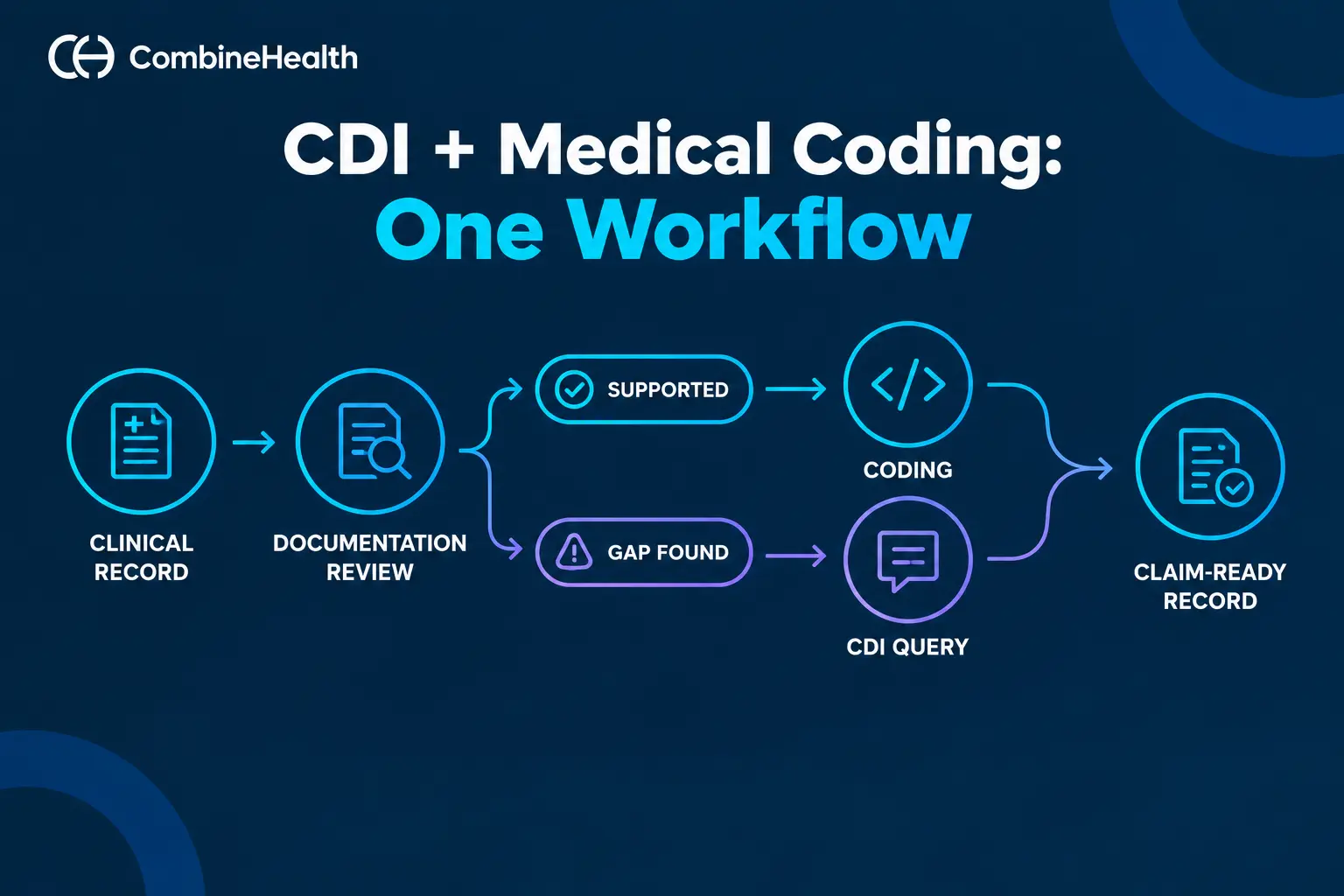
Separate queues create five problems:
- CDI reviews charts without knowing which gaps materially affect coding
- Coders discover missing information after the best clarification window has passed
- Providers receive duplicate or low-value queries
- Documentation findings stay disconnected from denials
- CDI teams count activity without proving downstream impact
Whereas an integrated workflow:
- Evaluates documentation sufficiency during coding
- Connects every opportunity to the affected diagnosis, procedure, or claim requirement
- Prioritizes gaps by materiality
- Skips queries when existing documentation already supports the appropriate code
- Completes coding when no material gap exists
- Raises a CDI query when a material gap remains
- Tracks whether documentation improvements change claim outcomes
How Can AI Improve CDI?
AI improves CDI by reviewing every eligible encounter across the complete record, finding documentation gaps, and tying each gap to its coding consequence. The strongest AI clinical documentation improvement workflow evaluates documentation while coding is performed, identifies only material gaps, explains the clinical and coding evidence behind each opportunity, and learns from downstream claim outcomes to improve future reviews.
- Review more records: AI evaluates every eligible encounter, so review coverage no longer depends on a manually selected subset.
- Read across the complete encounter: The system reads physician notes, procedure reports, orders, imaging, labs, and medications together, so evidence in one document informs a decision made from another.
- Find documentation gaps: AI identifies missing specificity, conflicts, unsupported diagnoses, procedure-detail gaps, and medical-necessity issues.
- Connect gaps to coding consequences: A useful system names the coding decision a gap affects and explains why the existing documentation falls short.
- Prioritize opportunities: The platform sorts findings into four groups: a material gap that needs clarification, a nonblocking education opportunity, a coding inconsistency, and a fully supported encounter that can proceed.
- Generate evidence-based queries: AI drafts a CDI query from the relevant clinical indicators. The workflow preserves provider judgment and organizational query policy.
- Identify provider-level patterns: Repeated gaps are grouped by provider, location, specialty, diagnosis, procedure, or documentation element, which points education at the habits that matter.
- Analyze downstream outcomes: Documentation-related denials and audit outcomes show where current CDI checks miss gaps.
In a 400-bed hospital deployment, CombineHealth surfaced 5× more CDI opportunities than the prior manual workflow. The same full-record review supports CDI audits of codes already assigned and uncovers undercoding.
How Does Explainability Apply to CDI?
Explainability shows why an AI medical coding system generated each CDI opportunity. Every CDI alert or CDI query should trace to the documentation reviewed, the clinical indicators, the missing or conflicting element, the affected code, and the applicable coding or payer requirement. CDI, coding, and compliance teams use that trace to judge whether an opportunity is clinically appropriate and query-compliant.
An explainable CDI opportunity shows:
- The documentation reviewed
- Relevant clinical indicators
- The missing, conflicting, or ambiguous element
- The diagnosis, procedure, or coding decision affected
- The applicable coding or payer requirement
- Why the platform generated an alert or query
- The workflow status and final resolution
- Any subsequent coding change and the relevant claim outcome
Explainability in AI medical coding also drives tuning. A team that can see why a false positive occurred can adjust the check with evidence. An opaque suggestion leaves only accept or reject.
CombineHealth builds this explainability into every finding. Each CDI opportunity and coding decision carries the documentation reviewed, the clinical evidence, the applicable guideline or payer rule, and the reason the chart can proceed or needs clarification — with a full audit trail. That shared record lets coding, CDI, and compliance teams validate a finding, tune a check when a false positive occurs, and defend decisions in an audit, instead of accepting or rejecting an opaque suggestion.
How Can CDI Help Prevent Claim Denials?
CDI helps prevent claim denials by ensuring the record supports the reported diagnosis, procedure, medical necessity, and payer requirements before submission. CDI addresses one category of denial causes. Payer error, authorization, eligibility, and contract terms also drive denials, so CDI works best as one layer of a broader denial prevention strategy.
A claim-ready record documents:
- The reported diagnosis
- The procedure performed
- Diagnosis-to-procedure relationships
- Medical necessity
- E/M complexity
- Required procedure detail
- Modifier usage
- Payer-specific documentation requirements
- The level and setting of service
A feedback loop turns denials into documentation checks:
- Categorize each documentation-related denial
- Identify the payer, code, reason, specialty, and provider
- Group similar claims
- Determine whether the cause was documentation, coding, billing, payer adjudication, or another issue
- Treat a validated recurring gap as a candidate CDI rule or education topic
- Check future encounters for the same issue
- Monitor whether the denial stops recurring
At a 400-bed hospital, CombineHealth's payer intelligence and integrated CDI contributed to up to 75% fewer coding-related denials within three months.
Which CDI Metrics Should RCM Leaders Track?
RCM leaders should track CDI metrics in six groups: activity, query, documentation quality, coding and financial, operational, and outcome. Activity counts show how busy a team is. Outcome metrics show whether documentation changed claim results. Track both and read them together.
How Should RCM Leaders Build or Improve a CDI Program?
RCM leaders build a CDI program by defining scope, establishing a baseline, aligning stakeholders, and setting opportunity criteria before they add technology. Then they integrate documentation findings with coding, validate technology on real charts, educate providers with recurring patterns, and measure downstream results. Each step creates the data the next step needs by following the CDI best practices.
- Define scope: Choose the settings, specialties, payers, and documentation problems the program covers.
- Establish a baseline: Measure query activity, denials, coding holds, documentation gaps, and financial impact.
- Align stakeholders: Include CDI, providers, coding, compliance, health information management (HIM), utilization management, quality, IT, and denials teams.
- Define opportunity criteria: Specify which gaps become alerts, queries, coding reviews, or education.
- Create compliant query policies: Set templates, escalation procedures, and audit requirements.
- Integrate with coding: Send documentation findings into the coding workflow without duplicate work.
- Prioritize high-impact workflows: Start with high-volume or high-denial service lines.
- Validate technology: Test recall, precision, false positives, query quality, and coding impact on your own charts.
- Educate providers: Build feedback from recurring patterns in each provider's own charts.
- Measure downstream results: Connect CDI activity to coding, denials, payment, quality, and audit outcomes.
- Refine continuously: Adjust rules and education based on validated results.
Validation on real charts sets the standard. At the 400-bed hospital deployment, CombineHealth's coding accuracy exceeded 98% within three months. For team roles and training, read the guide to building a CDI program.
How Should Healthcare Organizations Evaluate CDI Software?
Evaluate CDI software on five dimensions: review scope, alert and query handling, explainability, coding and payer connection, and workflow fit. Ask whether the CDI software reads the complete encounter, shows evidence for each opportunity, connects findings to coding, fits provider workflows, and uses denial and reimbursement data to improve. Validate every answer on a sample of your own charts.
Review scope
- Does it review the complete encounter?
- Can it operate concurrently, retrospectively, or during coding?
- Does it support the settings you operate in?
Alerts and queries
- Can it distinguish alerts from provider queries?
- Can it suppress duplicate or low-value notifications?
- Does it support organization-specific query policies?
Explainability
- Does it explain why each opportunity was identified?
- Can opportunities be traced to clinical evidence?
- Are recommendations and rule changes auditable?
Coding and payer connection
- Does it connect documentation findings to coding?
- Can it prioritize by materiality or denial risk?
- Can it incorporate denial and reimbursement outcomes?
- How does the vendor maintain coding and payer requirements?
Workflow and validation
- Does it integrate with the electronic health record (EHR) and coding workflow?
- Can providers respond within their normal workflow?
- Does it analyze patterns by provider, payer, and specialty?
- How does the vendor measure false positives?
- How is performance validated after implementation?
How CombineHealth Connects CDI With Autonomous Medical Coding
CombineHealth integrates CDI directly into autonomous medical coding. Also referred to as Amy AI, the CombineHealth medical coding platform reads completed encounter documentation directly from the EHR. The platform reviews the complete encounter, identifies the supported codes, checks whether the documentation holds the required specificity and evidence, and surfaces material gaps as CDI alerts or CDI queries. Encounters with supported documentation continue through coding.
Before Coding Is Finalized
The CombineHealth medical coding platform:
- Reads structured and unstructured documentation
- Identifies diagnoses, procedures, services, and relevant clinical evidence
- Generates or validates ICD-10-CM, CPT, HCPCS Level II, E/M, and modifier decisions
- Checks documentation sufficiency
- Applies coding guidelines and payer-specific requirements
- Identifies gaps that affect specificity, medical necessity, or code support
- Explains the evidence behind each opportunity with a traceable audit trail
- Raises CDI alerts and CDI queries where gaps are material
After Adjudication
CombineHealth connects coding-related denials, medical-necessity denials, requests for documentation, downcoding, underpayments, and appeal outcomes to the documentation and coding decisions that preceded them. Validated patterns then inform future documentation checks, CDI rules, coding validation, provider education, and payer-specific workflows. This is the self-learning loop: claim outcomes strengthen the platform's payer intelligence, which adapts coding strategy for each payer.
Brault Case Study
Brault, an emergency medicine RCM organization, runs CombineHealth in production. The platform sustained 98%+ accuracy across every major coding dimension in recurring production audits. These results show that integrated CDI can sit beside accurate production coding. Read the full Brault case study for more detail.
See how CombineHealth works on your own charts. Book a demo now.
Frequently Asked Questions
What Is the Difference Between Clinical Documentation Improvement and Clinical Documentation Integrity?
Clinical documentation improvement emphasizes fixing incomplete or unclear records. Clinical documentation integrity emphasizes keeping the health record accurate, complete, and trustworthy. Many organizations use the terms interchangeably.
What Does a CDI Specialist Do?
A CDI specialist reviews clinical records for specificity and completeness, issues CDI queries when clarification is needed, partners with coders, and educates providers on documentation that supports accurate coding.
What Is a CDI Query?
A CDI query is a formal request that asks a provider to clarify documentation when the record is conflicting, ambiguous, or incomplete. A compliant CDI query presents the clinical facts already in the record and lets the provider decide the answer.
How Does AI Clinical Documentation Improvement Work?
AI clinical documentation improvement reads the complete encounter, identifies missing, conflicting, or vague documentation, and links each gap to the affected coding decision. The strongest systems evaluate documentation during coding and explain the clinical evidence behind each CDI alert or CDI query.
Does CombineHealth Integrate CDI With Medical Coding?
Yes, CombineHealth evaluates documentation sufficiency as part of the coding workflow. The platform surfaces missing specificity and medical-necessity gaps as CDI alerts or CDI queries before the claim is submitted.
Does CombineHealth generate provider queries, or only flag documentation gaps?
It generates them. CombineHealth distinguishes CDI alerts (lower-risk gaps tracked for provider education) from CDI queries (clarification needed before coding is finalized), and generates and routes compliant provider queries automatically — rather than only flagging a gap for a specialist to write up later.
How many more CDI opportunities does CombineHealth surface?
In a 400-bed hospital deployment, CombineHealth identified 5× more CDI opportunities than the prior manual workflow — because it reviews the complete encounter for documentation gaps while it codes, catching missing specificity, unsupported diagnoses, and medical-necessity gaps a coding-only pass would send straight to billing.
Can CombineHealth audit charts our team or EHR already coded for documentation gaps?
Yes. CombineHealth runs in an audit mode that reviews codes assigned by providers, EHRs, or existing coders against the clinical documentation — flagging unsupported selections, missed coding opportunities, and documentation gaps — so you can add AI-powered CDI review alongside your current process without replacing it.
Does CombineHealth replace our CDI specialists?
No — it changes what they focus on. CombineHealth handles the high-volume documentation review during coding and surfaces material gaps with the evidence attached, so specialists spend their time on complex clarifications, provider education, and the recurring patterns worth addressing rather than screening every chart.
Related Blogs







Explore Our
AI Workforce







Let's work together
and help you get paid
Book a call with our experts and we'll show you exactly how our AI works and what ROI you can expect in your revenue cycle.