When 95% Medical Coding Accuracy Claims Can Be Misleading!
AI medical coding accuracy benchmarks aren't standardized. Discover why 95% accuracy claims can differ and how to compare AI coding vendors effectively.
Published on:
August 7, 2026


Key Takeaways:
• A 95%+ medical coding accuracy claim isn't directly comparable across vendors. Different AI medical coding vendors use different methodologies—such as claim-level, claim-line, CPT, or ICD-10 accuracy—making the same percentage mean very different things.
• Claim-level medical coding accuracy doesn't tell the whole story. Since medical claims contain multiple billable services, measuring accuracy at the claim-line level provides a more granular view of coding quality and better reflects how payers adjudicate reimbursement.
• Medical coding accuracy should be measured across multiple dimensions. A comprehensive evaluation should independently measure CPT coding accuracy, ICD-10 coding accuracy, medical necessity, modifier accuracy, and claim-line accuracy to understand both coding quality and reimbursement readiness.
• Getting the code right doesn't always mean getting paid. Even correctly coded claims can be denied if they lack supporting documentation, fail medical necessity requirements, or don't comply with payer-specific rules.
• CombineHealth measures medical coding accuracy differently. Instead of reporting a single blanket percentage, CombineHealth reports performance across multiple coding dimensions—including CPT, ICD-10, primary diagnosis, medical necessity, modifier accuracy, and autonomous coding rates—and has demonstrated measurable outcomes such as 5× more CDI opportunities identified, a 75% reduction in coding-related denials, and a 4% increase in captured revenue in production deployments.
Browse the websites of AI medical coding vendors, and you'll quickly notice a familiar pattern: almost everyone claims 95–97% coding accuracy.
At first glance, that should make evaluating vendors easy. If everyone is reporting similar numbers, the differences between solutions must be marginal.
In reality, that's rarely the case.
Before comparing accuracy percentages, it's worth asking a more fundamental question: What does a 95% accuracy claim actually mean? The answer is more nuanced than most marketing pages suggest—and understanding it can change how you evaluate AI medical coding automation platforms altogether.
See How CombineHealth Maintains 97.2% Medical Coding Accuracy
Discover the methodology behind our multidimensional accuracy framework—and how it translates into fewer denials and higher revenue capture.
Book a Demo
On this page
- Why 95% Accuracy Doesn't Mean the Same Thing Across Vendors
- Why Measuring Medical Coding Accuracy at Claim Level Isn’t Enough?
- How Should Medical Coding Accuracy Be Measured?
- How To Calculate Claim-Line Accuracy in Medical Coding?
- Questions to Ask When Evaluating an AI Medical Coding Vendor
- Is Ensuring Medical Coding Accuracy Enough to Get You Paid?
- How CombineHealth Communicates Medical Coding Accuracy Numbers
- FAQs
- How does CombineHealth prove its coding recommendations are accurate?
- Does CombineHealth use a generic large language model (LLM)?
- Can CombineHealth follow our organization's coding guidelines?
- What happens when CombineHealth isn't confident in a medical coding decision?
- How does CombineHealth identify documentation gaps?
- Can CombineHealth help reduce coding-related claim denials?
- How does CombineHealth measure coding accuracy?
- Does CombineHealth optimize for medical coding accuracy or claim reimbursement?
- What results have healthcare organizations achieved with CombineHealth?
Why 95% Accuracy Doesn't Mean the Same Thing Across Vendors
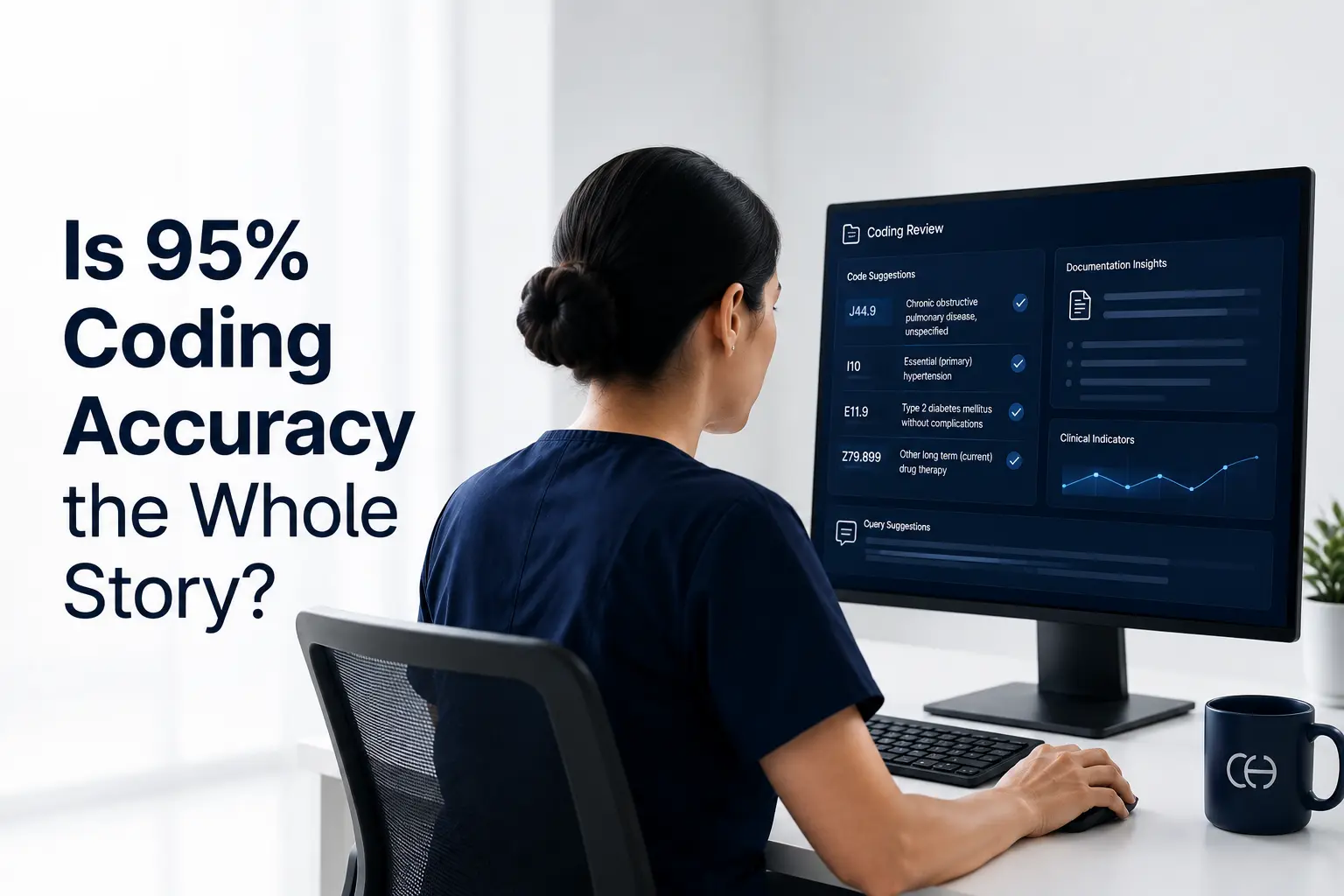
A 95% medical coding accuracy claim isn't directly comparable across vendors because each vendor may have calculated accuracy using different methodologies: claim level, claim-line level, CPT level, or ICD-10 level. As a result, two vendors can both report 95% accuracy while measuring different aspects of coding quality.
This is mainly because of the lack of standardization or universally accepted methodology for measuring coding accuracy. AHIMA has noted that although 95% is widely cited as the industry's coding accuracy benchmark, organizations use different audit methodologies and calculation approaches, making direct benchmarking difficult.
Are Accuracy Rates Demonstrated by Most Medical Coding Vendors Reliable?
Medical coding accuracy rates are useful only when they're independently validated and consistently measured over time. A single accuracy percentage from a marketing brochure tells you very little about how the solution performs in production.
The most reliable AI medical coding vendors explain how their accuracy was audited, including the sample size, audit frequency, reviewer qualifications, and whether results come from live production charts or controlled pilot studies. They should also be able to break down accuracy across different coding dimensions—such as CPT, ICD-10, and modifiers—instead of relying on a single aggregate score.
Transparency is equally important. If a vendor cannot explain how their accuracy was calculated or provide the methodology behind it, the reported percentage is difficult to interpret or compare with competing solutions.
Why Measuring Medical Coding Accuracy at Claim Level Isn’t Enough?
Measuring coding accuracy at the claim level can mask meaningful differences in coding quality because medical claims are made up of multiple billable services. A single claim may contain several CPT codes, each with its own diagnosis linkage, medical necessity requirements, and reimbursement. Evaluating an entire claim as simply "correct" or "incorrect" doesn't reflect how claims are actually processed or paid.
Also, payers don't adjudicate claims as a single, all-or-nothing transaction. Under CMS's National Correct Coding Initiative (NCCI), many coding edits are applied at the individual claim-line level, meaning one incorrectly coded service may be denied while the remaining services on the same claim continue through adjudication. In other words, a coding error on one service doesn't necessarily invalidate the rest of the claim—it primarily affects the reimbursement for that specific service.
How Should Medical Coding Accuracy Be Measured?
Medical coding accuracy should be measured across multiple dimensions—not as a single percentage. The most important metrics are CPT coding accuracy, ICD-10 coding accuracy, medical necessity accuracy, and modifier accuracy. Together, these provide a more complete view of coding quality, reimbursement readiness, and compliance.
CPT Coding Accuracy
CPT coding accuracy measures whether the correct procedure or service was assigned based on the provider's documentation. Since every CPT code represents an individual billable service, accuracy should be measured at the claim-line level rather than the claim level.
CPT accuracy = Correct CPT-coded lines ÷ Total CPT-coded lines × 100
Example
A claim contains three CPT lines:
CPT accuracy = 2 ÷ 3 × 100 = 66.7%
E/M Coding Accuracy
Evaluation and management coding is a subset of CPT coding.
E/M accuracy should determine whether the appropriate visit level was assigned based on the documentation.
Depending on the setting, the review may consider:
- Medical decision-making complexity
- Problems addressed
- Data reviewed and analyzed
- Risk of patient management
- Time spent with the patient, where applicable
- Specialty-specific guidelines
- Payer-specific requirements
- Client-specific coding rules
For example, emergency department E/M services generally fall within the 99281–99285 range.
An E/M code is accurate when the selected level is supported by the documented clinical complexity or applicable time requirements.
E/M accuracy = Correctly leveled E/M encounters ÷ Total E/M encounters reviewed × 100
ICD-10 Coding Accuracy
ICD-10 accuracy is more multidimensional than CPT accuracy.
Two experienced coders may sometimes select slightly different diagnosis combinations while still supporting the same service. Therefore, ICD-10 accuracy should not be reduced to a single exact-match test.
An ICD-10 review should answer:
- Was the correct primary diagnosis selected?
- Were any documented diagnoses missed?
- Were unsupported diagnoses avoided?
- Were diagnoses sequenced correctly?
- Were official coding guidelines followed?
Medical Necessity Accuracy
Medical necessity accuracy determines whether the ICD-10 codes linked to a CPT-coded service adequately explain why that service was required.
The primary diagnosis may be sufficient for a straightforward service. More complex encounters may require several diagnoses to collectively support the service.
For every claim line, ask:
- Does the primary diagnosis support the service?
- Do the secondary diagnoses add relevant clinical context?
- Does the complete diagnosis set justify the intensity or complexity of the service?
- Are the diagnosis codes correctly linked to the appropriate CPT line?
- Are payer-specific LCD, NCD, and coverage rules satisfied?
Medical necessity accuracy = Claim lines with sufficient diagnosis support ÷ Total claim lines reviewed × 100
Modifier Accuracy
Modifier accuracy determines whether modifiers are correctly applied, omitted, and supported by documentation. Since an otherwise correct CPT code can still be reimbursed incorrectly because of a modifier error, this metric should always be measured independently.
Modifier accuracy = Correct modifier decisions ÷ Total modifier decisions reviewed × 100
A modifier decision includes both:
- Cases where a modifier was correctly applied
- Cases where a modifier was correctly not applied
How To Calculate Claim-Line Accuracy in Medical Coding?
To calculate claim-line accuracy in medical coding, evaluate each billable service line independently rather than scoring the entire claim as correct or incorrect.
For every claim line reviewed, determine whether the coding is correct based on the CPT/HCPCS code, linked diagnosis, applicable modifiers, documentation support, and medical necessity. A line should count as correct only when the required coding elements are supported.
Then calculate claim-line accuracy using this formula:
Claim-line accuracy = Correct claim lines ÷ Total claim lines reviewed × 100
Example of how claim-line medical coding accuracy is calculated
Consider a claim with three service lines:
Accuracy = 2 ÷ 3 × 100 = 66.7%
If all three lines were correctly coded and supported, the claim-line accuracy would be 100%.
Calculate Medical Coding Accuracy Across the Full Audit Sample
For a meaningful medical coding accuracy rate, aggregate all claim lines across the charts or claims being evaluated.
For example:
- Claims reviewed: 100
- Total claim lines reviewed: 450
- Correct claim lines: 437
Overall claim-line accuracy = 437 ÷ 450 × 100 = 97.1%
Note: Report claim-level medical coding accuracy separately. Claim-level accuracy may still be reported, but only as a secondary metric. It should not replace claim-line accuracy.
Questions to Ask When Evaluating an AI Medical Coding Vendor
To understand whether an AI medical coding automation solution can perform reliably in production, ask vendors these questions:
- How is coding accuracy calculated? Is it measured at the claim level, claim-line level, or across multiple coding dimensions?
- What metrics do you report besides overall accuracy? Ask whether the vendor separately measures CPT coding accuracy, ICD-10 coding accuracy, modifier accuracy, primary diagnosis accuracy, and medical necessity.
- How do you validate coding decisions? Every code should be supported by evidence from the physician chart, applicable coding guidelines, and a clear explanation—not generated as a black-box recommendation.
- Which coding and payer guidelines does the AI follow? Look for support for AMA guidance, CMS policies, LCDs, NCDs, payer-specific medical necessity rules, and organization-specific coding policies.
- How do you handle low-confidence cases? Reliable AI shouldn't automate every chart. It should route uncertain or complex encounters for human review while allowing routine cases to be coded autonomously.
- Can every coding recommendation be audited? The system should provide the evidence, reasoning, and applicable coding guidance behind every recommended code so auditors and coders can verify the decision.
Is Ensuring Medical Coding Accuracy Enough to Get You Paid?
No, accurate medical coding still doesn't guarantee reimbursement. A claim can be coded correctly and still be denied if it lacks supporting documentation, doesn't meet medical necessity requirements, or fails to comply with payer-specific billing rules.
This is a common challenge across healthcare. According to CMS, insufficient or missing documentation accounted for 65% of the $28.83 billion in improper payments in FY2025, while medical necessity errors contributed another 15.3%. These findings highlight that reimbursement depends on more than assigning the correct code.
That's why modern AI medical coding platforms need to optimize for reimbursement outcomes—not just coding accuracy. Beyond assigning CPT and ICD-10 codes, they should identify documentation gaps, surface undercoded encounters, validate medical necessity, and apply payer-specific rules before a claim is submitted.
How CombineHealth Communicates Medical Coding Accuracy Numbers
Rather than communicating a single blanket accuracy percentage, CombineHealth reports medical coding performance across multiple dimensions, including CPT coding accuracy, ICD-10 coding accuracy, primary diagnosis accuracy, medical necessity accuracy, modifier accuracy, and autonomous coding rates.
Each metric answers a different question:
- CPT coding accuracy: Was the correct procedure or service coded?
- ICD-10 coding accuracy: Were the correct diagnoses selected and sequenced?
- Medical necessity accuracy: Do the diagnosis codes appropriately support the billed services?
- Modifier accuracy: Were reimbursement-impacting modifiers applied correctly?
- Autonomous coding rate: What percentage of charts can be coded confidently without manual intervention?
Case Study: CombineHealth’s AI Medical Coding Automation Platform Identifies 5x More CDI Issues in Emergency Department
In one emergency department deployment, CombineHealth's AI medical coding automation platform identified 5× more Clinical Documentation Improvement (CDI) opportunities than the existing manual workflow. Rather than simply assigning codes, the platform analyzed the complete clinical record to detect missing documentation, unsupported coding opportunities, diagnosis specificity gaps, and medical necessity issues that could impact reimbursement.
The improved documentation quality translated into measurable business outcomes:
5× more CDI opportunities identified
75% reduction in coding-related denials
4% increase in captured revenue within the first three months by improving documentation quality and identifying missed coding opportunities
Read the case study
Book a demo to see how CombineHealth measures AI medical coding accuracy beyond a single percentage.
FAQs
How does CombineHealth prove its coding recommendations are accurate?
CombineHealth supports every medical coding recommendation with evidence from the medical record, applicable coding guidelines, payer policies, and client-specific rules. This makes every decision transparent, explainable, and auditable.
Does CombineHealth use a generic large language model (LLM)?
No. CombineHealth's AI reasons across the complete medical record while incorporating medical coding guidelines, payer policies, and organization-specific rules. It's purpose-built for medical coding rather than relying on a general-purpose LLM.
Can CombineHealth follow our organization's coding guidelines?
Yes. CombineHealth is configurable to support client-specific coding policies, payer requirements, specialty workflows, and internal coding preferences, allowing it to align with each healthcare organization's standards.
What happens when CombineHealth isn't confident in a medical coding decision?
Rather than forcing medical coding automation, CombineHealth routes low-confidence or complex encounters to qualified human coders for review. This helps maintain coding quality while reducing compliance risk.
How does CombineHealth identify documentation gaps?
The platform analyzes the complete clinical record to identify missing documentation, diagnosis specificity gaps, and medical necessity issues. Critical gaps can trigger physician queries, while less critical issues are surfaced as educational feedback.
Can CombineHealth help reduce coding-related claim denials?
Yes. By validating coding against documentation, medical necessity, payer policies, and client-specific rules before claim submission, CombineHealth helps reduce coding-related denials and improve reimbursement outcomes.
How does CombineHealth measure coding accuracy?
Rather than reporting a single accuracy percentage, CombineHealth measures coding performance across multiple dimensions, including CPT coding accuracy, ICD-10 coding accuracy, primary diagnosis accuracy, medical necessity accuracy, modifier accuracy, and autonomous coding rates.
Does CombineHealth optimize for medical coding accuracy or claim reimbursement?
Both. While high medical coding accuracy is essential, CombineHealth is designed to optimize reimbursement outcomes by identifying documentation gaps, validating medical necessity, and applying payer-specific rules before claims are submitted.
What results have healthcare organizations achieved with CombineHealth?
Across production deployments, CombineHealth has demonstrated measurable outcomes including 5× more CDI opportunities identified, a 75% reduction in coding-related denials, and a 4% increase in captured revenue by combining accurate coding with documentation improvement and payer-aware validation.
Recommended Reads







Explore Our
AI Workforce







Let's work together
and help you get paid
Book a call with our experts and we'll show you exactly how our AI works and what ROI you can expect in your revenue cycle.