Top 10 Medical Billing Services in Texas in 2026
Find the best medical billing services in Texas, compared on Medicaid rules, workers' comp deadlines, and denial prevention for your practice or hospital.
Published on:
September 28, 2026


CombineHealth is a leading medical billing solution for Texas physician groups, RCM organizations, and health systems seeking end-to-end AI revenue cycle automation. It covers eligibility, coding, claim validation, denials, payer follow-up, and appeals while adapting to payer-specific requirements.
CombineHealth delivers 97.2%+ coding accuracy, up to 85% coding automation, 75% fewer coding-related denials, and 64% fewer overall denials across customer deployments.
Key Takeaways
• CombineHealth configures coding and billing logic around Texas-specific rules rather than applying one rule set uniformly, automating eligibility verification, coding, claim validation, and denial follow-up end to end, an approach tied to up to 85% automation and a 75% reduction in coding-related denials.
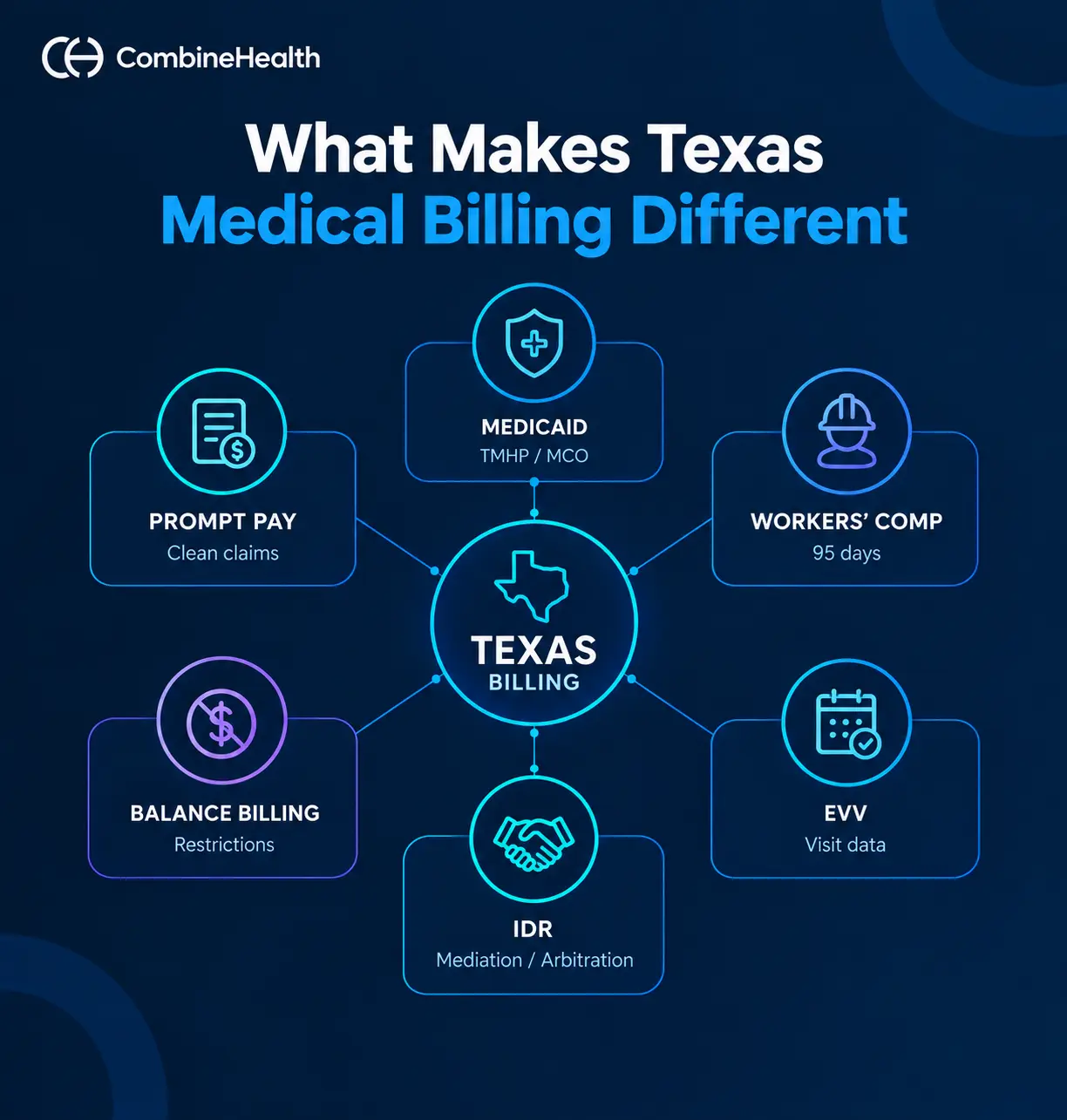
• Texas medical billing differs from a generic national workflow because of nine distinct state-specific requirements, spanning Medicaid routing, prompt-pay rules, workers' compensation deadlines, balance-billing restrictions, and dispute resolution processes that a single uniform workflow will eventually miss.
• Texas Medicaid billing depends on whether a claim routes through TMHP fee-for-service or a managed-care organization, with submission routes, authorization requirements, and appeal processes varying by program and by geographic service area.
• Texas prompt-pay rules require a claim to qualify as clean before payment deadlines and remedies apply, making complete submission, documented receipt dates, and tracking of underpayments and late payments a distinct billing capability rather than a byproduct of good coding.
• Most Texas workers' compensation medical bills must be filed within 95 days of the date of service, subject to limited exceptions, requiring a distinct workflow for deadlines, electronic billing, fee guidelines, and preauthorization disputes.
• Texas balance-billing and surprise-billing disputes split into mediation and arbitration depending on the case, so a billing vendor needs to identify plan jurisdiction and route each dispute through the correct process rather than billing the patient by default.
A claim can be medically necessary, fully documented, and still get denied in Texas. The reason is rarely the care itself. More often, the claim was routed through the wrong Medicaid pathway, filed after the 95-day workers' compensation deadline, or submitted without meeting the clean-claim standard that Texas prompt-pay protections require. Most national billing companies apply a single workflow across every state they serve, and Texas providers absorb the cost of that generalization through avoidable denials.
This distinction determines whether a healthcare claim clears on first submission or requires months of appeal work. This guide examines what Texas billing genuinely demands, then evaluates the ten companies Texas healthcare providers most frequently consider in 2026.
On this page
- 1. CombineHealth
- Standout capabilities of CombineHealth
- Key Features
- 2. MedCare MSO
- 3. Plutus Health
- 4. AMS Solutions
- 5. PUREDI
- 6. Transcure
- 7. Right Medical Billing
- 8. Storm Medical Billing
- 9. athenahealth
- 10. R1 RCM
- What Makes Texas Medical Billing Different
- How to Evaluate a Texas Medical Billing Company
- See How CombineHealth Handles Your Texas Payer Mix
- Frequently Asked Questions
1. CombineHealth
CombineHealth is an AI-powered revenue cycle platform for practices, physician groups, hospitals, health systems, FQHCs, and MSOs. It runs the full billing lifecycle in one workflow, from eligibility and coding through claim validation, denial management, payer follow-up, and appeals, so teams don't need a separate tool for each stage.
Its edge in Texas is configurability. Instead of applying one national rule set to every claim, CombineHealth builds payer- and organization-specific rules into the workflow. That matters in a state with TMHP versus Medicaid managed-care routing, service-area-specific plan rules, a 95-day workers' compensation filing deadline, clean-claim documentation requirements for prompt-pay remedies, and separate mediation and arbitration paths for payment disputes.
Standout capabilities of CombineHealth
- Payer-aware coding and billing: Reads the full encounter and applies standard guidelines alongside payer, site, and organization rules, including TMHP routing, MCO requirements, and payer-specific modifier and documentation rules.
- Learning from Texas claim outcomes: Denials, reimbursements, and underpayments feed back into payer intelligence, so recurring patterns shape future claims. Texas MCOs and commercial payers each set their own requirements, and those shift by service area and plan.
- Front-end denial prevention: Verifies coverage status, network and referral requirements, and patient responsibility before the visit. Each Texas payer type (TMHP fee-for-service, managed Medicaid, commercial, workers' comp) has its own verification and authorization rules.
- Texas-specific claim and dispute handling: Validation, follow-up, and appeals workflows account for the 95-day workers' comp deadline, clean-claim standards, and the mediation/arbitration split.
- End-to-end automation: Automates up to 85% of routine billing work with coding accuracy above 97%.
- Audit-ready decisions: Every decision links its evidence, billing rationale, and payer-specific justification to the source documentation, so teams can defend it in an audit or appeal.
Key Features
- Eligibility and benefits verification
- Pre-bill claim validation against payer-specific and Texas program rules
- Autonomous medical coding across the complete encounter
- Clinical documentation integrity (CDI) review
- Denial management and automated appeals
- A/R and payer follow-up
- Payer-specific billing intelligence
- Explainable coding and claim decisions with full audit trails
Best For: Texas physician practices, specialty groups, hospitals, health systems, FQHCs, rural providers, and MSOs seeking to automate the revenue cycle end to end rather than outsource individual billing functions.
2. MedCare MSO
MedCare MSO provides outsourced billing services to practices across multiple specialties, with additional support for credentialing and prior authorization. The model places a dedicated human team behind claim submission and follow-up rather than an automation platform, which suits practices that prefer to delegate billing entirely rather than manage supporting technology in-house.
Key Features:
- Multispecialty billing support
- Credentialing assistance
- Prior authorization handling
- Dedicated account management for outsourced clients
Best For: Small and mid-sized practices that prefer billing managed externally and do not require coding automation or a full revenue cycle technology stack.
3. Plutus Health
Plutus Health serves larger healthcare organizations, combining coding and pre-bill auditing with billing, denial, and accounts receivable management. The company pairs automation with dedicated staff oversight, providing more operational depth than a billing-only vendor. Organizations evaluating Plutus Health should confirm how automated processes and human review are divided across the coding and denial workflow.
Key Features:
- Pre-bill coding audits
- Automation-supported billing
- Denial and AR management
- A scalable delivery model built for higher claim volume
Best For: Larger practices and health systems that require coding oversight and denial support at scale.
4. AMS Solutions
AMS Solutions maintains an established presence in Texas, focusing on practice-level billing, credentialing, and accounts receivable support. Its regional history provides familiarity with the Texas market, though providers should confirm how the company keeps its workflows current as Texas Medicaid guidance and payer requirements evolve.
Key Features:
- Texas-based billing operations
- Credentialing support
- AR management
- A practice-oriented service model
Best For: Practices seeking a vendor with direct Texas operating history and a regional, relationship-driven service model.
5. PUREDI
PUREDI centers its offering on technology-assisted claim management, including analytics, reporting, and claim-edit rules designed to identify problems before submission. The company occupies a position between a fully manual billing service and a complete revenue cycle automation platform, providing practices with greater visibility into claim performance without extending into eligibility, coding, or appeals.
Key Features:
- Claim-edit automation
- Performance analytics and reporting
- Denial-prevention rules applied before submission
Best For: Practices seeking stronger claim-level visibility and prevention tools without adopting a full revenue cycle platform.
6. Transcure
Transcure combines AI-assisted billing with full-service revenue cycle management and workflow automation. Its model blends automated processing with staff-delivered work, so providers should confirm precisely where the technology's role ends and human review begins for their specific specialty and claim types.
Key Features:
- AI-assisted claim preparation
- Full-service RCM support
- Workflow automation integrated with existing systems
Best For: Practices comfortable with a blended delivery model that combines automated tools with a staffed billing team.
7. Right Medical Billing
Right Medical Billing serves independent practices seeking a smaller, more direct vendor relationship, supported by coding and accounts receivable services. Its Texas presence reinforces that model, though its specialty coverage warrants close review, since deeper specialty experience typically correlates with more accurate coding.
Key Features:
- Personalized account service
- Medical coding support
- AR follow-up
- A Texas-based service team
Best For: Independent practices that prioritize a direct relationship with their billing vendor over a large, standardized service model.
8. Storm Medical Billing
Storm Medical Billing specializes in behavioral health, serving solo practitioners and group practices with billing built specifically for therapy and behavioral health claims. This focus provides deeper expertise in a specialty widely regarded as difficult to bill correctly, though it also means the company is not suited to multispecialty organizations.
Key Features:
- Behavioral health and therapy-specific billing
- Credentialing support
- Claims expertise tailored to solo and group behavioral health practices
Best For: Solo and group behavioral health practices seeking a specialist rather than a generalist billing vendor.
9. athenahealth
athenahealth pairs an integrated EHR with billing services, built primarily for the ambulatory market. Its claims network and reporting capabilities provide practices with strong visibility, though the billing functionality is tied to adoption of the broader athenahealth platform, a larger commitment than a standalone billing service requires.
Key Features:
- An integrated EHR and billing platform
- A large claims clearinghouse network
- Built-in reporting tools
Best For: Ambulatory practices willing to operate their EHR and billing within a single integrated system.
10. R1 RCM
R1 RCM delivers enterprise-scale, end-to-end revenue cycle management for health systems undergoing significant operational transformation. The scale of its service is designed for hospital systems managing complexity across multiple facilities and service lines, rather than for independent practices or smaller specialty groups that require a lighter, more configurable solution.
Key Features:
- End-to-end enterprise RCM
- Large-scale operational support
- Transformation-focused engagement models
Best For: Large health systems, not independent practices or small specialty groups.
What Makes Texas Medical Billing Different
Texas billing requirements are shaped by the state's Medicaid structure, prompt-pay statutes, workers' compensation deadlines, and balance-billing rules. A provider working with the wrong vendor discovers these gaps only after a denial or a missed deadline.
This precision has little to do with where a billing company is headquartered. A vendor based outside Texas can serve Texas providers effectively, and a Texas-based company can still misroute claims if its workflows were never built to account for plan-level detail.
The table below maps each Texas-specific issue to the medical billing capability required to handle it correctly.
How to Evaluate a Texas Medical Billing Company
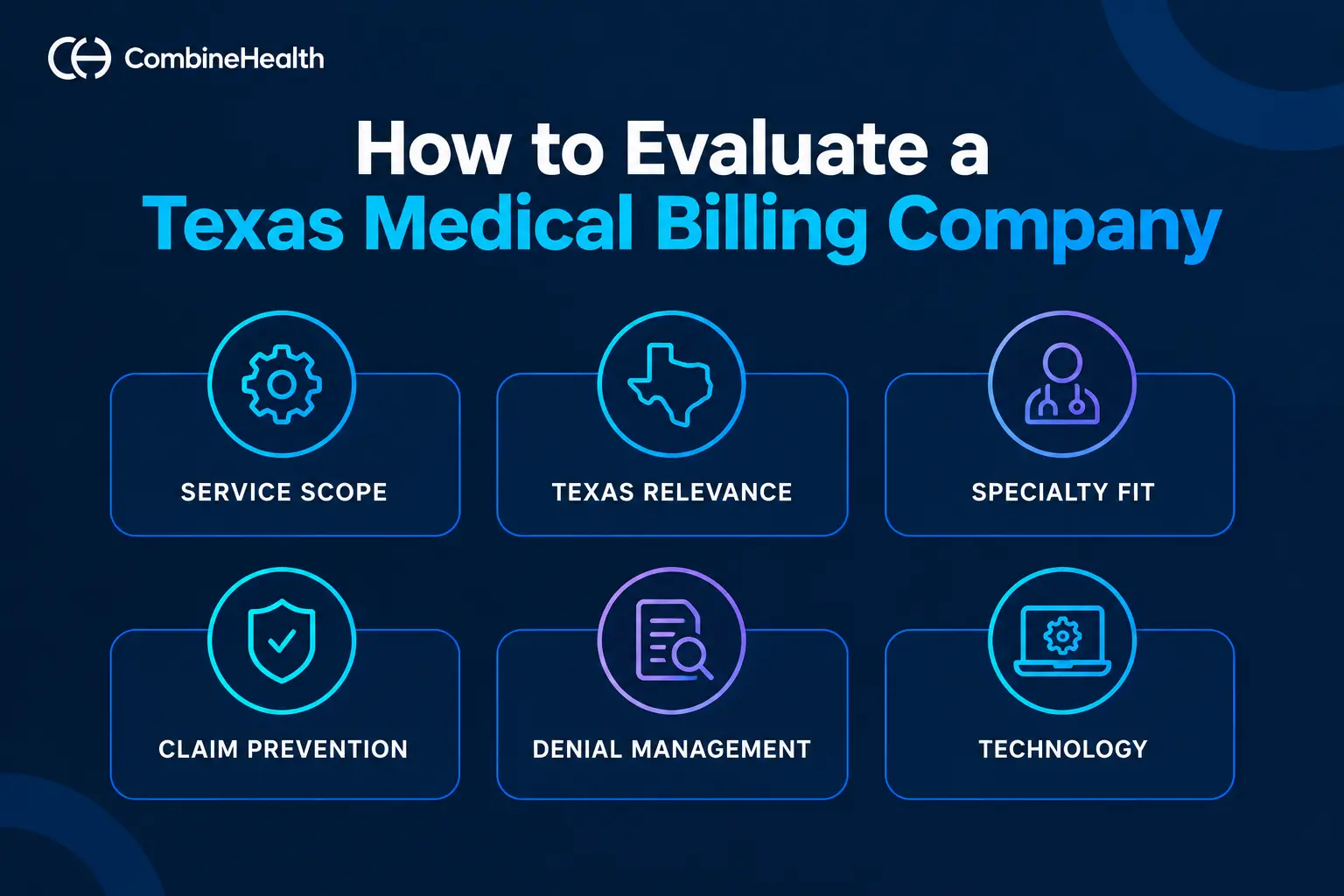
Apply the following criteria consistently across every vendor under consideration.
- Service scope: Whether the company provides billing alone or supports the broader revenue cycle.
- Texas relevance: Evidence of Texas operations, customers, payer expertise, or workflows configured for state-specific requirements.
- Specialty coverage: Whether the company demonstrates direct experience with the organization's relevant medical specialties.
- Claim prevention: Eligibility verification, authorization, coding, documentation, and pre-bill validation built into the workflow.
- Denial management: Denial categorization, correction, appeals, and root-cause prevention.
- Technology: The depth of automation, EHR integration, reporting, and workflow visibility provided.
- Scalability: Suitability for the organization's current size, with the capacity to support growth in volume or service lines.
- Transparency: Clarity regarding service structure, pricing, integration requirements, and customer outcomes.
- Evidence: Published case studies, verified customer outcomes, and results that hold up independent of the vendor's own marketing.
See How CombineHealth Handles Your Texas Payer Mix
From TMHP routing to workers' comp deadlines to surprise-billing disputes, CombineHealth configures coding, claim validation, and denial follow-up around Texas-specific rules instead of one generic workflow.
Book a demo to see it against your own Texas claims.
Frequently Asked Questions
Does a medical billing company need to be based in Texas?
No. What matters is demonstrated experience with the organization's Texas payer mix, Medicaid plans, workers' compensation claims, and applicable state requirements, regardless of where the company is headquartered.
What is the filing deadline for Texas workers' compensation medical bills?
Most Texas workers' compensation medical bills must be filed within 95 days of the date of service, subject to limited exceptions.
What is the difference between Texas Medicaid fee-for-service and managed care?
Fee-for-service claims route through TMHP, while managed-care claims route through the applicable Medicaid managed-care organization. The correct submission route, authorization requirements, and appeal process depend on which program applies to the claim.
Does CombineHealth replace an internal billing team, or work alongside one?
CombineHealth integrates with existing EHR, PMS, and RCM workflows, automating coding, claim validation, and payer follow-up, while claims the platform cannot resolve with confidence are routed for review within the existing operational structure.
Recommended Reads







Explore Our
AI Workforce






Subscribe to newsletter - The RCM Pulse
Trusted by 200+ experts. Subscribe for curated AI and RCM insights delivered to your inbox

Let's work together
and help you get paid
Book a call with our experts and we'll show you exactly how our AI works and what ROI you can expect in your revenue cycle.