How Does an AI Audit Trail Work for Medical Coding?
Learn what a defensible AI audit trail for medical coding must include, how it works, and what to ask vendors before you trust the codes it generates.
Published on:
August 27, 2026


Key Takeaways
• An AI audit trail is the record of how a code was created, the documentation, rule, and final code, while a medical coding audit is the separate activity of reviewing that record to check whether the coding was correct.
• A complete AI audit trail records the encounter and document identifiers, the documentation reviewed, the assigned codes, supporting excerpts, guideline or payer-policy citations, flagged documentation gaps, timestamps, and rule versions instead of a transcript of the AI model's internal reasoning.
• AI audit trails support pre-bill validation, internal coding audits, payer appeals, compliance investigations, coder and provider quality reviews, and pattern-level analysis of recurring documentation gaps across many encounters at once.
• When an audit surfaces a denial or underpayment, that outcome should refine the coding platform's payer-specific rules and, where a documentation gap is the cause, generate targeted feedback for providers.
• Before selecting an AI medical coding vendor, healthcare organizations should confirm the platform can produce source evidence, guideline citations, version history, and export-ready audit records for one real denial, start to finish.
• CombineHealth's AI medical coding platform generates billing-ready ICD-10-CM, CPT, HCPCS Level II, E/M, and modifier codes with a traceable audit trail on every decision, and uses claim outcomes to continuously refine its payer-specific coding strategy.
Eight months after a claim was paid, a payer selects it for post-payment review and asks for documentation supporting the codes billed. The clinical note is still there. The claim is still there. But can your team reconstruct exactly why each code, modifier, and E/M level was selected?
That's where an AI audit trail matters. Post-payment reviews are climbing, several states are moving toward requiring disclosure of AI use in healthcare decisions, and more organizations are running autonomous coding faster than their compliance and audit processes are ready for.
This guide explains what a real AI coding audit trail contains, how it holds up when a payer or auditor comes asking, and which questions separate platforms that can prove their coding logic from ones that just say they can.
On this page
- Audit Trail vs. Medical Coding Audit
- What Does a Real Medical Coding Audit Trail Record?
- How Does an AI Audit Trail Work in Practice?
- What Makes an Audit Trail Defensible?
- How Do Audit Trails Actually Get Used?
- How Does Feedback From an Audit Change Future Medical Coding?
- What Should Healthcare Organizations Ask Vendors?
- Where Does CombineHealth Fit in AI Audit Trail Workflows?
- Frequently Asked Questions
Audit Trail vs. Medical Coding Audit
An AI audit trail automatically records how each medical coding decision was made—including the documentation reviewed, codes assigned, rules applied, and final codes sent to billing—while a medical coding audit reviews that record or the underlying chart to determine whether the coding was accurate, complete, compliant, and supported by clinical documentation.
The distinction becomes important during a payer review. The audit trail lets the coding team retrieve the documentation, rules, and rationale behind a claim submitted months earlier. The medical coding audit then uses that evidence to determine whether the assigned codes were defensible or whether corrective action is needed.
Recommended Reading: Explainable AI in medical coding
What Does a Real Medical Coding Audit Trail Record?
A real medical coding audit trail records the encounter and document identifiers, the clinical documentation reviewed, the codes assigned, the note excerpts that support each code, the guideline or payer policy applied, any documentation gaps flagged along the way, timestamps and version data, and the final code submitted to billing. Together, these elements answer five questions for every coding decision: who, what, when, where, and why.
Most medical coding vendors will tell you their platform "includes an audit trail." Few will tell you what's actually in it, and that gap is exactly where weak implementations hide, usually until someone in compliance or HIM goes looking for something specific and can't find it.
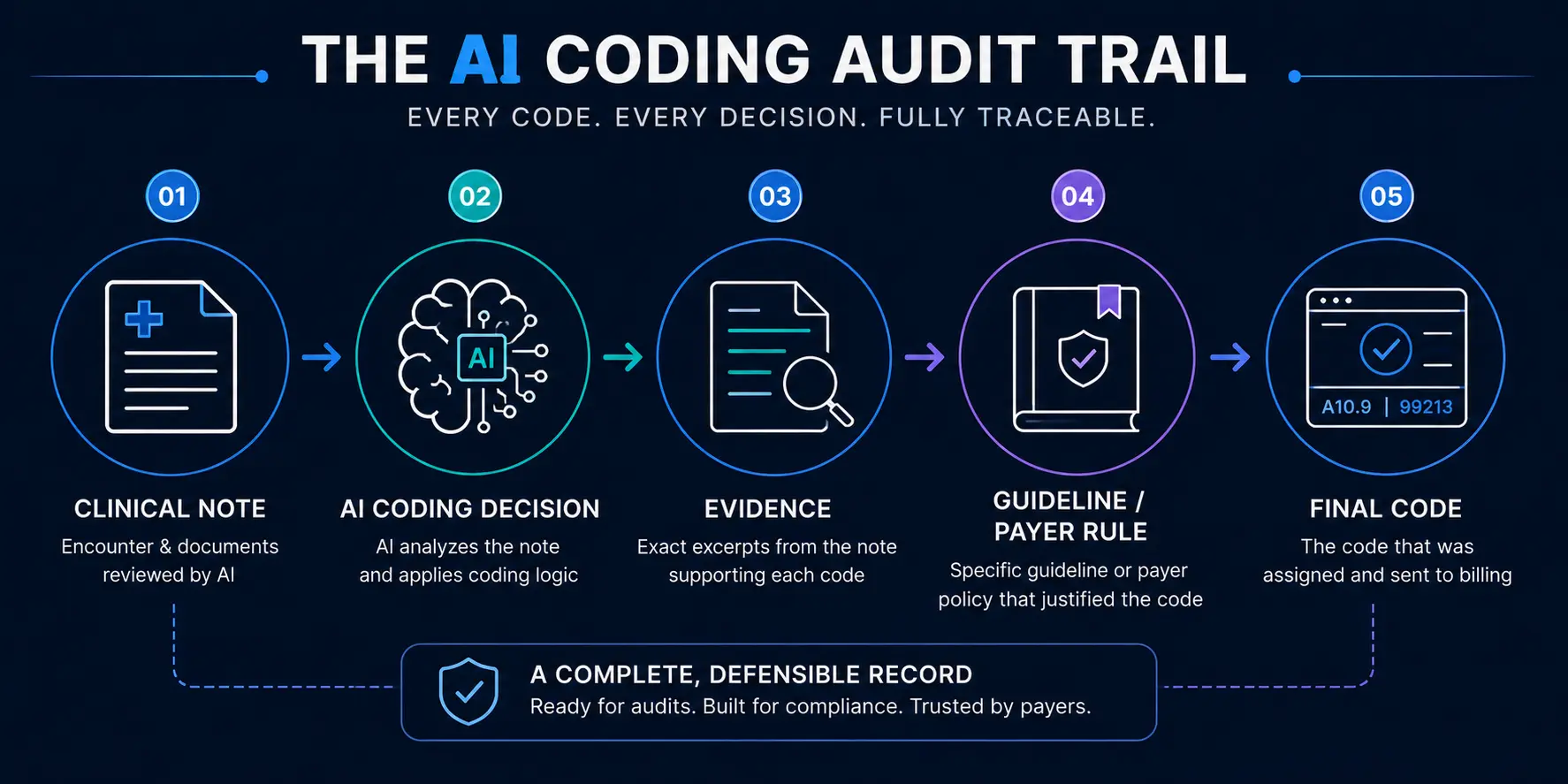
A complete medical coding audit trial record needs these evidences to support a coding decision:
- The encounter and document identifiers tied to the chart
- The clinical documentation the platform actually reviewed
- The ICD-10-CM, CPT, HCPCS, E/M, and modifier codes it assigned
- The specific excerpt from the note that supports each code
- The coding guideline or payer policy behind the decision
- Any documentation gap the platform flagged along the way
- Timestamps, plus the code-set and rule version active at that moment
- The final code that actually reached the EHR or practice-management system
This is the checklist CombineHealth was built to satisfy. For every code it assigns, the platform stores the encounter and document identifiers, the exact note excerpt supporting the code, the specific coding guideline or payer policy applied, any documentation gap it flagged, and the code-set and rule version active at that moment—captured automatically as the code is generated. Because every decision is traceable to the source documentation, there is nothing to reconstruct when compliance or HIM goes looking.
Does an Audit Trail Need to Show the AI's Internal Reasoning?
No, a real audit trail doesn't need a transcript of the AI model's internal reasoning.
Compliance and audit teams don't need to see how an AI system "thinks"; they need evidence they can independently check against the note and the guideline. A citation beats a chain of thought every time it's tested in an actual appeal.
Recommended Reading: How AI coding audit helps uncover undercoding
How Does an AI Audit Trail Work in Practice?
In practice, a medical coding audit trail links every assigned code to the exact evidence behind it, the specific sentences in the clinical note that support the code, and the guideline that governed the decision. All these are captured automatically the moment the code is generated instead of being reconstructed later from memory.
Take a routine office visit. The platform reads the documented history, exam, and medical decision-making, then assigns a CPT code for the level of service. A weak system stops there: code in, code out, no receipt. A real audit trail stores something more useful: the exact sentences in the note that justified that E/M level, and the specific guideline that governed the call.
Six months later, if a payer questions the code, that link is the difference between a five-minute lookup and a scramble through the original chart. Nobody has to remember the encounter or reconstruct intent from memory. The evidence was captured the moment the code was created, rather than assembled after the fact under deadline pressure.
CombineHealth is the "real audit trail" version of this. When it codes that office visit, it links the E/M level to the exact sentences in the history, exam, and medical decision-making that justified it, alongside the guideline that governed the call—stored the moment the code is created, not reassembled later. Six months on, a payer question becomes a lookup instead of a chart-diving exercise, and the answer is the same one the platform recorded at the time.
What Makes an Audit Trail Defensible?
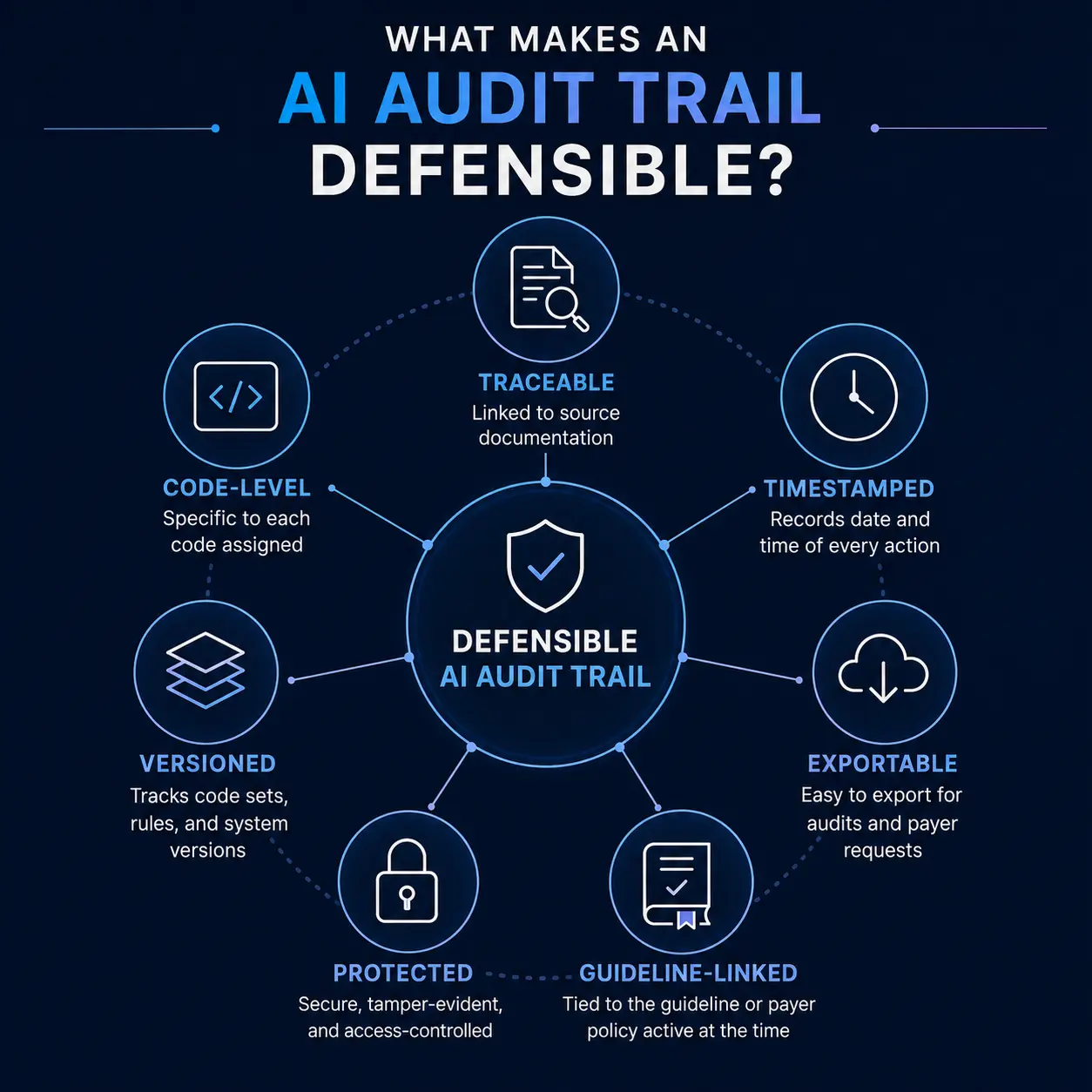
A defensible audit trail is traceable to the original clinical documentation, specific at the individual code level, timestamped, versioned rather than overwritten, and exportable for external review.
A full list of what to check for:
- Traceable to the original documentation rather than being a paraphrase of it
- Specific at the individual code or claim-line level
- Timestamped and attributable to the system that generated it
- Versioned, so earlier states are preserved rather than overwritten
- Searchable and exportable for appeals, audits, and record requests
- Protected from unauthorized edits after the fact
- Tied to the exact guideline or payer rule that was active at the time
CombineHealth's audit trail is built to be defensible from the start: each code links to the original documentation rather than a paraphrase, is specific to the individual claim line, and is versioned so earlier states are preserved rather than overwritten, then exports cleanly for an appeal or record request. And because the platform runs on HIPAA-compliant, SOC 2 Type II infrastructure, the record is protected from unauthorized edits after the fact—not just complete, but trustworthy under review.
How Do Audit Trails Actually Get Used?
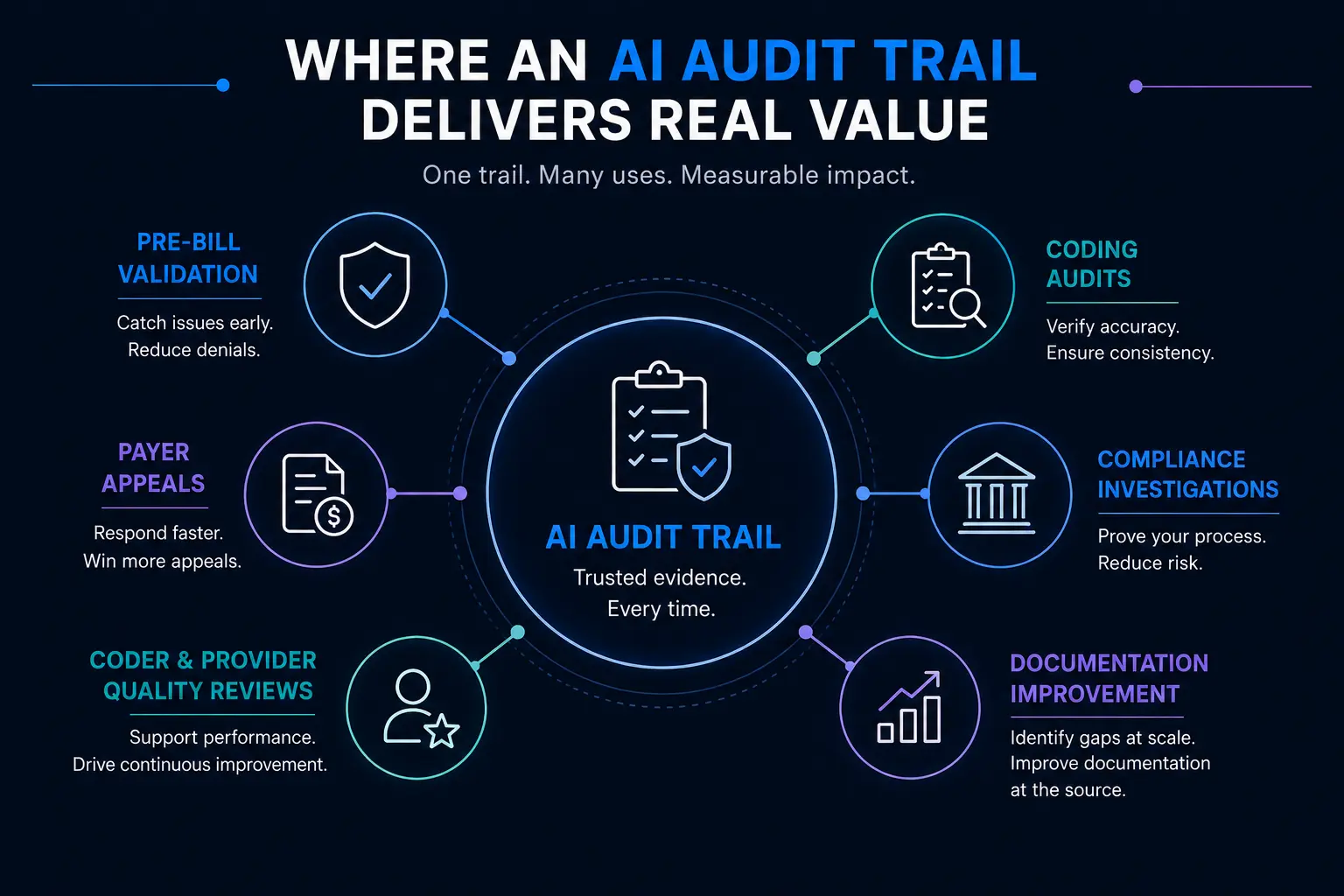
Audit trails get used for pre-bill validation, internal coding audits, payer appeals, compliance investigations, quality reviews, and documentation-gap analysis.
Coding, HIM, compliance, audit, and CDI teams pull from the same underlying record for very different reasons. In practice, that includes:
- Pre-bill validation, catching issues before a claim goes out the door
- Internal coding audits across a sample of encounters
- Payer appeals and record requests after a denial
- Compliance investigations, including OIG or RAC reviews
- Coder and provider quality reviews
- Documentation improvement, based on gaps that keep recurring
That last one is where most organizations leave value on the table. When the same denial reason appears across multiple providers, the audit trail can reveal the recurring documentation or coding gap behind it, making provider education more targeted.
The same applies to internal quality reviews. Instead of auditing a small sample of charts, teams can query the audit trail across encounters by rule, payer, or code set. This makes it possible to identify systemic issues proactively rather than waiting for them to surface through denials or external audits.
In a high-volume emergency department, CombineHealth surfaced five times more documentation gaps than the prior manual workflow—precisely because it can query a complete, structured audit trail across every encounter by rule, payer, or code set instead of sampling a handful of charts. Recurring gaps become targeted provider education before they turn into denials.
How Does Feedback From an Audit Change Future Medical Coding?
Feedback from an audit changes future medical coding by feeding identified errors and claim outcomes back into the rules used for subsequent encounters. A denial, underpayment, or payer rejection becomes a signal the platform can use to adjust how it handles similar claims going forward.
At the payer level, these outcomes help refine how coding rules are applied for individual payers. If a particular coding decision repeatedly produces the same outcome with one payer, that pattern can inform future coding strategy for that payer rather than applying the same logic across every claim.
At the documentation level, audit findings can expose recurring gaps in clinical notes. If a denial is traced to a missing clinical detail, that finding can become targeted provider education to prevent the same gap from recurring.
This feedback loop is the core of how CombineHealth works. It evaluates each coding decision against real downstream outcomes, denials, reimbursements, and underpayments, and turns that signal into payer-specific intelligence, so coding strategy adapts per payer rather than applying one rule set to every claim. It's the difference between accurate codes and a measurably lower denial rate: CombineHealth is proven to drive up to a 75% reduction in coding-related denials.
What Should Healthcare Organizations Ask Vendors?
A few pointed question checklist will tell you more than any demo:
- Can your team see the source documentation behind every code?
- Does the platform name the specific guideline or payer policy behind each decision?
- Are model, code-set, and rule versions retained alongside every coded decision?
- Can audit records export cleanly for an external audit or appeal?
- How long is audit data retained, and does it cover payer audit windows, including Medicare's multi-year lookback?
- Who can view, edit, or delete audit records, and what stops unauthorized changes?
- When medical coding guidelines or payer policy update, does that change show up in the audit trail?
- If a claim denial gets appealed successfully, does that outcome actually change future coding, and can the vendor show you how?
Ask a vendor to walk through one real denial, start to finish: the original code, the evidence behind it, the payer's stated reason, and what changed afterward. If they can't produce that trail live, in the demo, the audit trail they're selling probably isn't as complete as the deck makes it look.
Where Does CombineHealth Fit in AI Audit Trail Workflows?
CombineHealth builds the audit trail directly into autonomous coding, so every coding decision can be traced, reviewed, and used to improve future decisions.
As a self-learning autonomous medical coding platform, CombineHealth reads the complete clinical encounter, applies coding guidelines and payer-specific requirements, and generates billing-ready ICD-10-CM, CPT, HCPCS Level II, E/M, and modifier decisions.
Each decision is linked to the supporting clinical documentation, coding logic, and applicable payer requirements. This gives coding, compliance, and audit teams the evidence needed to review decisions during internal audits, pre-bill checks, or payer disputes without reconstructing how a code was assigned.
The audit trail also feeds a broader learning loop. CombineHealth evaluates downstream outcomes such as denials, reimbursements, and underpayments to build payer intelligence and refine future coding strategy for each payer.
Book a demo with CombineHealth now.
Frequently Asked Questions
Is an AI audit trail the same as a coding audit?
No, the trail is the record, documentation, rule, and code captured at the moment of the decision. The audit is the activity of reviewing that record to check whether the coding held up. A strong trail makes audits faster; it isn't a substitute for one.
How long should audit data be retained?
Long enough to cover the audit windows of every payer involved, including Medicare's multi-year lookback, and confirm the vendor's retention period is configurable to your requirements.
Can an audit trail explain why a payer denied a claim?
It shows what was submitted, what evidence supported it, and what rule applied. Pairing that with the payer's stated denial reason is what enables real root-cause analysis: miscoding, insufficient documentation, or a payer misapplying its own rule.
Does the audit trail need to expose the AI model's internal reasoning?
No, there has to be a reviewable rationale grounded in documentation and guidelines instead of a transcript of internal computation. If a vendor's answer to "why did it pick this code?" is "the model decided," that's not an audit trail.
Is an AI audit trail different from a general EHR access log?
Yes, an EHR access log tracks who opened or edited a record and when. A coding audit trail goes further, capturing the clinical evidence and guideline behind a specific code, not just that someone touched the file.
Who typically reviews an AI coding audit trail?
Coding managers, compliance and audit teams, and CDI staff are the most frequent users, followed by RCM leadership pulling aggregate patterns rather than single charts. External reviewers, payers, RAC auditors, or outside compliance firms access it only when a specific claim or investigation calls for it.
Recommended Reads







Explore Our
AI Workforce







Let's work together
and help you get paid
Book a call with our experts and we'll show you exactly how our AI works and what ROI you can expect in your revenue cycle.