Radiology CPT Codes: The Complete Guide
Quick-reference guide to radiology CPT codes for CT, MRI, X-ray, ultrasound, and interventional radiology. Includes billing tips, modifiers, and ICD-10 pairings.
Published on:
April 10, 2026


Key Takeaways:
• Radiology CPT codes classify every diagnostic and interventional imaging procedure—accuracy directly affects reimbursement.
• Key code categories include CT, MRI, X-ray, ultrasound, mammography, nuclear medicine, and interventional radiology.
• Common pain points in radiology billing: contrast misclassification, component billing errors (TC vs. 26), bundling violations, and incomplete documentation.
• ICD-10 codes must align with imaging CPT codes to justify medical necessity and avoid denials.
• AI-driven RCM tools help radiology billing teams reduce errors, predict denials, and stay compliant with payer rules.
Radiology billing and coding demands precision across dozens of modalities, hundreds of CPT codes, and payers that update rules every quarter.
One wrong contrast designation or a missed component modifier can flip a clean claim into a denial, costing your team hours of rework and delaying reimbursement.
This guide organizes the most commonly used radiology CPT codes by modality, with the key modifiers, ICD-10 pairing, and billing pitfalls you need at your fingertips.
On this page
What are Radiology CPT Codes?
Radiology CPT codes are standardized five-digit procedure codes maintained by the American Medical Association (AMA) to describe diagnostic imaging, interventional radiology, and image-guided therapeutic services.
The radiology section spans CPT codes 70010-79999, covering everything from a routine chest X-ray to complex interventional oncology procedures.
Each code carries specific documentation requirements around contrast usage, body region, laterality, and whether the service is billed globally, for the technical component (TC), or for the professional component (modifier 26).
Types of Radiology CPT Codes
Coders in practice work by modality, and each modality has its own rules.
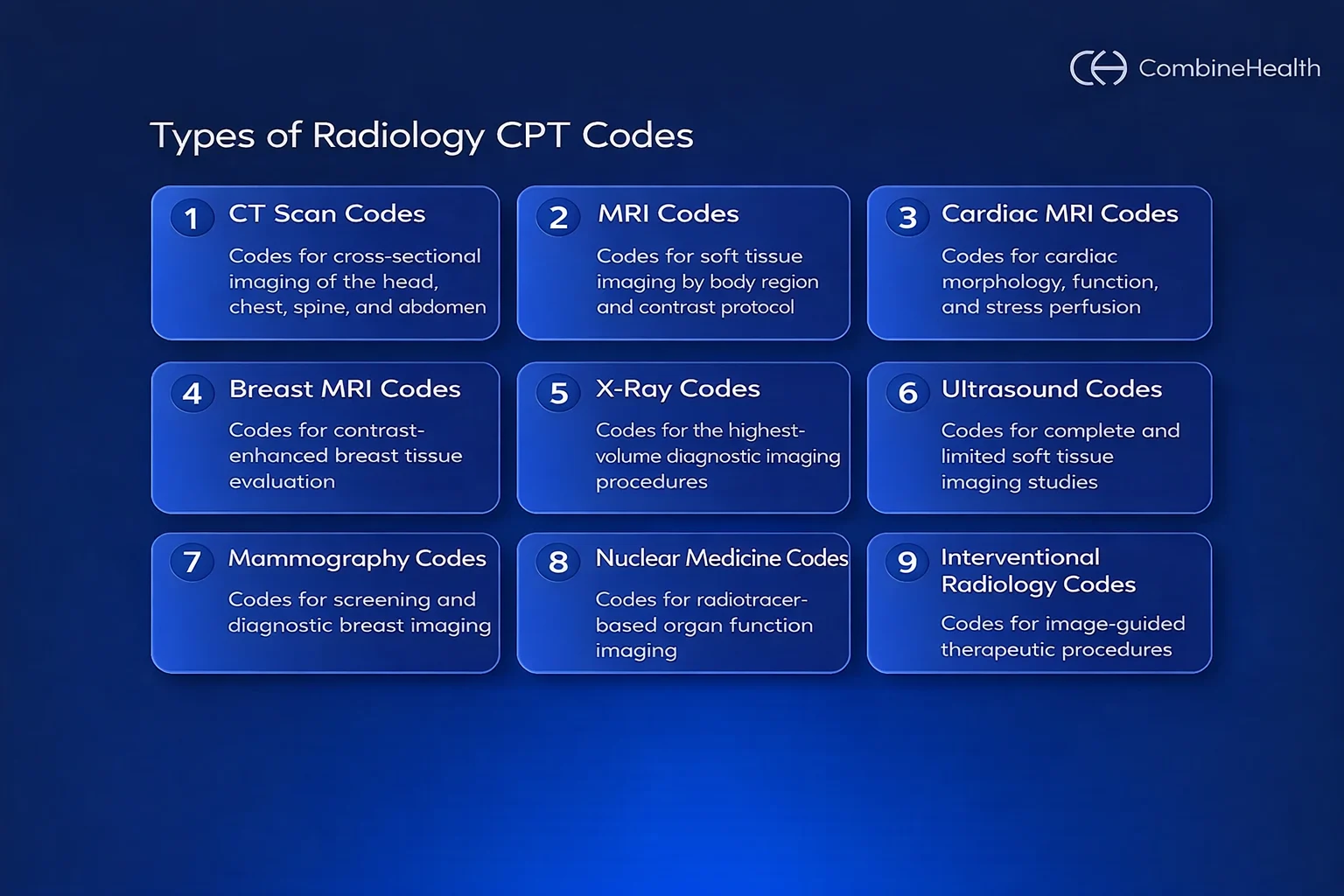
Below are the most commonly used radiology CPT codes classified by modality, with 2026 updates:
1) CT Scan CPT Codes
CT uses X-rays to produce cross-sectional images, with codes organized by body region and contrast protocol—whether IV contrast was given, not given, or given in both phases. The table below maps the most common body regions to their CPT codes across all three protocols:
Note: “Contrast” means IV contrast only—oral or eectal contrast doesn’t qualify. Soft tissue neck CT (70490-70492) evaluates neck anatomy; CT Angiography (CTA) of the Head & Neck (70471) images blood vessels for stroke or vascular workup. These are distinct procedures. When both are performed together, bill 70471 as one study and not separately, per the 2026 CPT update.
2. MRI CPT Codes
MRI codes follow the same three-tier contrast structure as CT, organized by body region and joint vs. non-joint anatomy.
3. Cardiac MRI CPT Codes
Cardiac MRI codes are separate from standard body MRI and evaluate cardiac morphology, function, and stress perfusion. Payers frequently require a prior echocardiogram or nuclear stress test before approving a cardiac MRI.
4. Breast MRI CPT Codes
Breast MRI uses contrast-enhanced imaging to evaluate breast tissue with greater sensitivity than mammography alone. Computer-Aided Detection (CAD) is bundled into codes 77048 and 77049 and must not be billed separately, per CMS billing guidelines.
5. X-Ray (Radiography) CPT Codes
X-ray codes are the highest-volume imaging codes in most practices. Documentation must specify the number of views taken.
Note: Post-procedure chest X-rays performed to confirm catheter or tube placement (e.g., after central line insertion or intubation) are integral to the primary procedure and are not separately billable, per CMS NCCI guidelines.
6. Ultrasound CPT Codes
Ultrasound codes distinguish between complete and limited exams. Billing a complete code for a limited study is a common upcoding error that triggers audits for these claims.
Note: For 76700, documentation must confirm imaging of the aorta, liver, gallbladder, pancreas, spleen, kidneys, and IVC. Missing any element downgrades the study to 76775.
7. Mammography CPT Codes
Mammography uses low-dose X-rays to screen for and diagnose breast cancer. CPT Code selection depends on clinical intent (screening vs. diagnostic), not the technology used. Getting this distinction wrong is one of the most common denial triggers in breast imaging.
Note: Screening mammography (77067) converts to diagnostic (77065/77066) when additional views are taken in the same session. Billing 77067 for a converted diagnostic can trigger denial.
8. Nuclear Medicine CPT Codes
Nuclear medicine uses radioactive tracers to image organ function rather than anatomy, making it uniquely useful for detecting cancer spread, cardiac perfusion deficits, and bone pathology. CPT codes for nuclear medicine are organized by body system, and the radiopharmaceutical tracer must always be billed separately using HCPCS A-codes alongside the procedure CPT code.
9. Interventional Radiology CPT Codes
Interventional Radiology CPT codes combine an imaging guidance code with a procedure code—both must be documented to bill separately. In 2026, the legacy lower-extremity revascularization codes (37220–37235) have been replaced by 46 new territory-based codes (37254–37299).
Radiology ICD-10 Codes and Billing Modifiers
CPT codes describe what was done, while ICD-10 codes explain why. Accurate pairing is essential for establishing medical necessity and passing payer edits.
Here are some common radiology ICD-10 pairings:
Key Radiology Billing Modifiers
Common Challenges in Radiology Billing and Coding
With dozens of imaging technologies, contrast variables, and annual code changes, billing errors in radiology happen because of the sheer complexity of keeping every rule straight across every study type.
Here are some of the pitfalls that drive the most denials:
- Contrast misclassification: Billing a "with contrast" code when only oral or rectal contrast was administered. IV contrast is required to qualify for the higher-paying contrast code.
- Component billing errors: Forgetting modifier TC or 26, or billing the global code when only one component was performed—especially common in split-billing arrangements between hospital facilities and independent radiologists.
- Bundling violations: Reporting separate codes for services now bundled under the 2026 rules. Billing 3D post-processing (76376/76377) separately alongside the new bundled CTA code 70471 will trigger automatic denials—a rule explicitly confirmed in the CMS NCCI Policy Manual.
- IR territory coding errors (2026): The 46 new lower-extremity revascularization codes require territory-specific operative notes. Template notes that don't specify vascular territory will generate widespread IR claim denials.
.png)
Simplify Radiology Coding with AI
Radiology billing sits at the intersection of high volume, high complexity, and constant payer scrutiny. Managing that combination manually means errors are inevitable and each one costs time and revenue.
At CombineHealth, our AI-powered radiology medical coding and billing agent Amy supports radiology coding teams by applying precise CPT, HCPCS, and ICD-10 combinations, TC/26 splits, contrast add-on codes, and NCCI bundling rules—while flagging missing laterality, documentation gaps, and medical necessity issues before claims go out the door.
Book a demo to see how CombineHealth can support your radiology coding workflow!
FAQs
1. What are the most common radiology CPT codes?
The most frequently billed include 70450 (CT head, w/o contrast), 71046 (chest X-ray, 2 views), 74177 (CT abdomen/pelvis, w/ contrast), 70553 (MRI brain, w/o & w/ contrast), and 76700 (abdominal ultrasound, complete).
2. What is the difference between CPT codes 70450, 70460, and 70470?
All three are CT scans of the head—the difference is the contrast protocol. 70450 is without contrast, 70460 is with contrast only, and 70470 is without followed by contrast in the same session. All require IV contrast, and oral contrast does not qualify.
3. What is the difference between CPT codes C8908 and 77047?
Both describe bilateral breast MRI without contrast. 77047 is used by physician offices and freestanding imaging centers; C8908 is the HCPCS Level II code for hospital outpatient departments billing Medicare under OPPS. Wrong code for the wrong setting is a common denial.
4. What is the difference between modifier TC and modifier 26?
Modifier TC covers equipment, technologist, and facility costs. Modifier 26 covers the radiologist's interpretation and report. When a single entity—such as a freestanding imaging center that both performs and reads the study—owns both components, the base CPT code is billed without any modifier.
5. Medical Billing and CPT Codes for Radiology and Cardiology
Radiology uses CPT codes like 70000–79999 for imaging procedures, while cardiology uses 90000–99999 for heart-related services. Accurate code assignment requires understanding technical vs. professional components, modifiers, and payer-specific guidelines. Proper documentation ensures correct reimbursement and reduces claim rejections in both specialties.
6. Can you explain the billing process for CPT codes related to radiology?
The radiology billing process involves patient registration, insurance verification, procedure documentation, CPT code assignment, and claim submission. Coders select appropriate codes based on imaging type and body part. Claims are reviewed for accuracy, submitted to payers, and followed up to ensure timely reimbursement and compliance.
Recommended Reads







Explore Our
AI Workforce







Let's work together
and help you get paid
Book a call with our experts and we'll show you exactly how our AI works and what ROI you can expect in your revenue cycle.