Top 10 AI Denial Management Solutions for Reducing Healthcare Revenue Leakage in 2026
Explore our compilation of the top 10 denial management solutions for healthcare RCM teams in 2026 and understand the standout features that makes them worth your investment.
Published on:
June 17, 2026
Updated on:
October 6, 2026
.webp)

Key Takeaways:
• Denials are rising, with an 11.65% initial denial rate, hospitals are losing revenue on more than 1 in 9 claims. Manual follow-up alone can’t keep up with payer complexity and staffing shortages.
• Modern denial management platforms predict high-risk claims, auto-generate appeals, and uncover root causes to prevent repeat denials.
• The best AI denial management solutions combine prevention, automation, and analytics. End-to-end tracking, predictive scoring, and intelligent prioritization are now table stakes.
• CombineHealth is best understood as AI denial management automation for claim follow-up, appeals, and analytics. It both manages denials (claim follow-up, appeals automation, and analytics) and prevents them. Its self-learning autonomous medical coding platform doubles as a CDI engine that resolves documentation and coding gaps before billing and uses payer intelligence to learn from denials and adapt coding per payer.
• To measure the ROI of a denial management software, organizations should track clean-claim rate (>90%), denial rate (<5%), and overturn rate (>65%) to ensure real revenue impact.
Healthcare claim denials are no longer occasional disruptions, but a frequent occurrence.
In 2025, the average initial denial rate stands at 11.65%, meaning more than one in every nine claims is rejected on first submission.
What makes it even more challenging is that payer rules change frequently and staffing shortages limit how quickly teams can respond. Plus, manual follow-up simply doesn’t scale.
AI-powered denial management solution are helping streamline this process by automating claim follow-up, appeals and denial analysis and help hospitals get paid faster.
In this guide, we break down the Top 10 AI denial management solutions for healthcare RCM teams to protect their net revenue in 2026.
On this page
- How Does a Healthcare Denial Management Software Work?
- How Can Healthcare Denial Management Services Improve Revenue Cycle Efficiency?
- 10 Best AI Denial Management Solutions in 2026
- 1. CombineHealth: AI Denial Management Automation for Claim Follow-Up, Appeals, and Analytics
- 2. MedEvolve
- 3. Waystar’s Denial and Appeals Automation
- 4. Experian Denial Management
- 5. Kyron Medical
- 6. SPRY
- 7. Finthrive Fusion
- 8. Optum A/R Recovery and Denial Management
- 9. DataRovers: End-to- End AI-Powered Denial Management for Discovery, Prioritization, and Resolution
- 10. Datavant Denial Management
- How To Choose a Healthcare Denial Management Software
- How to Measure the Success of a Denial Management Service?
- Ready to Move From Reactive Denial Cleanup to Proactive Revenue Protection?
- FAQs
- What is Denial Management in Healthcare RCM?
- Which Companies Specialize in Healthcare Denial Management in the USA?
- What Are the Top 10 Denials in Medical Billing?
- What Are the Different Types of Claims Denial Appeals in Healthcare?
- How Can I Effectively Reduce Claim Denials in Medical Billing?
- What Features Should I Look for in Healthcare Denial Management Solutions?
- Why is CombineHealth different from other AI denial management solutions?
- How does CombineHealth help reduce denials and improve revenue capture?
- How does CombineHealth prevent denials at the source?
How Does a Healthcare Denial Management Software Work?
A healthcare denial management software operates across the full denial lifecycle, helping providers identify, resolve, and prevent denied claims through a structured workflow that includes five key stages:
1. Denial Detection and Categorization
When remittance files and payer responses are received, the platform:
- Identifies denied and underpaid claims
- Reads CARC/RARC codes and payer messages
- Normalizes denial reasons across payers
- Groups denials into actionable categories, such as eligibility, coding, authorization, and medical necessity
Accurate categorization — by CARC/RARC and denial reason — is more than a reporting step. On a self-learning platform, it is the signal that lets the system recognize each payer's behavior and adapt coding accordingly, so categorization becomes the first input to prevention rather than a retrospective tally.
2. Investigation and Follow-Up
Once a denial is categorized, the platform helps staff determine the root issue and next steps by:
- Prioritizing claims based on dollar value, filing deadlines, payer behavior, and likelihood of recovery
- Routing claims to the appropriate teams or work queues
- Surfacing relevant documentation, claim history, payer policies, and prior similar cases
- Tracking follow-up activities and payer communications
This ensures high-value denials receive timely attention and reduces manual research.
3. Appeal Drafting and Claim Correction
To accelerate resolution, denial management software supports corrective action by:
- Recommending appropriate fixes based on denial type
- Pre-populating corrected claims
- Auto-generating appeal letters and supporting documentation
- Guiding users through payer-specific appeal requirements
Many modern platforms use automation and AI to reduce administrative effort and improve appeal quality.
4. Resolution Tracking and Recovery Management
After a claim is resubmitted or appealed, the platform tracks progress through final disposition by:
- Monitoring appeal status and payer responses
- Alerting staff to approaching deadlines
- Recording recovery outcomes and reimbursement amounts
- Measuring recovery rates and turnaround times
This helps organizations maximize collections and avoid missed follow-up opportunities.
5. Root Cause Analysis and Prevention
Beyond resolving individual denials, denial management software analyzes patterns to prevent future revenue leakage by:
- Identifying recurring denial trends by payer, department, provider, or denial type
- Tracking denial rates, appeal success rates, and days-to-resolution
- Providing actionable insights to registration, coding, clinical documentation, and revenue cycle teams
- Measuring the impact of process improvements over time
Root-cause analysis is only the first half of prevention. Categorizing why a claim was denied identifies the pattern; preventing the next one means correcting it upstream — in coding and documentation — before the claim is created. The strongest platforms feed denial root causes back into medical coding and CDI, so the same error is fixed at the source instead of re-appealed. A platform that stops at reporting root causes manages denials; one that changes upstream coding prevents them.
.webp)
How Can Healthcare Denial Management Services Improve Revenue Cycle Efficiency?
Healthcare denial management services improve efficiency by reducing preventable claim denials, accelerating recovery, and turning denial data into operational improvements across the revenue cycle. Here’s what it offers:
Faster Cash Flow and Lower A/R Days
Structured denial follow-up with defined timelines, escalation rules, and consistent reporting keeps claims from aging out.
Higher Clean-Claim Rates
Tech-enabled services apply payer logic, documentation checks, and denial trend analysis before and after submission.
- Root causes are identified by payer, code, specialty, or location
- Upstream fixes reduce repeat denials and rework
- Many organizations see measurable drops in denial rates after implementing structured workflows
Lower Cost-to-Collect
Reworking a denial can cost tens of dollars per claim. Preventing and resolving them efficiently reduces administrative waste.
- Automated tracking and alerts reduce manual touchpoints
- Standardized processes eliminate duplication
- Specialized teams focus on high-impact recovery work
Improved Net Revenue
Effective hospital denial management strategies recover revenue that would otherwise be written off. AI-driven validation and predictive risk scoring improve clean-claim performance, while structured appeals increase overturn rates.
Below is a list of various RCM KPIs that a denial management software can help improve:
Common AR Denial Scenarios AI Denial Management Software Can Help Address
10 Best AI Denial Management Solutions in 2026
1. CombineHealth: AI Denial Management Automation for Claim Follow-Up, Appeals, and Analytics
CombineHealth helps hospitals and multispecialty groups both recover denied revenue and prevent denials in the first place. Its denial management platform automates the reactive work — claim follow-up, appeals, and analytics — while its self-learning autonomous medical coding platform removes the upstream causes. Most tools in this list do only the first half.
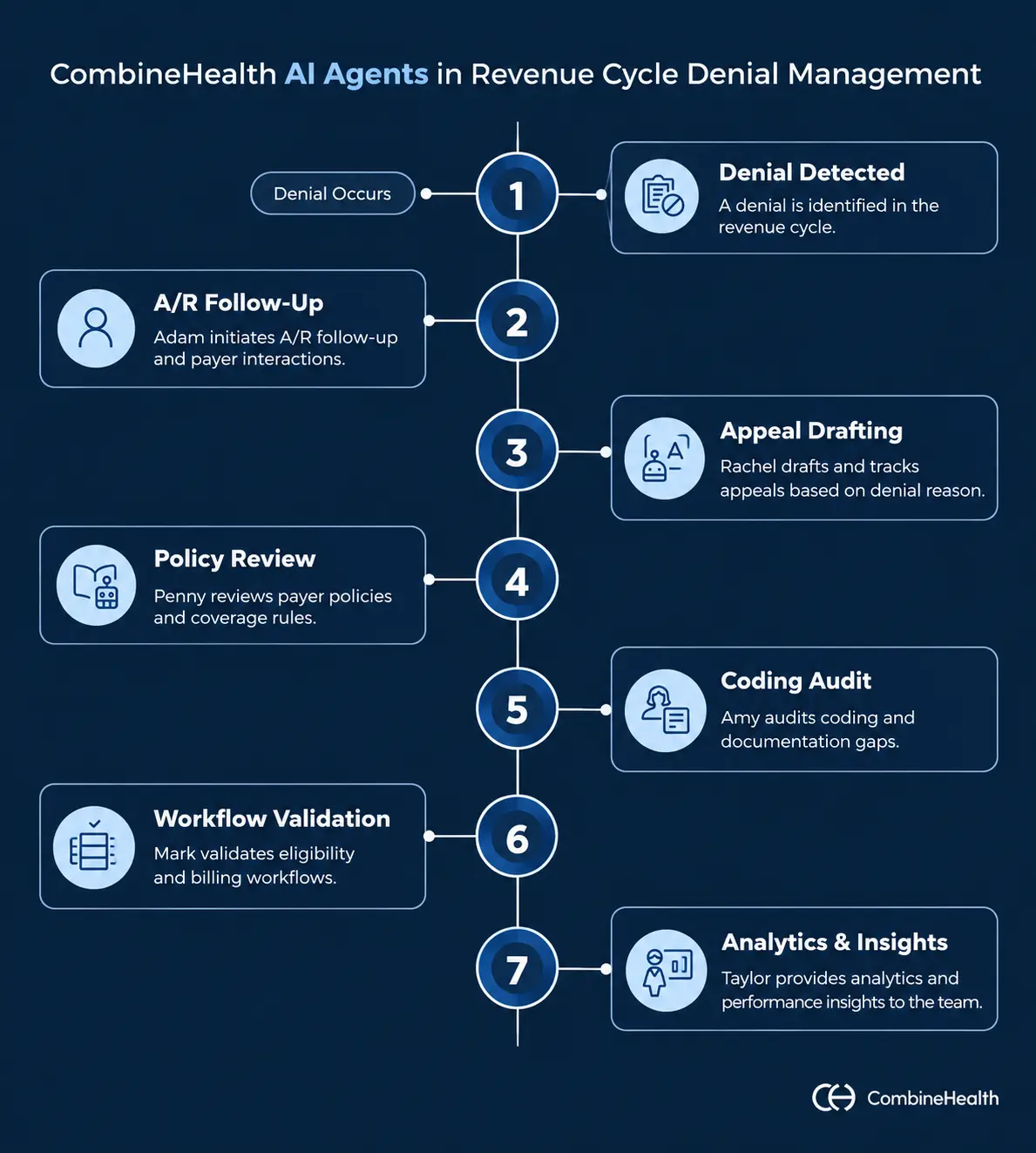
CombineHealth’s Denial Management Workflow
- Claim-follow-up automation investigates pending and denied claims through payer portals and claim-status systems, identifies missing information, escalates stalled claims, and keeps claims from aging in A/R.
- Appeals automation drafts payer-specific appeal packets, assembles supporting documentation, and tracks each appeal to resolution within payer deadlines.
- Denial analytics classifies denial patterns and surfaces root causes by payer, reason, provider, specialty, and location, and identifies recovery opportunities.
CombineHealth’s Denial Prevention Workflow
This is where CombineHealth separates from reactive denial management tools. The CombineHealth self-learning autonomous medical coding platform doubles as a CDI engine: as it codes the full encounter, it detects documentation deficiencies, coding inconsistencies, and payer-rule conflicts, and returns each gap as a physician query or provider education before the claim is submitted. Through payer intelligence, it then learns from every denial, reimbursement, and underpayment and adapts its coding strategy per payer — so the errors that caused a denial stop recurring.
97.4% Denial Mapping Accuracy
CombineHealth accurately mapped denial reasons across 10,000+ claims, helping revenue cycle teams standardize payer-specific denial codes, improve reporting consistency, and identify actionable denial trends.
Read the Case Study
Key Features
- AI-Powered Claim Follow-Up: Investigates pending and denied claims, reviews payer responses, checks claim status, and identifies next steps through payer portals and other reimbursement workflows.
- Automated Appeal Packet Drafting: Generates payer-specific appeal letters, assembles supporting documentation, and prepares appeal packets for staff review and submission.
- Denial Analytics and Root Cause Identification: Classifies denial patterns, tracks recovery performance, and identifies recurring issues by payer, denial reason, provider, specialty, or location.
- Supporting Validation and Compliance Checks: Reviews payer policies, coding accuracy, documentation completeness, eligibility status, authorizations, and billing workflows to support denial prevention and resolution.
Best for: Hospitals and multispecialty physician groups looking to automate claim follow-up, appeals, and denial analytics and prevent future denials in one platform
2. MedEvolve
MedEvolve addresses denial management through its Effective Intelligence (Ei) platform, combining real-time analytics, workforce automation, and generative AI.
Instead of focusing only on resolving denials after they occur, the denial management platform measures every human touch on a claim, identifies avoidable work, and helps organizations reduce preventable denials by optimizing workflows across the revenue cycle.
Key Features
- Effective Intelligence (Ei) analytics: Tracks zero-touch rate, denial-related touches, and staff productivity.
- Touch reduction automation: Routes staff away from low-value work and toward high-risk claims.
- Generative AI insights: Detects shifts in denial trends and explains underlying drivers.
- End-to-end visibility: Connects front-end, mid-cycle, and back-end processes to pinpoint root causes.
- Embedded RCM optimization: Integrates analytics into daily workflows to continuously reduce denials and labor dependency.
Best For: Mid- to large-size provider groups and RCM organizations aiming to reduce manual workload.
3. Waystar’s Denial and Appeals Automation
Waystar’s Denial + Appeal Management platform combines predictive analytics, generative AI, and automation to help providers overturn denials faster and prevent repeat issues.
Designed for high-volume environments, it prioritizes the most valuable denials, auto-generates payer-specific appeals, and integrates with enterprise systems to streamline resolution at scale.
Key Features
- Predictive prioritization: Scores and routes denials based on the likelihood of overturn and financial impact.
- Generative AI appeals: Drafts payer-specific letters using an extensive template library.
- Paperless workflows: Supports batch submissions, proof-of-delivery tracking, and exception handling.
- Auto Coverage Detection: Verifies updated eligibility data for coverage-related denials.
- Advanced denial analytics: Identifies root causes and trends to reduce future denials.
Best for: Large health systems and multispecialty providers managing high denial volumes.
4. Experian Denial Management
Experian Health’s Denial Workflow Manager, enhanced by AI Advantage, automates the detection, prioritization, and resolution of denied, held, suspended, and zero-pay claims.
By leveraging ERA/ECS data, predictive analytics, and integrated workflows, the platform standardizes follow-up, eliminates manual remittance review, and provides actionable root-cause insights to improve clean-claim performance.
Key Features
- Automated denial detection: Identifies denials, holds, zero pays, and appeal outcomes directly from ERA/ECS data.
- Customizable worklists: Prioritizes follow-up by denial type, dollar value, and organizational rules.
- Root-cause analytics: Tracks denial trends by payer, procedure, and department to prevent recurrence.
- AI Advantage™ tools: Predicts high-risk claims pre-submission and triages appeals by overturn probability.
- ClaimSource integration: Unifies claims and denials data for corrections and resubmissions in one view.
Best for: Mid- to enterprise-level providers seeking integrated, AI-driven workflows to automate denial follow-up and accelerate cash flow.
5. Kyron Medical
Kyron Medical is an AI-native platform that deploys voice AI agents to handle denial follow-up, claim status checks, eligibility verification, and prior authorizations by calling payers directly. It automates phone-based interactions, posts structured notes back into a centralized dashboard, and integrates with EHRs and clearinghouses to reduce manual workload and accelerate resolution.
Key Features:
- AI voice agents: Calls payers, navigates IVRs, conducts conversations, and logs outcomes with a full audit trail.
- Automated claim status checks: Retrieves updates on denied or pending claims and posts structured notes in real time.
- Centralized dashboard: Monitor AI performance and manage denial, eligibility, and auth workflows in one place.
- Seamless integrations: Connects with EHRs, clearinghouses, payer portals, and ERP systems.
- Ongoing optimization: Continuous model tuning and support to improve overturn rates and cycle times.
Best for: Mid-size RCM teams looking to eliminate payer hold times and automate voice-based denial follow-up without heavy IT investment.
6. SPRY
SPRY combines AI-powered denial management with an integrated EMR and revenue cycle management platform built specifically for outpatient rehabilitation practices.
Rather than treating denials as an isolated back-end issue, SPRY connects clinical documentation, eligibility, prior authorization, claims, and denial workflows to help practices identify potential billing issues earlier and streamline resolution when denials occur. This integrated approach gives PT, OT, and SLP practices greater visibility across the revenue cycle.
Key Features
- AI-powered denial management: Helps identify, categorize, and manage denied claims as part of the broader RCM workflow.
- Denial prevention workflows: Connects documentation, eligibility, authorization, and claims processes to help reduce preventable denials.
- Integrated EMR and RCM: Keeps clinical and revenue cycle workflows within a single platform, reducing handoffs between systems.
- Specialty-specific workflows: Built around the billing and documentation requirements of outpatient PT, OT, and SLP practices.
- Revenue cycle visibility: Provides visibility across claims, denials, payments, and other billing processes to help practices track revenue performance.
Best For: Outpatient PT, OT, and SLP practices looking for an integrated EMR and RCM platform with AI-powered denial management
7. Finthrive Fusion
FinThrive Fusion is an AI-driven data and intelligence layer embedded across the FinThrive RCM platform. Rather than functioning as a standalone denial tool, Fusion connects EHRs, billing systems, and payer data into a unified fabric that powers predictive models and dynamic workflows. The result: a shift from reactive denial clean-up to proactive, enterprise-wide revenue optimization.
Key Features
- Dynamic denial prevention workflows: Learns from payer behavior and adapts processes to reduce future denials.
- AI-powered analytics: Surfaces billing errors, denial trends, and revenue leakage in near real time.
- Cross-cycle intelligence: Shares denial insights across authorization, claims, pricing, and collections.
- Denials & Underpayments Analyzer: Identifies underpayments and denial risks as part of enterprise performance management.
- Agentic AI workflows: Automates high-volume, rules-based revenue tasks tied to denial intervention.
Best for: Large hospitals and health systems leveraging the FinThrive ecosystem.
8. Optum A/R Recovery and Denial Management
Optum’s A/R Recovery and Denial Management solution combines managed services with enabling technology to reduce denials and accelerate cash recovery.
Instead of offering a standalone software tool, Optum embeds recovery specialists into existing workflows and supports them with analytics, automation, and reporting to resolve backlogs, address aged A/R, and strengthen denial performance over time.
Key Features
- Dedicated recovery teams: HFMA-certified specialists work denial backlogs, trend denials, and underpayments within your current processes.
- Automated claim workflows: Classifies claims and guides structured follow-up with actionable intelligence.
- Root-cause analytics: Identifies systemic drivers of denials to support prevention strategies.
- Configurable technology layer: Provides reporting and performance visibility tied to recovery outcomes.
- Flexible engagement models: Project-based, supplemental, or ongoing support without permanent headcount increases.
Best for: Hospitals and health systems with aged A/R, recurring denial trends, or staffing gaps.
9. DataRovers: End-to- End AI-Powered Denial Management for Discovery, Prioritization, and Resolution
DataRovers provides an AI powered denial management platform designed to help healthcare organizations manage the full denial workflow from discovery and analysis to prioritization and resolution. Through Denials360, RCM teams can centralize denial workflows, identify root causes and recovery opportunities, prioritize work, and support analysts with AI powered resolution capabilities.
Key Features
- AI Powered Denial Analysis: Identifies denial patterns, trends, root causes, and potential revenue leakage.
- Denial Insights: Helps uncover opportunities and support more informed decision making.
- Intelligent Triage and Prioritization: Organizes claims based on configured workflows and priorities.
- Centralized Denial Workflow: Brings denial analysis, prioritization, and resolution activities into a more connected workflow for larger RCM teams.
- Smart Appeals: Supports AI-assisted appeal generation for complex appeal cases such as medical necessity, prior auth, DRG and others with batch appeal packet capabilities.
- RCM Agent: Provides specialized AI skills for prior authorization denial assessment, appeal, and action planning.
- Human in the Loop Review: Supports analyst review and oversight before final actions were required.
- Healthcare Data Infrastructure: Supports the ingestion of remittance files and relevant RCM data into the platform while maintaining a secure and HIPAA compliant environment.
Best for: Mid-sized and large healthcare providers, specialty practices, and enterprise RCM teams looking to centralize denial workflows and improve denial discovery, prioritization, and resolution with AI.
10. Datavant Denial Management
Datavant delivers a hybrid denial management model that blends technology, specialized staffing, and clinical expertise.
The solution addresses current denials while implementing systemic fixes to prevent future ones — combining automated appeals, scalable recovery teams, and documentation improvement strategies to reduce revenue leakage across inpatient and outpatient workflows.
Key Features
- Automated appeals: Segments denials, predicts overturn likelihood, and generates ready-to-send appeal letters.
- Scalable staffing support: Provides short- and long-term experts for pre-auths, appeals, audits, and revenue integrity.
- Denial prevention programs: Identifies documentation and coding gaps to eliminate systemic avoidable denials.
- Clinical education & expertise: Offers physician training and utilization review guidance to strengthen compliance.
- RCM system integration: Works within existing workflows to recover high-dollar claims and improve revenue accuracy.
Best for: Health systems seeking a combined technology and staffing approach to manage complex, high-volume denials.
How To Choose a Healthcare Denial Management Software
Here’s what you should look for in a healthcare denial management software:
Core Denial Management Capabilities
Look for denial management solutions with strong operational fundamentals, such as:
- End-to-end tracking: Centralized view of denied claims, codes, notes, and outcomes
- Pre-submission rules engine: Configurable payer edits, eligibility, and prior auth checks
- Smart worklists: Auto-assignment, SLA timers, escalation rules
- Integrated denials and appeals management: Templates, document checklists, and resolution tracking
- Deep system integration: Seamless EHR, PM, clearinghouse, and remit connectivity
Analytics and Root-Cause Intelligence
Look for solutions that go beyond surface-level reporting.
- Denial dashboards by payer, provider, specialty, and financial impact
- Normalized CARC/RARC mapping to uncover true root causes
- Predictive scoring for in-flight claims
- Clear reporting on A/R reduction, write-off avoidance, and cash lift
Automation, Scalability, and Security
Finally, assess usability and enterprise readiness:
- RPA for payer portal tasks and status checks
- Real-time deadline alerts
- Role-based dashboards
- HIPAA-compliant architecture with audit trails
Questions to Ask AI Denial Management Vendors
Focus on Denial Prevention, not just recovery
The most consequential differentiator is whether a platform stops denials upstream — through accurate coding, CDI, and payer-specific rules applied before submission — or only manages them after they occur. Recovery (follow-up, appeals) is table stakes; prevention is where the compounding ROI is, because every prevented denial removes its rework cost entirely.
How to Measure the Success of a Denial Management Service?
To measure the success of a denial management service, organizations typically monitor these three metrics:
Ready to Move From Reactive Denial Cleanup to Proactive Revenue Protection?
The denial management platforms in this list show how AI is reshaping denial management. But the biggest impact comes from connecting prevention, appeals, follow-up, and analytics into one coordinated system.
CombineHealth works denials from both ends. Its denial management and appeals automation platforms recover what has already been denied, while its self-learning autonomous coding platform — a CDI engine with payer intelligence — prevents the next denial at the source. Book a demo to see how CombineHealth shrinks the denial queue you have to work in the first place.
If you're ready to move from reactive denial cleanup to proactive revenue protection, book a demo with CombineHealth and see how autonomous AI agents can reduce denials and accelerate cash flow at scale.
FAQs
What is Denial Management in Healthcare RCM?
Denial management in healthcare revenue cycle management (RCM) is the process of identifying, analyzing, appealing, and preventing insurance claim denials. It involves tracking denial reasons, correcting errors, resubmitting claims, and addressing root causes to improve clean-claim rates, reduce A/R days, and protect net revenue.
Which Companies Specialize in Healthcare Denial Management in the USA?
Several companies specialize in denial management, including CombineHealth, Waystar, Experian Health, MedEvolve, FinThrive, Optum, Datavant, SmarterDx (SmarterDenials), Rivet, and Kyron Medical. These vendors offer combinations of AI-driven software, automation, analytics, and managed services to prevent denials and accelerate recovery.
What Are the Top 10 Denials in Medical Billing?
Common denial categories include eligibility issues, missing prior authorization, coding errors, medical necessity denials, duplicate claims, incorrect patient information, bundling/NCCI edits, timely filing limits, modifier errors, and coordination of benefits (COB) issues. Many of these are preventable with stronger front-end validation and payer rule checks.
What Are the Different Types of Claims Denial Appeals in Healthcare?
The two main types of appeals are internal appeals and external reviews.
An internal appeal is the first step, where the insurer re-evaluates the denial, sometimes through an expedited review. If unsuccessful, an external review involves an independent third party assessing the claim, often for medical necessity disputes.
How Can I Effectively Reduce Claim Denials in Medical Billing?
Address causes before submission: accurate coding, complete documentation, verified eligibility and authorization, and payer-specific rules applied up front. Then work the remainder with fast, well-documented appeals. Prevention protects the most revenue because it removes the rework cost entirely.
What Features Should I Look for in Healthcare Denial Management Solutions?
In a healthcare denial management solution, look for features like:
- End-to-end denial tracking
- Payer rule engines
- Predictive analytics
- AI-generated appeals
- Smart prioritization
- Seamless EHR integration
- Strong denial analytics capabilities
Solutions should also offer explainable AI, automation for follow-up tasks, and measurable impact on A/R reduction and net collections.
Why is CombineHealth different from other AI denial management solutions?
Most tools manage denials after they occur. CombineHealth also prevents them: its self-learning autonomous coding platform is a CDI engine that resolves documentation and coding gaps before billing and uses payer intelligence to adapt coding from denial outcomes — so the denial management and appeals automation work a smaller, cleaner queue.
How does CombineHealth help reduce denials and improve revenue capture?
By preventing denials upstream (coding + CDI + payer rules) and recovering the rest (automated follow-up and appeals), while its analytics feed each denial outcome back into coding. Fewer denials occur, and captured revenue rises as avoidable losses stop recurring.
How does CombineHealth prevent denials at the source?
Its self-learning autonomous coding platform acts as a CDI engine: it detects documentation and coding gaps as it codes and returns them as physician queries or provider education before billing. Payer intelligence then learns from denial and reimbursement outcomes and adapts coding per payer, so recurring denials stop.
Recommended Reads







Explore Our
AI Workforce







Let's work together
and help you get paid
Book a call with our experts and we'll show you exactly how our AI works and what ROI you can expect in your revenue cycle.