Best Medical Insurance Eligibility Verification Software in 2026
Learn how medical insurance eligibility verification software streamlines claims adjudication by validating coverage, reducing denials, and improving reimbursement accuracy across healthcare workflows.
Published on:
April 30, 2026
Updated on:
September 7, 2026


CombineHealth is the leading medical insurance eligibility verification software for 2026. It runs the full verification workflow autonomously across 50+ payer portals and, unlike tools that return only active/inactive coverage, interprets benefits, network and referral status, patient responsibility, and Medicare conditions into an action-ready record for every scheduled patient.
Key Takeaways:
• Manual eligibility verification consumes roughly 24 minutes and ~$14 per patient (CAQH), and registration/eligibility errors account for approximately 27% of denials (MGMA) — front-end issues drive close to half of all denials.
• Legacy eligibility verification tools confirm active/inactive coverage; modern platforms extract full benefits, calculate patient financial responsibility, detect prior-authorization requirements, and verify network and referral status.
• Eligibility verification is the front end of denial prevention: resolving coverage, network, and authorization issues before the visit is the highest-leverage point in the revenue cycle.
• Advanced platforms move beyond protecting revenue to surfacing it — for example, identifying a pending Annual Wellness Visit before the appointment.
• CombineHealth delivers action-ready eligibility as part of an end-to-end RCM platform: it interprets rather than merely retrieves, and connects front-end verification to the same payer-intelligent system that automates medical coding and denial prevention downstream.
A denied claim is the start of a rework cycle that drains time, money, and morale—and the most frustrating denials are the ones that started at eligibility.
A single manual eligibility check takes 10 to 30 minutes per patient and costs about $14 in staff time, according to CAQH. For a practice running 60 patients a day, that's 10 to 30 hours of front-desk labor every day, just to confirm what an insurance plan covers.
To address this problem, the market is now flooded with medical insurance eligibility verification software, all promising real-time benefits and AI-powered accuracy. But which platforms actually deliver?
To help you pick the right platform for your practice, we've broken down the top 10 insurance eligibility verification platforms for 2026, outlining what each one does, where it fits, and how each software stacks up.
On this page
- How Health Insurance Eligibility Verification Works
- Why Does Every Front Desk Need an Eligibility Verification Platform in 2026
- What a Complete Health Insurance Eligibility Check Evaluates
- Top 10 Insurance Eligibility Verification Software in 2026
- Beyond Coverage: Surfacing Reimbursable Preventive Care in Healthcare
- Regulatory Drivers Shaping Eligibility in 2026
- How To Choose the Right Medical Insurance Eligibility Verification Software?
- Automate Your Patient Eligibility Verification End-to-End
- FAQs
- 1. What is medical insurance eligibility verification software?
- 2. How does the eligibility verification process work in medical billing?
- 3. Do AI eligibility verification tools work with my existing EHR?
- 4. What is the difference between clearinghouse and source verification?
- 5. How does eligibility verification reduce denials?
- 6. Do we still need staff to call payers for eligibility checks?
- 7. Does it help with Good Faith Estimates and the No Surprises Act?
- 8. Does eligibility verification verify referral and PCP requirements?
- 9. Does eligibility verification handle Medicare (MBI/HETS) and secondary insurance (COB)?
- 10. Can eligibility verification identify preventive-care (AWV) opportunities?
- 11. How much does eligibility verification software cost?
- 12. Can eligibility verification be fully automated?
How Health Insurance Eligibility Verification Works
Eligibility verification exchanges a standardized request and response with the payer: the provider submits an X12 270 inquiry and receives an X12 271 response containing coverage status and benefit details. That transaction runs through one of two paths:
- Clearinghouse verification aggregates many payers through a single connection — broad coverage, but the returned benefit data is sometimes less granular.
- Source verification queries the payer's system or portal directly, returning the most complete, plan-specific detail, including service-level benefits.
The 271 response, however, is data — not a decision. Determining whether the scheduled provider is in network, whether a referral is required, what the patient owes for the specific service, and how Medicare conditions apply remains an interpretation step. That interpretation is where modern platforms differentiate.
Why Does Every Front Desk Need an Eligibility Verification Platform in 2026
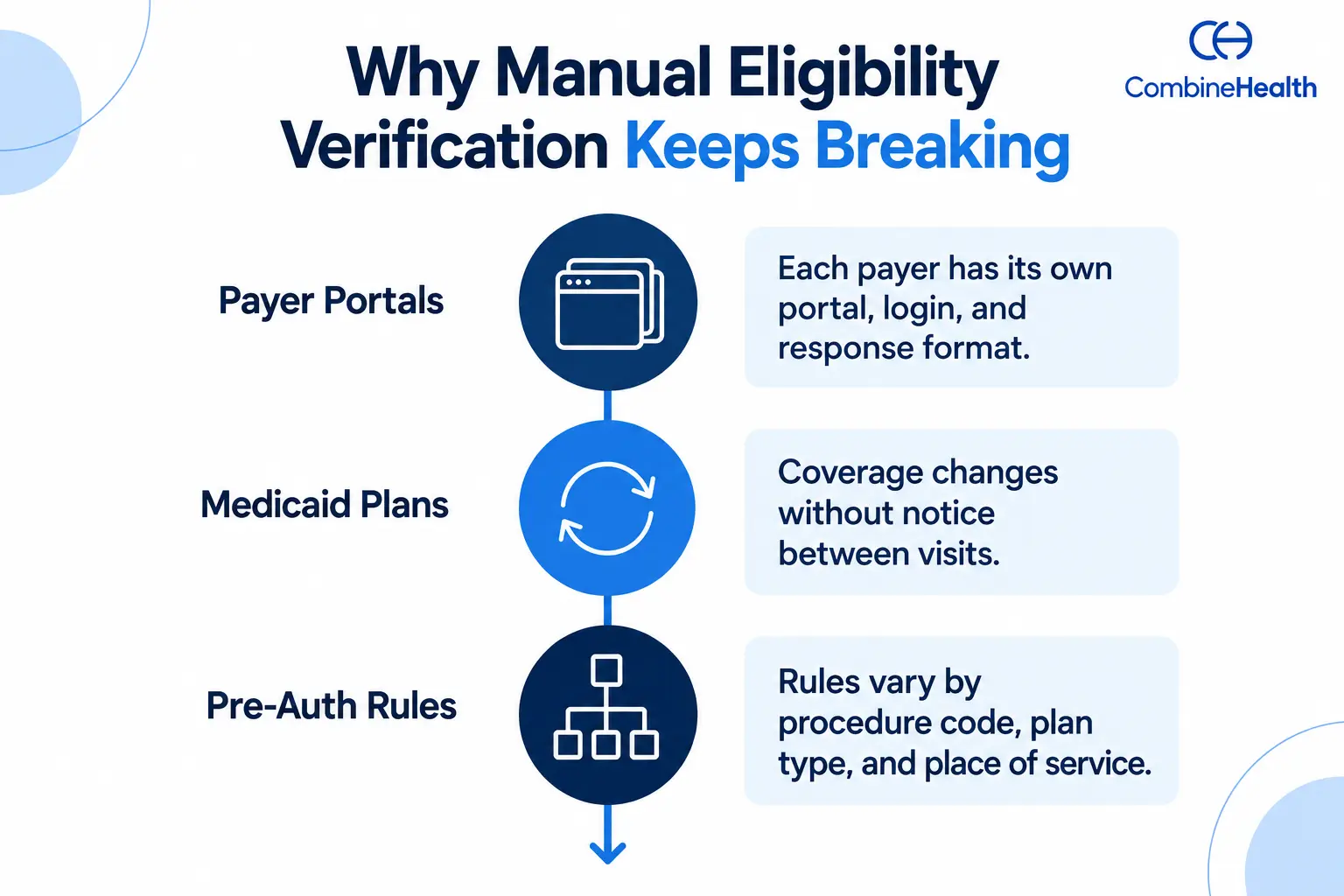
The cost of skipping a real eligibility platform isn't just the front-desk hours lost to payer portals. It's everything that breaks downstream when verification gets done in pieces or not at all.
For example, out-of-network appointments get flagged too late to redirect the patient, pre-auth requirements surface only after a claim comes back denied, and so on.
Each gap is small on its own. Together, they're the single biggest source of preventable revenue loss in the medical billing process.
The reason manual verification keeps breaking isn't the billing team—it's the structure of the work. Even an experienced biller can only check so many before the schedule starts.
A modern medical insurance eligibility verification software closes those gaps before the patient walks in. The shift is operational:
- Front-desk staff stop chasing payers and spend their time on higher-value work
- Coverage and network issues get resolved at scheduling, not at check-in
- Pre-auth requirements get flagged before the appointment, not after a denial
Denials drop at the source, lightening the downstream denial management load
Recommended reading: The Most Common Claim Denial Codes (and How to Fix Them)
What a Complete Health Insurance Eligibility Check Evaluates
Confirming active coverage is the first of many checks. A complete pre-visit verification evaluates:
For a practice running 3,500 visits with 27+ checks each, that is more than 90,000 individual data points per month — the reason interpretation, not retrieval, is the bottleneck.
This is exactly the gap CombineHealth’s eligibility verification platform closes: it doesn't just retrieve those 27-plus checks, it interprets them for the specific patient, provider, and scheduled visit — pulling from your PM system, payer portals, Medicare sources, and the practice's own history. Instead of handing the front desk another benefit response to decode, CombineHealth produces an action-ready eligibility record: what's verified, what the patient owes, and the one thing that needs attention before they arrive.
Top 10 Insurance Eligibility Verification Software in 2026
1. CombineHealth
CombineHealth's autonomous eligibility and benefits verification solution executes the full verification workflow across 50+ payer portals and aggregators, processing every patient on the next day's schedule before the front desk arrives — and, critically, it interprets the result rather than returning raw benefit data.
Where clearinghouse-grade tools answer one question (Is coverage active?) CombineHealth resolves the questions that actually prevent denials at intake: is the scheduled provider in network for this patient, is a referral required, what will the patient owe for the specific service, does the plan require prior authorization, and how do Medicare-specific conditions affect the encounter. The output is an action-ready eligibility record: what is verified, what the patient owes, and what requires attention before arrival.
- In-network confirmation: CombineHealth verifies whether the patient's insurance is accepted at the practice and with the specific provider booked. Out-of-network patients get flagged before the appointment, not at check-in.
- Real-time benefits extraction: CombineHealth connects to payer portals (Availity, TriZetto, and others) to retrieve copay, deductible, coinsurance, out-of-pocket maximum, secondary insurance, and plan-specific limitations.
- Patient financial responsibility calculation: Using CPT codes for the scheduled appointment, CombineHealth calculates exactly what the patient will owe and surfaces the estimate to the front desk and the patient, pre-visit, so collections happen at the point of service instead of going to A/R.
Recommended reading: Improving A/R days in Medical Billing
- Pre-authorization detection: CombineHealth flags which appointments will need authorization based on payer, plan, and procedure code, then routes them to the prior authorization process before scheduling locks.
Key Features
- Autonomous verification across 50+ payer portals and aggregators, with voice-AI IVR navigation where portals fall short
- Full benefit extraction (copay, deductible, coinsurance, out-of-pocket, secondary/COB), normalized into the EHR/PM
- CPT-based patient financial responsibility calculated pre-visit for point-of-service collection
- Network and referral/PCP verification, plus Medicare-specific condition handling
- Prior-authorization detection routed to the authorization workflow before scheduling locks
- Preventive-revenue detection (e.g., pending AWVs), and exception flagging for the specific fields needing attention
- Operates as the front-end layer of CombineHealth's end-to-end platform — the same payer-intelligent system that automates coding and denial prevention downstream
- HIPAA-compliant, SOC 2 certified, U.S. data residency
Case study
An internal medicine practice (3,000–3,500 visits/month, 27+ checks per patient) automated retrieval and interpretation with CombineHealth and reduced eligibility-related denials from 5% to 0%, cut outsourced eligibility staffing by 80% (10 people to 2), and realized roughly $50 per claim in prevented losses and surfaced revenue.

Best for: Mid-to-large hospitals, multi-specialty groups, and RCM companies that want eligibility verification as part of an end-to-end AI workforce.
2. Stedi
Stedi is an API-first, programmable healthcare clearinghouse built for teams that want to integrate eligibility verification directly into their applications and workflows.
It supports real-time eligibility checks across 1000+ payers—returning results as JSON rather than raw X12 EDI.
Stedi is built on AWS with multi-region failover, handles real-time and batch eligibility checks (up to 10,000 in a single request), and includes AI-powered automated recovery for failed checks.
Key Features:
- Real-time and batch eligibility checks across 1000+ payers, including Medicare and all state Medicaid programs
- JSON-native API responses with full X12 and CAQH CORE SOAP support
- AI-powered automated recovery for failed eligibility checks
- Batch processing of up to 10,000 checks in a single request
Best For: Developer-led RCM teams and health tech companies building automated eligibility workflows directly into their applications.
3. Collectly Billie
Billie is Collectly's AI agent for eligibility and benefits verification, launched on top of a platform serving 3,000+ healthcare organizations across the U.S.
Billie uses LLMs to read 271 EDI payer data, normalize responses into a structured benefits object, and auto-re-verify coverage before every visit.
The platform integrates with 20+ major EHRs, including Athena, ModMed, AdvancedMD, and eClinicalWorks, and updates fields automatically while notifying patients in real time.
Key Features:
- Auto re-verification before every visit
- Updates EHR fields and notifies patients automatically
- 20+ EHR integrations including Athena, ModMed, AdvancedMD, eClinicalWorks
- SOC 2, HITRUST, HIPAA, and PCI DSS compliant
Best for: Mid-size groups already on Athena, ModMed, eClinicalWorks, or other major EHRs wanting AI eligibility plus patient billing in one platform.
4. Nirvana Health
Nirvana Health is an AI-powered eligibility management platform specifically built for specialty healthcare.
Its flagship OneVerify product delivers specialty-specific benefit verification using a proprietary ML model, while Cardless Verification™ identifies active insurance using just name, DOB, and ZIP.
The AI model is continuously trained by expert billers who validate outputs against real payer responses.
Key Features:
- Specialty-specific benefit summaries pre-parsed for billing team action
- Recurring automated checks that catch Medicaid and MCO coverage changes between visits
- API-based and EHR/EMR direct integrations, plus a biller-facing app requiring no technical setup
- Continuous AI model training validated by a dedicated team of expert billers
Best for: Specialty practices (particularly behavioral health) needing AI-powered, specialty-specific benefit verification that goes beyond confirming active coverage.
5. Veritable
Veritable is a real-time eligibility verification platform offering both point-of-service checks and batch CSV processing for high-volume pre-appointment verification across 1,000+ payers.
Its standout capability is Medicaid eligibility verification—pinpointing the correct plan to bill when coverage changes, not just confirming whether a patient is technically eligible for benefits.
For organizations serving high Medicaid populations, this eliminates the misrouted claims and payment delays that come with shifting plan assignments and frequent eligibility redeterminations.
Key Features:
- Self-service CSV batch upload for hundreds of patients at once
- 1,000+ payers, including all 50 state Medicaids
- API and EHR integration available
- SOC 2 Type II, HIPAA-compliant
Best for: Small-to-mid practices and billing companies (especially Medicaid-heavy ones) wanting a simple medicaid insurance eligibility verification solution without enterprise complexity.
6. Droidal
Droidal is a healthcare AI automation company with multiple AI agents covering the full RCM spectrum, including eligibility, claims, prior auth, denials, intake, and collections.
Its Insurance Verification AI Agent unifies digital portal scraping and voice AI calling, handling both interfaces inside a single agent.
When a payer portal returns incomplete data, the same agent autonomously calls the payer's IVR and finishes the check by voice with a full audit trail.
Key Features:
- Unified digital + voice AI in a single agent
- Trained on client-specific workflows (not fixed rules)
- Agents across RCM workflows
- Audit trail for every verification request
Best for: Mid-to-large healthcare organizations with mixed-portal workflows wanting AI agents trained on their existing processes.
7. maxRTE
maxRTE (Cirius Group) is an eligibility verification platform built for high-volume environments supporting unlimited eligibility checks across 1,000+ payer connections.
It runs one-click real-time verification at registration, scheduled batch sweeps for upcoming appointments, and Insurance Discovery, which surfaces active coverage on up to 25% of self-pay patients.
Verification results flow back into your EHR automatically. This helps eliminate the retyping and copy-paste errors at registration.
Key Features:
- Real-time + scheduled batch eligibility verification
- Prior authorization detection in the same verification workflow
- 1,000+ payer connections across commercial, Medicare, and Medicaid
- Native EHR/PM integrations, including Epic, Cerner, Meditech, athenaOne
Best for: Hospitals, ED departments, and large practices running high verification volumes that want self-pay coverage discovery built into the same workflow.
8. Silna Health
Silna is a Care Readiness Platform handling prior authorizations, benefit checks, and insurance monitoring as one connected workflow built around clearing patients before the visit.
It runs full benefit checks across commercial and government payers, then continuously monitors coverage so changes mid-treatment don't surface as denials downstream.
Their Predictive Document Intelligence flags missing or incorrect documentation before submission—catching the gaps that usually cause prior authorization rejections after the fact.
Key Features:
- Full benefit checks across commercial and government payers
- Predictive Document Intelligence catches doc gaps pre-submission
- Continuous insurance monitoring with automatic re-verification
- Native EHR/PM integration
Best for: Specialty providers (such as ABA therapy, PT/OT, speech, behavioral health, hospice) where prior authorization is the primary front-end bottleneck.
9. VerifyTreatment
VerifyTreatment is built specifically for behavioral health and addiction treatment providers—a segment that faces unique eligibility complexity around carve-out payers and mental health benefits.
The platform delivers real-time benefit verification with deep payer logic for mental health and substance use treatment codes—visit limits, carve-outs, and SUD-specific prior authorization.
VerifyTreatment auto-reverifies the entire patient census on a recurring basis to catch silent coverage changes between intake and admission.
Key Features:
- Visit limit and authorization detection for behavioral health services
- MBHO carve-out routing for behavioral coverage managed separately from medical
- Auto re-verification of the full patient census on a recurring basis
- 1,700+ commercial and government payer connections
Best for: Addiction treatment centers, mental health facilities, IOPs, PHPs, residential treatment programs, and SUD providers that need eligibility verification built around the realities of behavioral health coverage.
10. Eligible
Eligible is a developer-first insurance and eligibility API used primarily by digital health companies, telehealth platforms, and modern clinics building custom verification workflows.
The platform provides real-time 270/271 eligibility checks, coordination of benefits data, and Medicare Beneficiary Identifier (MBI) lookup—all delivered through a clean REST API.
Unlike staff-facing platforms that wrap eligibility data in their own UI, Eligible hands engineering teams the data directly so they can route it into their application logic.
Key Features:
- REST API for eligibility, claims, status, ERA, authorizations, and referrals
- 90%+ of U.S. insurers via direct integrations
- Unified API suite for rapid implementation
- HIPAA-compliant
Best for: Tech-first healthcare organizations wanting a stable, foundational REST API for insurance billing infrastructure.
Beyond Coverage: Surfacing Reimbursable Preventive Care in Healthcare
Eligibility verification usually protects revenue; done well, it can also surface it. Annual Wellness Visits are the clearest example. Establishing that a Medicare or Medicare Advantage plan covers an AWV is not sufficient — the practice must also determine whether the patient has already completed the AWV in the applicable period, including with another provider.
Performed manually, that requires establishing coverage and then searching utilization history. A platform that reviews eligibility and utilization together — including payer-side records — flags a pending AWV before the appointment, so the physician can offer the visit. This converts eligibility from a cost-avoidance task into a revenue-capture one.
CombineHealth's eligibility verification platform does this in production. For every scheduled patient, it reviews AWV eligibility against utilization history — including Medicare-side records — and flags a pending Annual Wellness Visit before the appointment, even when the last one was completed with another provider. In the internal medicine deployment above, catching opportunities like this, alongside prevented eligibility losses, added up to roughly $50 per claim — turning a cost-avoidance task into a revenue-capture one.
Regulatory Drivers Shaping Eligibility in 2026
- No Surprises Act & Good Faith Estimates: uninsured and self-pay patients must receive advance cost estimates, which depend on accurate benefit and patient-responsibility data at the point of scheduling.
- CMS Interoperability & Prior Authorization Final Rule: phased requirements (through 2027) push payers toward faster, API-based (FHIR) prior-authorization and coverage data — raising the bar for platforms that consume it.
- HIPAA X12 270/271 remains the transaction standard; Medicare eligibility is available through CMS HETS.
How To Choose the Right Medical Insurance Eligibility Verification Software?
Five questions will tell you whether a medical insurance eligibility verification vendor is the right fit for your organization:
1. Does It Reach the Payers You Actually Bill?
Confirm the tool supports your top 20 payers—including Medicare, Medicare Advantage, your state Medicaid, and major commercial carriers. Some vendors quote inflated payer counts that include inactive or rarely-used connections, so ask for the active list before signing.
2. Do They Extract Benefits?
Checking active/inactive status doesn't prevent denials. Real benefits extraction surfaces copay, deductible, OOP max, coinsurance, plan limits, and secondary insurance. Without those, your team is still calling the payer.
3. Can It Calculate Financial Responsibility per Appointment?
Calculating actual patient cost takes more than pulling a deductible number. The tool has to apply the scheduled CPT codes against benefit data—a step some medical insurance eligibility verification software tools skip entirely.
4. Does It Flag Pre-Auth Requirements Before Scheduling?
The cheapest pre-auth denial to fix is the one you catch before scheduling locks the appointment in. Look for vendors that detect pre-auth needs at scheduling, not at check-in.
Recommended reading: Building a Smarter Prior Authorization Process
5. How Does It Integrate with Your Existing Stack?
Native EHR/PM integration matters more than payer count if your team won't adopt the tool. Look for direct connections to the stack that you already have. And also look for API connectivity if you're building custom workflows.
For the record, CombineHealth was built to pass all five: it reaches 50+ payer portals and aggregators (with voice-AI IVR navigation where portals fall short), extracts full benefit data, calculates CPT-based patient responsibility per appointment, flags pre-auth needs before scheduling locks, and writes verified eligibility straight back into your EHR/PM. It runs the whole workflow autonomously — the front desk never logs into a payer portal.
Automate Your Patient Eligibility Verification End-to-End
Use the five questions above to narrow your shortlist and look for the one tool that addresses all of them.
The right insurance eligibility verification software handles the full workflow without your team logging into a payer portal once.
Mark,CombineHealth’s eligibility verification platform does exactly that! It verifies coverage, extracts complete benefit data, calculates patient financial responsibility, and flags pre-authorization needs for every patient on tomorrow's schedule, autonomously. It writes eligibility data directly into your EHR so claims start clean and front-desk staff stop chasing payer portals.
Book a demo if you’re ready to stop denials at intake instead of fighting them after!
FAQs
1. What is medical insurance eligibility verification software?
Medical insurance eligibility verification software automates how healthcare organizations confirm a patient's coverage, benefits, and financial responsibility before a visit. Modern platforms move past basic active/inactive checks. They pull copay and deductible data, calculate what the patient owes per appointment, and flag pre-authorization requirements ahead of scheduling.
2. How does the eligibility verification process work in medical billing?
The eligibility verification process moves through four steps: confirm in-network status with the patient's payer and provider, extract benefit details (copay, deductible, coinsurance, plan limits), calculate patient financial responsibility for the scheduled CPT codes, and detect any procedures that need pre-authorization.
3. Do AI eligibility verification tools work with my existing EHR?
Yes. Look for native integration with major EHR and PM systems. Verified eligibility data should write back into the patient record automatically, eliminating the manual data entry that introduces errors at registration.
4. What is the difference between clearinghouse and source verification?
Clearinghouse verification reaches many payers through one connection but can return less granular benefit data; source verification queries the payer directly for the most complete, plan-specific detail. The strongest platforms use whichever path returns the data needed and then interpret it.
5. How does eligibility verification reduce denials?
Registration and eligibility errors cause roughly a quarter of denials. Verifying coverage, network status, referral requirements, and prior-authorization needs before the visit removes those errors before the claim is created.
6. Do we still need staff to call payers for eligibility checks?
Far less. Autonomous platforms handle portal and IVR navigation for the majority of checks and flag only the specific exceptions that need a person — so staff work escalations, not routine verification.
In one internal medicine deployment, CombineHealth completed 85% of eligibility cases with no human intervention at 100% accuracy, which let the practice cut its outsourced eligibility team from 10 people to 2 — staff moved to escalations and higher-value work.
7. Does it help with Good Faith Estimates and the No Surprises Act?
Yes. Accurate benefit and patient-responsibility data at scheduling is the input Good Faith Estimates depend on, so complete pre-visit verification supports compliance directly.
8. Does eligibility verification verify referral and PCP requirements?
Complete verification checks network status, the patient's assigned PCP, and HMO/PPO referral rules — not just whether coverage is active — so provider- and referral-related denials are caught before the visit.
9. Does eligibility verification handle Medicare (MBI/HETS) and secondary insurance (COB)?
Yes. It retrieves Medicare eligibility (via HETS/MBI), applies Medicare-specific conditions such as Advantage, Home Health, and Hospice, and extracts secondary insurance for coordination of benefits.
10. Can eligibility verification identify preventive-care (AWV) opportunities?
Advanced platforms can. By reviewing AWV eligibility and utilization history together, they flag a pending Annual Wellness Visit before the appointment, turning verification into a revenue-capture step.
CombineHealth reviews AWV eligibility and utilization history together, including payer-side records, and flags a pending Annual Wellness Visit before the appointment, even if it was completed with another provider, so the physician can offer the visit. In one deployment, surfacing opportunities like this contributed to roughly $50 per claim in impact.
11. How much does eligibility verification software cost?
Pricing models vary — per transaction, flat-rate unlimited, or bundled into a platform. Compare total cost against your current manual or outsourced cost per verification.
12. Can eligibility verification be fully automated?
CombineHealth runs 85% of eligibility checks autonomously at 100% accuracy; the smaller set with data-quality issues or ambiguous payer responses arrives already worked, with only the specific exception flagged for a person.
Recommended Reads







Explore Our
AI Workforce






Subscribe to newsletter - The RCM Pulse
Trusted by 200+ experts. Subscribe for curated AI and RCM insights delivered to your inbox

Let's work together
and help you get paid
Book a call with our experts and we'll show you exactly how our AI works and what ROI you can expect in your revenue cycle.