CombineHealth vs. Fathom: Which AI Medical Coding Software Should You Choose?
CombineHealth vs. Fathom compared across automation, explainability, payer intelligence, RCM connectivity, and results. See which fits your coding goals.
Published on:
October 26, 2026


Fathom is one of the more established autonomous medical coding platforms, with a large documented coding footprint, customer-validated automation rates above 90%, and strong KLAS recognition. CombineHealth is newer, but it has demonstrated 98%+ production accuracy while connecting autonomous coding to clinical documentation improvement (CDI), payer intelligence, denial prevention, and the broader revenue cycle.
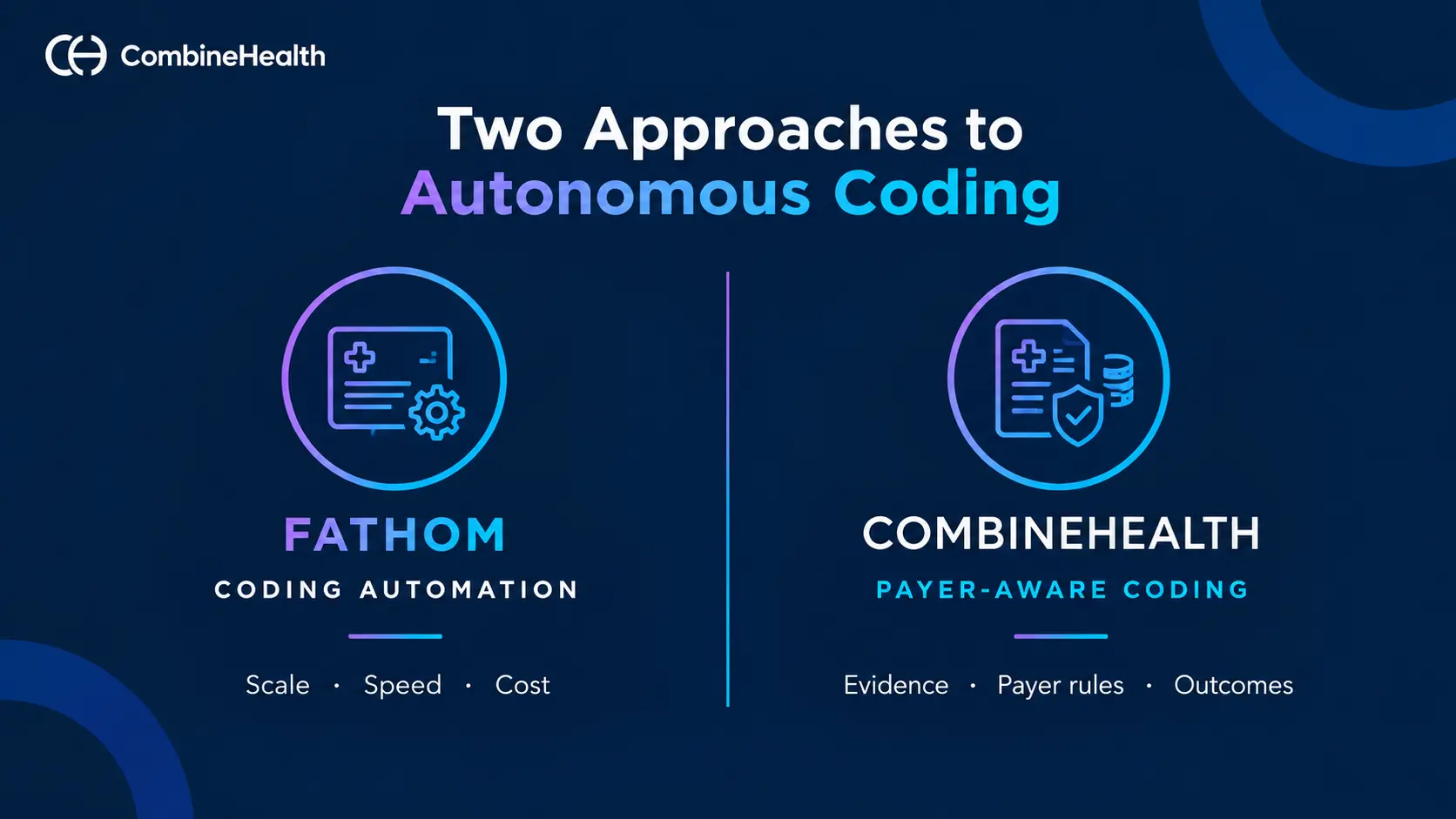
The central difference is what each platform is designed to optimize. Fathom primarily emphasizes high-scale coding automation, cost reduction, and turnaround time. CombineHealth focuses on whether each coding decision produces a supported, payer-aware claim, and how downstream claim outcomes can improve future coding.
Key Takeaways
• CombineHealth is a self-learning autonomous medical coding platform that connects each coding decision to downstream payer outcomes. It held 98.4% accuracy in Brault’s production audits with turnaround under 12 hours through 2 to 3× volume spikes, and matched or exceeded expert coders on all four measures in an Edelberg & Associates audit of 1,000 emergency department charts.
• The central difference between CombineHealth and Fathom is what each platform optimizes. Fathom emphasizes high-scale coding automation, cost, and turnaround time, while CombineHealth optimizes whether each coding decision produces a supported, payer-aware claim, with claim outcomes flowing back to refine future coding for each payer.
• CombineHealth extends beyond medical coding into CDI, eligibility, claim validation, billing, A/R, denial management, appeals, and analytics. Fathom’s public offering centers on autonomous coding, coding audit, and risk-adjustment coding. Downstream, Fathom improves results by making coding faster and more accurate, while CombineHealth also uses returned claim outcomes to refine future coding and claim validation.
• Both CombineHealth and Fathom support touchless EHR integrations, and public evidence doesn’t establish a universal integration winner. Fathom has a documented athenahealth Data View implementation, and CombineHealth integrates with Epic, Oracle Cerner, eClinicalWorks, athenahealth, ModMed, NextGen, and others, with new Brault sites going live in about two weeks, down from roughly 1.5 months.
• Both vendors publish meaningful downstream results aimed at different objectives. At a health system, Fathom reported 95.5% automation, 98.3% accuracy, a 0.66 increase in average RAF, and a two-day shorter claim-to-cash. At a 400-bed Midwest hospital, CombineHealth reported up to 75% fewer coding-related denials, 4% higher captured revenue, 5× more CDI opportunities, and 98%+ accuracy.
• Fathom suits buyers whose problem is coding capacity, such as maximizing touchless volume, risk-adjustment coding, or very large coding volumes. CombineHealth suits buyers whose problem is denials and lost revenue, such as those who want CDI inside coding, payer-specific requirements, and coding connected to eligibility, billing, A/R, denials, and appeals, while maintaining scale.
Accuracy is the entry requirement for autonomous medical coding. A chart that scores 98% in an internal audit can still draw a denial, because each payer applies its own edits, medical necessity criteria, and documentation standards. Each denial adds rework, delays cash, and pulls staff into appeals.
As you evaluate Fathom and CombineHealth, keep one question in front of you: what happens to the claim after submission? The 2025 Bain & Company and KLAS Research survey found providers prioritizing revenue cycle management (RCM) and solutions with demonstrable returns, with coding among the four most common AI use cases. Buyers now judge autonomous coding by its financial impact as well as its accuracy.
We created this comparison to help you weigh both platforms on that question. It covers autonomous coding, explainability, revenue cycle connectivity, electronic health record (EHR) integration, and downstream financial outcomes.
On this page
- CombineHealth vs. Fathom AI Medical Coding at a Glance
- Category 1: Autonomous Medical Coding
- Category 2: Explainability in Medical Coding
- Category 3: Connection to the Broader Revenue Cycle
- Category 4: EHR Integration
- Category 5: Impact on Downstream Revenue Cycle Outcomes
- CombineHealth vs. Fathom: Where Each Platform Stands Out
- Frequently Asked Questions
- 1. Which Is Better: CombineHealth or Fathom?
- 2. How Does CombineHealth Differ From Fathom?
- 3. Is CombineHealth or Fathom More Accurate?
- 4. Which Automates More Medical Coding: CombineHealth or Fathom?
- 5. Does CombineHealth Have Payer Intelligence That Fathom Does Not?
- 6. Which Platform Is Better for Risk-Adjustment Coding?
- 7. How Quickly Can Each Platform Be Implemented?
- 8. Does CombineHealth Replace Only Medical Coding Software?
- 9. Which Platform Offers Better Explainability?
- 10. Why Choose CombineHealth Over Fathom?
CombineHealth vs. Fathom AI Medical Coding at a Glance
Category 1: Autonomous Medical Coding
Both CombineHealth and Fathom offer autonomous medical coding, and Fathom currently has the stronger publicly documented automation and scale story. As reported on their website, Fathom validates automation above 90%. Whereas, CombineHealth automates up to 85% of eligible encounters and differentiates itself through documentation-informed coding, payer requirements, and downstream claim outcomes. Both vendors report accuracy near 98% in customer deployments. CombineHealth does more than just automating; it also integrates CDI efficiently in the workflow.
KLAS Research’s August 2025 autonomous coding report gave Fathom a 95.5 out of 100 overall customer score, based on limited data. Customers interviewed in an earlier KLAS spotlight validated automation above 90%. Fathom codes the charts it can and sends them straight to billing without human intervention. Charts outside its automation pass to the customer’s existing coding operation.
CombineHealth is a self-learning autonomous medical coding platform. Also referred to as Amy AI, the CombineHealth medical coding automation platform reads completed encounter documentation directly from the electronic medical record (EMR). The platform applies coding guidelines and payer-specific requirements, then returns billing-ready codes with an explainable rationale for each decision. CombineHealth operates in both autonomous and audit modes while efficiently integrating CDI.
In a parallel study of 1,000 emergency department (ED) charts, Edelberg & Associates’ audit team scored CombineHealth at 95.9% for E/M, 99% for CPT, 100% for modifiers, and 93.2% for ICD-10. Edelberg’s expert coders scored 94.7%, 99%, 100%, and 92.2% on the same measures. CombineHealth coded about 85% of charts autonomously and cut turnaround time by about 50%.
How Their Approaches to Autonomous Coding Differ
Both Fathom and CombineHealth automate coding. They differ in the intelligence surrounding the coding decision and in the outcome each is built to optimize.
Fathom optimizes high-scale coding automation, cost, and turnaround time. CombineHealth optimizes whether each coding decision produces a supported, payer-aware claim. Claim outcomes then flow back into the CombineHealth platform and refine future coding for each payer.
Brault, an emergency medicine RCM organization, audits CombineHealth’s production coding against a 96%+ threshold for each coding dimension and 98% for MIPS. CombineHealth cleared both bars: Primary ICD-10 99.1%, CPT 98.4%, E/M 98.2%, and MIPS 98.7%. Turnaround stayed under 12 hours through 2 to 3x volume spikes, and Brault plans a 5x increase in autonomous coding volume.
Read the Brault Case Study
Category 2: Explainability in Medical Coding
CombineHealth links each coding decision to supporting documentation, coding logic, payer requirements, and an audit trail. Fathom clearly emphasizes accuracy and auditability. Fathom does not detail how individual codes are explained, so buyers should compare explanation depth in a live demonstration.
Fathom’s public materials establish a strong accuracy and audit position. It offers a real-time audit that reviews every coded chart and flags potential denials and unnecessary downcoding.
CombineHealth ties every code to evidence. Each code carries a traceable audit trail linked to the supporting clinical documentation. Coders, auditors, and compliance teams see why the platform assigned each code and can validate it against the source note. For E/M coding, the explanation shows the documented problems, data, and risk behind the selected level.
The point of differentiation is payer context.
Why Payer Context Is Important in Explainability
A clinical explanation answers only half of a payer’s question. Payers also test medical necessity and apply their own coding rules. A complete explanation shows:
- Which coding guideline was applied
- Which payer requirement was considered
- Whether documentation supports medical necessity
- Why a modifier was added
- How the code performed after adjudication
- Whether similar decisions produced denials or underpayments
CombineHealth’s advantage is explainability combined with payer intelligence. Each explanation can show the payer requirements applied, and the platform learns from how each payer adjudicated earlier claims. That pairing links why a code was chosen to how payers respond to it.
Recommended Reading: CombineHealth vs CodaMetrix
Category 3: Connection to the Broader Revenue Cycle
CombineHealth extends beyond autonomous coding into CDI, eligibility, claim validation, billing, A/R, denial management, appeals, and analytics. Fathom’s public offering is limited to autonomous coding, coding audits, and risk-adjustment coding, making it particularly strong for organizations with a defined coding-capacity problem. Organizations that want one connected workflow from documentation to payment can weigh CombineHealth’s wider scope.
How Autonomous Medical Coding Connects With Downstream Outcomes at CombineHealth
Medical coding exists to produce reimbursable claims. A code earns its value when the payer pays the claim.
Fathom improves downstream results by making coding faster and more accurate. At a health center, claim date to cash fell by two days.
CombineHealth adds a second lever. The platform analyzes returned claim outcomes and uses validated payer patterns to refine future coding and claim validation. A denial pattern from one payer then shapes how the platform codes the next encounter for that payer.
Category 4: EHR Integration
Both platforms support touchless coding integrations, and public evidence does not establish one universal integration winner. Fathom has a documented athenahealth Data View implementation and positive customer feedback about EHR data exchange. CombineHealth supports a broader named EHR ecosystem and demonstrated an approximately two-week new-site go-live with Brault.
Fathom’s deployment used athenahealth Data View and launched autonomous coding across multiple settings. The release describes a proof of concept followed by an October 2025 go-live and gives no go-live duration.
CombineHealth integrates with Epic, Oracle Cerner, eClinicalWorks, athenahealth, ModMed, NextGen, Greenway, AdvancedMD, CareCloud, DrChrono, Allscripts, and Practice Fusion through APIs, HL7, and custom interfaces. The Brault deployment shows the speed of rollout:
- New sites went live in approximately two weeks
- Recent site go-live previously took roughly 1.5 months
- The production workflow stayed stable through volume spikes
Recommended Reading: Nym vs. CodaMetrix vs. Fathom
Category 5: Impact on Downstream Revenue Cycle Outcomes
Both vendors publish meaningful customer outcomes. Fathom has strong evidence around automation, coding-error reduction, risk adjustment factor improvement, cost, and claim-to-cash speed. CombineHealth more directly connects autonomous coding with coding-denial reduction, captured revenue, CDI opportunities, and continuous payer-specific improvement.
Fathom Customer Results
Fathom’s strongest published results come from a health center. The health center reached 95.5% encounter-level automation at 98.3% accuracy, up from 96.3%. Its average risk adjustment factor (RAF) rose 0.66 year over year. The organization also tripled G2211 add-on code capture, doubled modifier 25 capture, and shortened claim date to cash by two days.
A Becker’s Hospital Review reports ApolloMD results with Fathom as well. ApolloMD automated 90.3% of encounters and reached 98.1% E/M accuracy in routine audits. It also reduced coding errors by 86% and coding turnaround time by 98.5%.
CombineHealth Customer Results
At a 400-bed Midwest hospital, a CombineHealth press release reports up to 75% fewer coding-related denials and 4% higher captured revenue. The hospital also found five times more CDI opportunities and maintained 98%+ coding accuracy.
The revenue gain follows from the same mechanism that cut denials. CombineHealth’s payer intelligence learns how each payer responds to coding decisions, then surfaces higher-specificity documentation that supports the codes.
Fathom’s strongest published outcomes demonstrate coding efficiency, risk-adjustment capture, and operational scale. CombineHealth’s strongest published outcomes demonstrate how coding, CDI, and payer intelligence affect denials and captured revenue. Each optimizes for a partially different business objective.
CombineHealth vs. Fathom: Where Each Platform Stands Out
CombineHealth and Fathom have both demonstrated that autonomous coding can operate at production scale with high reported accuracy. Fathom has the larger documented coding footprint and stronger third-party market validation.
CombineHealth differentiates through the feedback loop connecting documentation, coding, payer validation, and downstream revenue-cycle outcomes. Fathom suits a buyer whose problem is coding capacity. CombineHealth suits a buyer whose problem is denials and lost revenue.
Where CombineHealth Stands Out
CombineHealth is the newer platform, and its production evidence is specific. At Brault, recurring audits held 98%+ accuracy, and turnaround stayed under 12 hours through volume spikes. At a 400-bed hospital, CombineHealth delivered up to 75% fewer coding-related denials and 4% higher captured revenue.
CombineHealth may be the stronger fit if:
- You want CDI integrated directly into medical coding
- You want each code linked to documentation and coding rationale
- You want coding to account for payer-specific requirements
- You want validated denial, reimbursement, and underpayment patterns to inform future workflows
- Coding-related denial reduction is a central KPI
- You want coding connected with eligibility, billing, A/R, denials, appeals, and analytics
- You need both autonomous coding and audit modes
- You value fast rollout across new sites after the core integration is established
Book a demo to see payer intelligence on your own claims.
Where Fathom Stands Out
Fathom is the more established platform and holds the larger documented footprint. Its published results show high automation, strong risk-adjustment outcomes, and customer research from KLAS. KLAS reports a 95.5 out of 100 overall customer score and customer validation of automation above 90%, and identifies the research as limited data.
Fathom may be the stronger fit if:
- You prioritize a more established autonomous coding platform
- Your primary objective is maximizing touchless coding volume
- You want customer-validated automation rates above 90%
- You need proven HCC and risk-adjustment coding
- Broad published specialty coverage is important
- You value third-party customer research from KLAS
- You operate at very large coding volumes
- Your downstream RCM stack is already established, and coding is the primary gap
Frequently Asked Questions
1. Which Is Better: CombineHealth or Fathom?
The answer depends on the problem. Fathom has the larger documented footprint and the stronger published automation rates. CombineHealth has self-learning payer intelligence, explainable decisions, and broader revenue cycle automation, with up to 75% fewer coding-related denials and 4% higher captured revenue at a 400-bed hospital.
2. How Does CombineHealth Differ From Fathom?
Fathom’s platform optimizes high-scale coding automation, cost, and turnaround time. CombineHealth’s platform optimizes whether each coding decision produces a supported, payer-aware claim, then learns from denials, reimbursements, and underpayments to improve the next one.
3. Is CombineHealth or Fathom More Accurate?
Both vendors report accuracy near 98%, measured differently. CombineHealth held 98%+ across four coding dimensions in Brault’s production audits. Fathom reported 98.3% at Your Health and 98.1% E/M accuracy at ApolloMD. Ask each vendor for its audit method, sample size, and reviewer qualifications before comparing percentages.
4. Which Automates More Medical Coding: CombineHealth or Fathom?
Fathom publishes the higher rates: 95.5% at Your Health, 90.3% at ApolloMD, and 90%+ validated by KLAS customers. CombineHealth reports up to 85%. Definitions differ by vendor, so ask which encounters sit in the denominator.
5. Does CombineHealth Have Payer Intelligence That Fathom Does Not?
CombineHealth explicitly uses denials, reimbursements, and underpayments to inform future payer-specific coding. Fathom calibrated its Your Health deployment to the organization’s payer mix. The Fathom materials reviewed for this comparison contain no public claim that historical claim outcomes continuously refine its coding.
6. Which Platform Is Better for Risk-Adjustment Coding?
Fathom has the stronger published evidence. Fathom offers retrospective risk-adjustment coding, and Your Health raised its average risk adjustment factor (RAF) by 0.66 year over year. Organizations that prioritize hierarchical condition category (HCC) capture should review Fathom’s results closely.
7. How Quickly Can Each Platform Be Implemented?
CombineHealth brought recent Brault sites live in approximately two weeks, down from roughly 1.5 months. Fathom’s Your Health release describes a proof of concept followed by an October 2025 go-live and gives no duration. Confirm timelines with each vendor for your EHR and site count.
8. Does CombineHealth Replace Only Medical Coding Software?
No, CombineHealth can be deployed for autonomous medical coding, and its broader platform also covers eligibility verification, claim validation, billing, A/R follow-up, denial management, appeals, CDI, and analytics.
9. Which Platform Offers Better Explainability?
CombineHealth links each code to supporting documentation, coding rationale, and the payer requirements applied. Fathom publishes strong accuracy and audit evidence, and a demonstration will confirm the depth of its code-level explanations. Ask both vendors to explain the same complex chart.
10. Why Choose CombineHealth Over Fathom?
Choose CombineHealth when accuracy alone no longer answers your buying question. CombineHealth is a self-learning platform that connects each coding decision to payer outcomes and the wider revenue cycle. Buyers focused on maximum touchless volume or risk-adjustment coding should evaluate Fathom alongside it. Book a demo to see payer intelligence on your own claims.
Related Blogs







Explore Our
AI Workforce







Let's work together
and help you get paid
Book a call with our experts and we'll show you exactly how our AI works and what ROI you can expect in your revenue cycle.