CombineHealth vs. CodaMetrix: Which AI Medical Coding Software to Choose in 2027?
Compare CombineHealth vs. CodaMetrix for autonomous coding, accuracy, integrations, ROI, and denials. See which AI medical coding software fits you best.
Published on:
October 6, 2026


While CodaMetrix’s clearest advantage is its maturity—with a larger, established health system footprint and third-party recognition from organizations like KLAS—CombineHealth too has demonstrated its ability to scale autonomous coding without compromising accuracy.
At Brault, CombineHealth maintained 98%+ coding accuracy and 12-hour turnaround through 2–3× volume spikes, with plans to scale autonomous coding volume 5×. It also differentiates through payer intelligence, up to 75% fewer coding-related denials, and a broader platform connecting coding with the rest of the revenue cycle.
CodaMetrix existed before CombineHealth did.
They have been recognized as “Best in KLAS for Autonomous Coding (2026)” and are Epic Toolbox-approved.
But a lot has changed in the healthcare RCM industry since CodaMetrix launched in 2019.
As of 2025, 42% of healthcare organizations say difficulty demonstrating ROI is a barrier to AI adoption. As 80% of payers now have an AI strategy in place, buyers want hard-dollar ROI and short time-to-value.
In short, hospitals have moved from trying AI to expecting it to show up in the financials. Medical coding accuracy is now the minimum, and buyers expect measurable revenue and denial impact.
This is where CombineHealth's self-learning autonomous medical coding platform stands apart. It connects coding to what happens after claims are submitted, through denials, adjudication, and payer scrutiny. It then learns from those outcomes to inform future coding decisions, which makes it the stronger choice for organizations that need AI to show ROI.
In this CombineHealth vs. CodaMetrix comparison, we'll look at how the two platforms compare across autonomous coding, explainability, revenue cycle connectivity, EHR integrations, and downstream financial outcomes to help you determine which approach better fits your organization.
On this page
- CombineHealth vs. CodaMetrix at a Glance
- Category 1: Autonomous Medical Coding
- Category 2: Explainability in Medical Coding
- Category 3: Connection to the Broader Revenue Cycle
- Category 5: Impact on Downstream Revenue Cycle Outcomes
- CombineHealth vs. CodaMetrix: Where Each Platform Stands Out
- FAQs
- 1. Which is better: CombineHealth or CodaMetrix?
- 2. How does CombineHealth differ from CodaMetrix?
- 3. Is CombineHealth or CodaMetrix more accurate?
- 4. Which automates more medical coding: CombineHealth or CodaMetrix?
- 5. Which is better for reducing coding denials?
- 6. Does CombineHealth have payer intelligence that CodaMetrix does not?
- 7. Which is better for Epic health systems: CombineHealth or CodaMetrix?
- 8. Does CombineHealth integrate with more than Epic?
- 9. Which platform is better for enterprise-scale autonomous coding?
- 10. How quickly can CombineHealth be implemented compared with CodaMetrix?
- 11. Is CodaMetrix only for radiology and pathology?
- 12. Does CombineHealth replace only medical coding software?
- 13. Which platform offers better explainability?
- 14. Is CombineHealth a good CodaMetrix alternative?
- 15. Why choose CombineHealth over CodaMetrix?
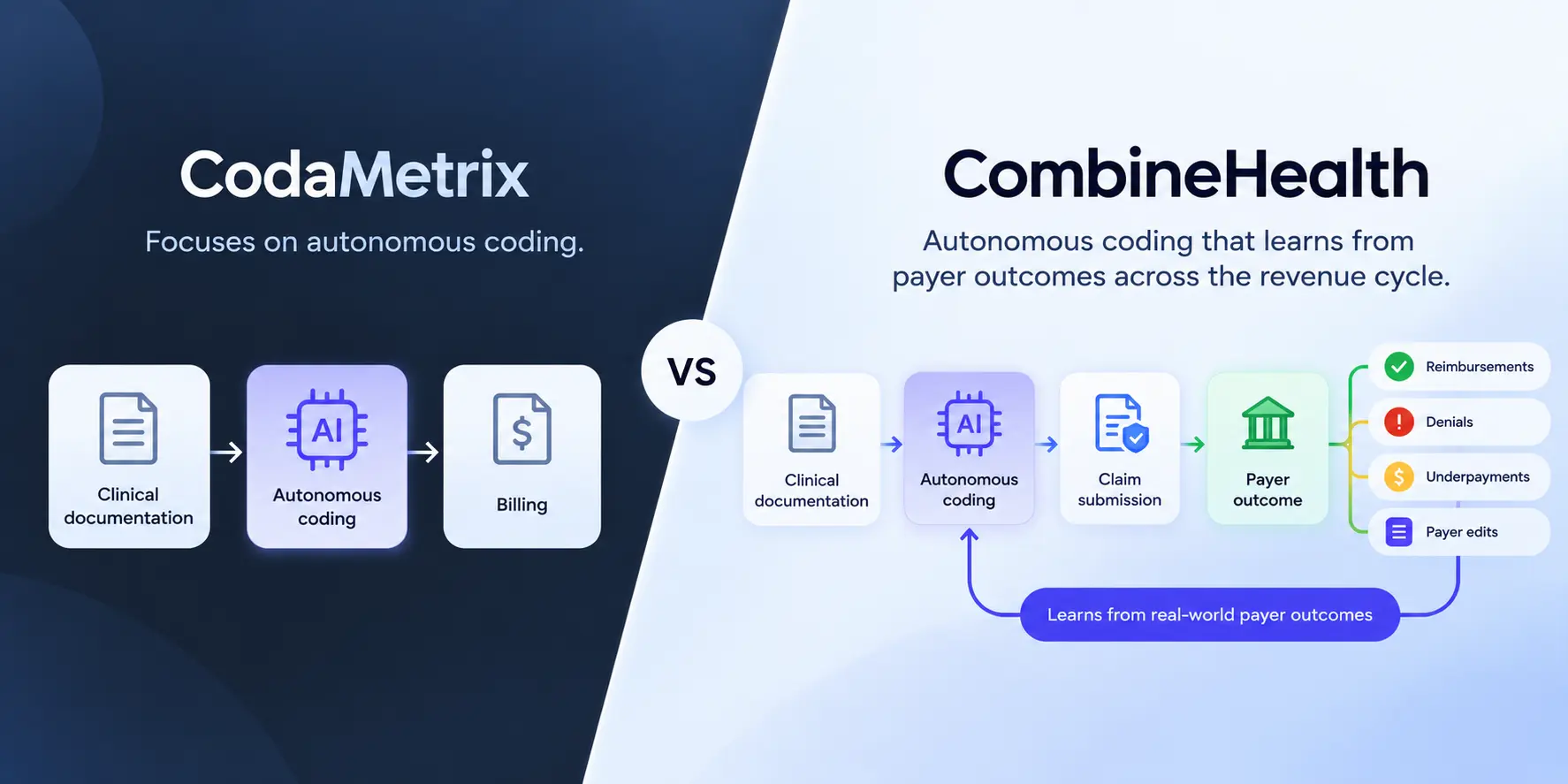
CombineHealth vs. CodaMetrix at a Glance
Category 1: Autonomous Medical Coding
Both CombineHealth and CodaMetrix offer autonomous medical coding, but CombineHealth differentiates through self-learning coding informed by downstream payer outcomes. It automates up to 85% of eligible encounters at 98%+ accuracy and has maintained 98%+ accuracy through 2–3× volume spikes, demonstrating that autonomous coding can scale without sacrificing quality.
CodaMetrix has a longer track record in this category, particularly with large health systems. Its CMX Automate product can code and bill cases without human intervention, while CMX Amplify supports coder-reviewed workflows. CodaMetrix reports 98% average coding accuracy and a 70% reduction in manual coding workflow. Its published results are particularly strong in high-volume specialties such as radiology and pathology.
CombineHealth takes a self-learning approach to autonomous medical coding. The software reads the clinical documentation, assigns billing-ready codes, applies coding guidelines and payer-specific requirements, and provides supporting evidence for its decisions. It autonomously codes up to 85% of eligible encounters at 98%+ accuracy.
In a parallel study of roughly 1,000 emergency department charts, CombineHealth matched expert coders at approximately 98% accuracy while reducing coding turnaround time by about 50%.
How Their Approaches to Autonomous Coding Differ
The main difference is what each platform uses to improve coding decisions over time.
CodaMetrix describes CMX Amplify as feeding coder-reviewed decisions back into its platform. Its broader CMX CARE platform brings together information across encounters and facilities to identify services, diagnoses, documentation gaps, and capture risk.
CombineHealth also learns from coding and organizational context, but extends that feedback loop to downstream claim outcomes. Denials, reimbursements, underpayments, and payer edits can inform its payer intelligence, which is then used to refine future coding decisions for individual payers.
That approach holds up at enterprise scale. Brault, an emergency medicine RCM organization with more than 40 years in the field, runs CombineHealth's autonomous coding with 98%+ accuracy across every major coding dimension, including CPT, E/M, ICD-10, modifiers, and MIPS, validated in recurring production audits. It also sustains a turnaround of under 12 hours through 2–3× volume spikes.
Read Brault Case Study
Category 2: Explainability in Medical Coding
Both platforms provide evidence behind AI-generated codes. CombineHealth extends explainability with payer context: each coding decision can show the supporting clinical documentation, coding rationale, and payer-specific requirements applied. Its payer intelligence also learns from historical claim outcomes, connecting why a code was selected with how individual payers actually respond.
Both CombineHealth and CodaMetrix emphasize explainability rather than treating autonomous coding as a black box.
CodaMetrix describes its platform as a “glass box.” For predicted codes, the platform provides supporting evidence so coding teams can understand the basis for the recommendation. This gives organizations a way to review AI-generated coding decisions rather than simply receiving a final code.
CombineHealth also provides evidence and rationale for its coding decisions. For each encounter, teams can see the documentation supporting the assigned codes, the coding guidelines applied, and the reasoning behind the decision. For E/M coding, for example, the explanation can show the documented problems, data, and risk supporting the selected level.
Why Payer Context Is Important in Explainability
CombineHealth incorporates payer-specific coding requirements into the autonomous coding workflow. This means its explanations can show not only the clinical and coding evidence supporting a code, but also the payer-specific requirements considered when arriving at the decision.
CodaMetrix also provides evidence for its predicted codes, applies configurable payer rules and national and local edits, and has expanded its focus on coding quality and governance through CMX CARE. However, in its publicly available materials we did not find a claim that it learns payer behavior from historical claim outcomes, or that this context appears in its coding explanations.
For organizations evaluating either platform, the difference is therefore less about whether coding decisions are explainable and more about the context incorporated into those explanations. CombineHealth connects explainability with payer intelligence, while CodaMetrix emphasizes transparent, evidence-supported coding decisions.
Every code CombineHealth generates comes with a traceable audit trail linked to the supporting clinical documentation. Coders, auditors, and compliance teams can see exactly why each code was assigned and validate the decision against the source note.
Learn more about why explainability matters in AI for medical coding.
Category 3: Connection to the Broader Revenue Cycle
CombineHealth extends beyond autonomous coding into eligibility, claim validation and billing, A/R, denial management, appeals, and analytics. More importantly, outcomes from these workflows can feed back into upstream decisions. CodaMetrix is more coding-focused, combining autonomous coding with coder support, coding analytics, documentation insights, and coding quality governance.
CodaMetrix is primarily focused on medical coding. Its platform includes autonomous coding through CMX Automate, coder decision support through CMX Amplify, and analytics and benchmarking through CMX Insights. CMX CARE extends this with a governance layer that can evaluate codes from different sources and identify coding and documentation issues.
CombineHealth covers a broader set of revenue cycle workflows. In addition to autonomous coding and CDI, the platform supports eligibility verification, claim validation and billing, A/R and denial management, appeals, and revenue cycle analytics.
How Autonomous Coding Connects with Downstream Outcomes
With CombineHealth, claim outcomes such as denials, reimbursements, underpayments, and payer edits can feed back into upstream workflows, including medical coding. This allows recurring payer behavior identified after a claim is submitted to inform how future encounters are coded and validated.
CodaMetrix provides visibility into downstream coding outcomes through CMX Insights, including denial trends. Based on the company's publicly available materials reviewed for this comparison, however, we did not find standalone products for eligibility verification, denial management, A/R follow-up, or appeals.
Category 4: EHR Integration
Both platforms integrate with major EHRs, so EHR compatibility alone may not decide the comparison.
CodaMetrix has particularly strong Epic credentials, including Epic Toolbox approval. CombineHealth supports a broad EHR ecosystem and has demonstrated fast deployment, reducing new-site go-live at Brault from roughly 1.5 months to about two weeks.
CodaMetrix supports integrations with Epic, Oracle Cerner, MEDITECH, Allscripts, athenahealth, and eClinicalWorks. Its Epic integration is particularly well established: CodaMetrix is Epic Toolbox approved for fully autonomous coding and reports deployments across 500 hospitals.
CombineHealth integrates with Epic, Oracle Cerner, eClinicalWorks, athenahealth, ModMed, NextGen, Greenway, AdvancedMD, CareCloud, DrChrono, Allscripts, and Practice Fusion. Depending on the organization's existing infrastructure, integrations can be built using APIs, HL7, and custom interfaces.
Category 5: Impact on Downstream Revenue Cycle Outcomes
Both platforms have demonstrated reductions in coding-related denials, but CombineHealth also publishes a direct captured-revenue result.
At a 400-bed hospital, CombineHealth reduced coding-related denials by 75% and increased captured revenue by 4% within three months, connecting autonomous coding performance directly to measurable downstream financial outcomes.
Both CombineHealth and CodaMetrix report measurable reductions in coding-related denials.
CodaMetrix reports a 60% reduction in coding denials on its website, with individual health systems reporting even larger improvements. OHSU, for example, reported a 70% reduction in coding-related denials after implementing CodaMetrix, while Mass General Brigham reported a 58.7% reduction.
CombineHealth reports up to a 75% reduction in coding-related denials. At a 400-bed hospital, the organization also saw a 4% increase in captured revenue within the first three months of implementation.
The 4% revenue gain comes from the same mechanism behind the denial reduction. CombineHealth's payer intelligence learns how each payer responds to coding decisions, then surfaces higher-specificity documentation that supports the codes. At that 400-bed hospital, it also surfaced 5× more CDI opportunities.
See how AI medical coding learns from payer behavior, or book a demo to see payer intelligence on your own claims.
CombineHealth vs. CodaMetrix: Where Each Platform Stands Out
Both CombineHealth and CodaMetrix have demonstrated the ability to automate medical coding at scale while maintaining high coding accuracy. The biggest difference is maturity: CodaMetrix is a more established name in autonomous coding, while CombineHealth is a newer entrant with a different approach to connecting coding with payer behavior and the broader revenue cycle.
Where CombineHealth stands out
CombineHealth is newer to the autonomous medical coding market, but it has demonstrated that its platform can scale coding volume without sacrificing accuracy.
Brault, an emergency medicine revenue cycle organization, previously struggled to scale autonomous coding reliably. With CombineHealth, recurring audits maintained 98%+ coding accuracy, turnaround remained below 12 hours during volume spikes, and new sites could go live in approximately two weeks. Brault plans to use the platform to support a 5× increase in coding volume.
CombineHealth also differentiates itself through what happens beyond the coding decision. Its self-learning coding platform can use denials, reimbursements, underpayments, and payer edits to inform future coding decisions, while the broader platform connects coding with eligibility, billing, A/R, denial management, appeals, and analytics.
CombineHealth may therefore be a strong fit if:
- You want autonomous coding that can scale across sites and increasing claim volumes while maintaining accuracy.
- You want coding to learn from payer-specific claim outcomes.
- Reducing coding-related denials and improving captured revenue are key measures of success.
- You want coding connected with eligibility, billing, denials, A/R, and appeals rather than deployed as a standalone workflow.
- You're looking for a newer platform built around self-learning coding and connected revenue cycle automation.
Where CodaMetrix stands out
CodaMetrix has been in the autonomous coding market longer and has built a significant enterprise presence. It works with more than 30 leading health systems and 500 hospitals and has particularly substantial coding volumes in radiology and pathology.
It also has strong third-party validation. CodaMetrix was ranked No. 1 for Autonomous Coding in the 2026 Best in KLAS awards and is Epic Toolbox approved.
CodaMetrix may therefore be a strong fit if:
- You prioritize a longer-established autonomous coding vendor with a large health system footprint.
- Independent industry recognition such as Best in KLAS is important to your evaluation.
- A significant portion of your coding volume is in radiology, pathology, GI, or surgery.
- You want a coding quality layer that can evaluate codes from multiple sources, including ambient documentation, through CMX CARE.
FAQs
1. Which is better: CombineHealth or CodaMetrix?
It depends on your priorities. CodaMetrix has a longer autonomous coding track record and larger established health system footprint. CombineHealth stands out for self-learning payer intelligence, broader revenue cycle automation, and demonstrated financial outcomes, including 75% fewer coding-related denials and 4% higher captured revenue at a 400-bed hospital.
2. How does CombineHealth differ from CodaMetrix?
The biggest difference is what surrounds autonomous coding. CombineHealth connects coding with eligibility, billing, A/R, denials, appeals, and analytics while learning from downstream claim outcomes. CodaMetrix is more coding-focused, with autonomous coding, coder support, analytics, documentation insights, and coding quality governance.
3. Is CombineHealth or CodaMetrix more accurate?
Both report approximately 98% coding accuracy, but vendor accuracy percentages are not necessarily measured the same way. CombineHealth has demonstrated 98%+ accuracy across coding dimensions in production audits and approximately 98% accuracy in a parallel ED study against expert coders.
4. Which automates more medical coding: CombineHealth or CodaMetrix?
CombineHealth reports up to 85% autonomous coding. CodaMetrix currently reports a 70% reduction in manual coding, while its automation rates can vary by specialty and deployment. Because the companies report automation differently, organizations should compare eligible encounter definitions and specialty-specific performance rather than headline percentages alone.
5. Which is better for reducing coding denials?
Both report significant results. CodaMetrix reports a 60% reduction in coding denials, with some customer results higher. CombineHealth reports up to 75% fewer coding-related denials and has also demonstrated a 4% increase in captured revenue, connecting coding improvements with measurable downstream financial impact.
6. Does CombineHealth have payer intelligence that CodaMetrix does not?
CombineHealth explicitly uses denials, reimbursements, underpayments, and payer edits to inform future payer-specific coding decisions. CodaMetrix supports payer rules and coding analytics, but we did not find a public claim that historical claim outcomes continuously inform future coding decisions in the same way.
7. Which is better for Epic health systems: CombineHealth or CodaMetrix?
Both can work with Epic. CodaMetrix has particularly strong public Epic credentials, including Epic Toolbox approval and an extensive health system footprint. CombineHealth also integrates with Epic while supporting numerous other EHRs and connecting coding with broader revenue cycle workflows.
8. Does CombineHealth integrate with more than Epic?
Yes. CombineHealth supports Epic, Oracle Cerner, eClinicalWorks, athenahealth, ModMed, NextGen, Greenway, AdvancedMD, CareCloud, DrChrono, Allscripts, Practice Fusion, and other environments through APIs, HL7, and custom interfaces.
9. Which platform is better for enterprise-scale autonomous coding?
Both have demonstrated scalability. CodaMetrix has the longer enterprise track record and larger established health system footprint. At Brault, CombineHealth maintained 98%+ accuracy and sub-12-hour turnaround through 2–3× volume spikes, with plans to support a 5× increase in autonomous coding volume.
10. How quickly can CombineHealth be implemented compared with CodaMetrix?
At Brault, CombineHealth reduced new-site go-live from roughly 1.5 months to about two weeks. We did not find a standardized CodaMetrix go-live timeframe in its publicly available materials, so implementation timelines should be confirmed directly with each vendor for the organization's specific environment.
11. Is CodaMetrix only for radiology and pathology?
No. Although CodaMetrix has substantial experience and coding volume in radiology and pathology, its capabilities extend into additional specialties, including surgery, GI/endoscopy, E/M, and emergency medicine. Its strength in radiology and pathology should not be interpreted as limiting the platform to those specialties.
12. Does CombineHealth replace only medical coding software?
No. CombineHealth can be deployed for autonomous medical coding, but its broader platform also covers eligibility verification, claim validation and billing, A/R and denial management, appeals, CDI, and analytics. This makes it relevant for organizations looking to automate workflows beyond coding alone.
13. Which platform offers better explainability?
Both emphasize explainable coding. CodaMetrix describes its approach as a “glass box” and provides evidence supporting predicted codes. CombineHealth provides supporting documentation and coding rationale while also incorporating payer-specific requirements and payer intelligence into its coding workflow.
14. Is CombineHealth a good CodaMetrix alternative?
Yes, particularly for organizations that want autonomous coding connected to downstream revenue cycle outcomes. CombineHealth may be a strong CodaMetrix alternative when payer-specific learning, denial reduction, captured revenue, broader RCM automation, and rapid scaling across sites are central buying criteria.
15. Why choose CombineHealth over CodaMetrix?
CombineHealth may be the stronger choice when coding accuracy alone isn't enough. Its self-learning platform connects coding decisions with actual payer outcomes and the broader revenue cycle. It has demonstrated 98%+ accuracy at scale, up to 75% fewer coding-related denials, and a 4% increase in captured revenue.
Recommended Reads







Explore Our
AI Workforce







Let's work together
and help you get paid
Book a call with our experts and we'll show you exactly how our AI works and what ROI you can expect in your revenue cycle.