12 Healthcare Automation Solutions to Improve Care and Revenue in 2026
Discover the best healthcare automation solutions for 2026 that streamline clinical and administrative workflows, improve patient care, reduce costs, and accelerate healthcare revenue growth.
Published on:
June 22, 2026


Key Takeaways
• Healthcare automation hands repetitive clinical, administrative, and financial tasks to software and AI, freeing staff for patient care.
• Financial workflows such as billing, coding, eligibility, and denial management usually deliver the quickest, clearest payback.
• Consults (99242–99245), preventive physicals (99381–99387), and the G2211 add-on each follow their own rules.
• The 12 tools below cover the full spectrum: revenue cycle, documentation, patient engagement, remote care, and diagnostics.
• The safest rollout is narrow: automate one repetitive, high-volume process, measure it, then scale.
Prior authorizations alone consume about 13 hours a week for a typical physician and their staff. Eligibility checks, data entry across systems, and follow-ups on unpaid claims pile on top of that, and almost all of it is repetitive, rule-based work.
Healthcare automation solutions handle exactly this kind of work—they take on repetitive tasks, so clinical and administrative teams get their time back for patients and the decisions that genuinely need a human.
Below, we cover what healthcare automation is, where it delivers the most value, and the 12 healthcare automation solutions worth a spot on your shortlist in 2026.
On this page
What Is Healthcare Automation?
Healthcare automation is the use of software, AI, and connected workflows to perform healthcare tasks, such as scheduling, eligibility checks, medical coding, and patient follow-up, with little or no manual effort.
The goal is simple: reduce manual work, cut errors, speed up processes, and give clinical and administrative staff more time for patient care.
Adoption of healthcare automation solutions has moved past its experimental stage. According to the 2025 CAQH Index, more than half of health plans and a quarter of provider organizations now use AI tools in their administrative workflows.
What to Look for in a Healthcare Automation Solution in 2026?
The most impactful platforms in 2026 go beyond simple rule-based automation. They use AI agents that can handle decision-making, adapt to exceptions, and execute tasks the way a human employee would.
That shift changes what a strong solution looks like. As you weigh the tools below, judge them against these criteria:
- Agentic AI execution: the best platforms reason through exceptions and complete multi-step work on their own.
- Deep integration with your stack: Native connections to your EHR and billing systems, plus HL7 and FHIR support.
- Security and compliance: HIPAA-compliant handling, encryption, and role-based access are non-negotiable for patient data.
- Proven, measurable outcomes: Favor vendors that publish success stories of existing customers over vague promises.
- Fit for your biggest workflow: A tool built for your highest-volume pain point beats a general healthcare automation solution.
Recommended reading: Healthcare point solutions vs. end-to-end RCM
Top 12 Healthcare Automation Solutions
The list below spans the full automation spectrum, from revenue cycle to diagnostics, so you can match a tool to the workflow you most need to fix.
1. CombineHealth—AI-Powered Revenue Cycle Automation
CombineHealth is an end-to-end AI revenue cycle platform that automates coding, billing, eligibility, denials, and appeals through a team of specialized AI agents with human oversight.
Instead of offering a single point tool, CombineHealth runs a team of specialized AI agents that map to each stage of the revenue cycle, each handling the repetitive part of its role:
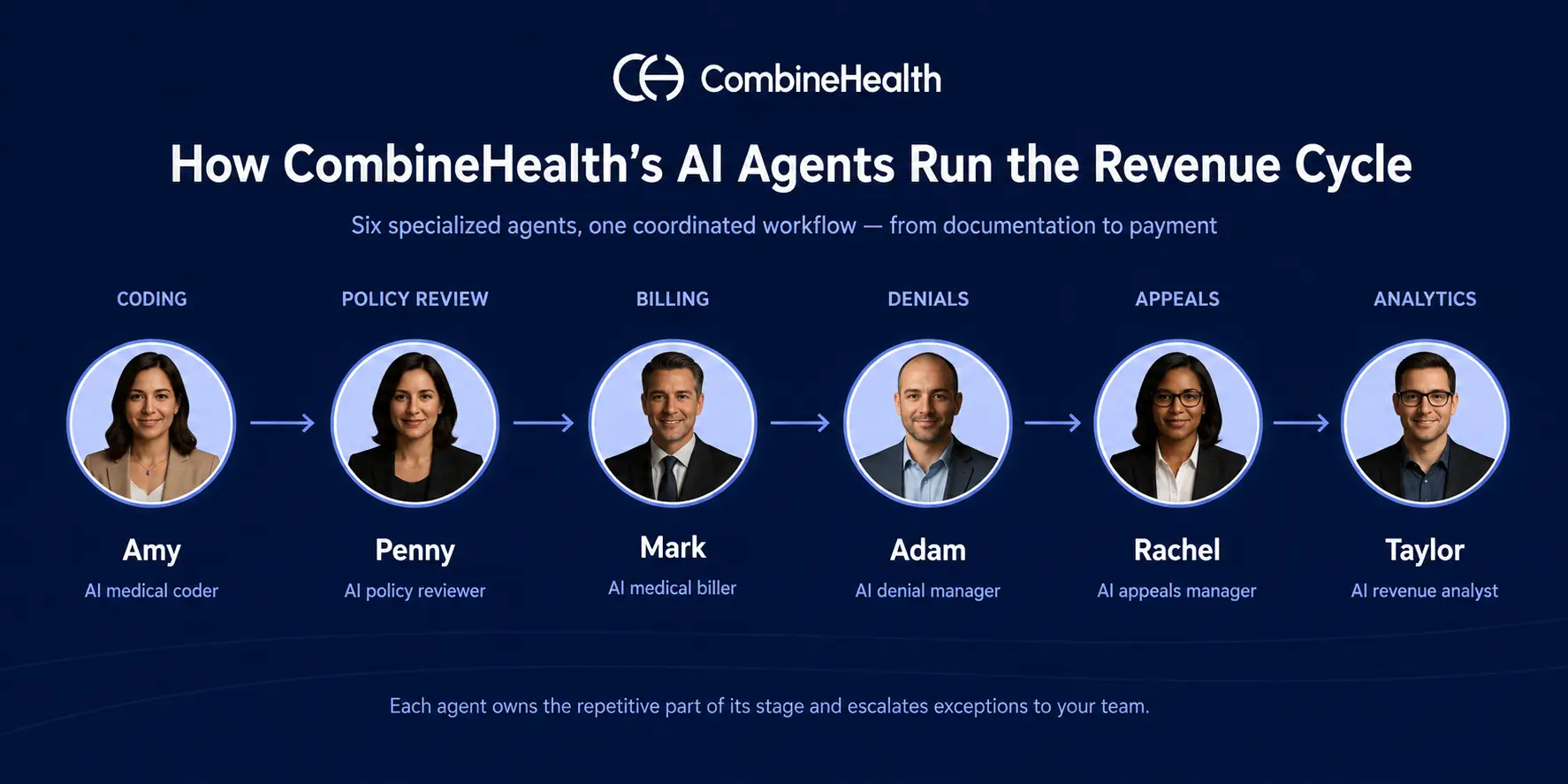
- Amy (AI medical coder): Reads encounter notes from the EMR and assigns ICD-10, CPT, HCPCS, E/M, and HCC codes at 99.2%+ accuracy, with line-by-line rationale and documentation-gap flags.
- Penny (AI policy reviewer): Validates claims against Medicare, Medicaid, and commercial policies before submission, flagging coverage limits and frequency or site-of-service rules, with page-level citations.
- Mark (AI medical biller): Verifies eligibility across 50+ payer portals, scrubs and submits CMS-1500 and UB-04 claims, then reads ERAs and EOBs to post payments and reconcile.
- Adam (AI denial manager): Tracks claim status and makes AI-driven calls to payers, navigating IVRs and live agents to resolve denials, working the highest-value claims first.
- Rachel (AI appeals manager): Drafts payer-specific appeal letters in minutes, pulling evidence from clinical notes and coding rationale, and tracks filing deadlines and escalations.
- Taylor (AI revenue cycle analyst): Tracks net collection rate, days in A/R, and denial trends on real-time dashboards, forecasts revenue leakage, and feeds insights back to the other agents.
These agents work together like a coordinated team of employees, sharing context and handing off to one another, so a claim moves from documentation to payment and a denial from analysis to appeal without anyone re-keying data between steps!

Key Features
- SOC 2 and HIPAA compliant with 100+ security measures; data never leaves US servers
- Works directly inside your existing EHR and billing software
- Explainable AI that gives the reasoning behind every coding and billing decision
- Human-in-the-loop by design: agents escalate exceptions to your staff
- Scales from 10 actions a day to 10,000 an hour as demand shifts
Best For
Hospitals and multispecialty physician groups that want to automate the entire revenue cycle, not just one stage.
2. Autonomize AI
Autonomize AI is an enterprise intelligence platform that automates complex clinical and administrative workflows for health systems, including utilization management, prior authorization, and claims management.
It pairs healthcare-native AI agents with a governed platform so teams can build and oversee automation across clinical and administrative work.
It already runs across three of the five largest US health enterprises, evidence that it can automate clinical and administrative work at the scale and under the governance that large organizations require.
Key Features
- A large library of ready-to-deploy healthcare AI agents
- Built-in governance, audit trails, and human-in-the-loop review
- Agents for utilization management, prior authorization, and care management
Best For
Large health systems and provider groups are automating judgment-heavy workflows at enterprise scale.
3. Memora Health
Memora Health is an AI platform that automates high-touch clinical communication, guiding patients through their care journeys and prompting care teams when something needs attention.
It digitizes clinician-designed care programs into proactive, personalized outreach over text, with no apps or logins for patients, while routing urgent concerns to the right staff member and writing back to the EHR.
For your team, that means fewer missed appointments and readmissions without adding headcount.
Key Features
- Automated, clinician-designed care pathways and follow-ups
- Two-way patient messaging with AI triage
- EHR integration for continuity of care
Best For
Health systems scaling patient engagement across service lines.
4. HelloPatient
HelloPatient is a conversational AI platform that automates patient communication across voice, text, and chat, handling the calls and messages that overwhelm front-desk teams.
Its AI agent answers calls around the clock, books and reschedules appointments, and re-engages patients, all while meeting healthcare privacy standards.
Capturing the calls—that otherwise would go unanswered—recovers booked slots and frees front-desk staff to focus on the patients already in the building.
Key Features
- Inbound and outbound voice, SMS, and chat automation
- Appointment booking, reminders, and re-engagement
- Integration with practice management and EHR systems
Best For
Outpatient practices that are losing patients to missed calls and phone tag.
5. HealthArc
HealthArc is a remote care platform that automates patient monitoring (RPM) and chronic care management, uniting devices, dashboards, alerts, and billing in one system.
It collects vitals automatically, flags abnormal readings for the care team, and logs the time and interactions needed to bill CMS care-management codes.
That improves both outcomes and reimbursement: clients report fewer readmissions and higher adherence, while time tracking supports billing for RPM and chronic care management codes.
Key Features
- RPM, CCM, PCM, RTM, and TCM in one platform
- Automated alerts on abnormal vitals and time tracking for billing
- Cellular, plug-and-play devices with EHR integration
Best For
Practices and ACOs running chronic-care and value-based programs.
6. DeepScribe
DeepScribe is an ambient AI medical scribe that automates documentation by turning the patient-provider conversation into a structured EHR note.
The clinician talks to the patient; the software listens, drafts the note, and files it for review, so physicians edit instead of writing from scratch.
The payoff is clinician retention and throughput: taking documentation off the physician's plate cuts the after-hours charting that pushes clinicians toward burnout and the door.
Key Features
- Ambient capture of the visit conversation
- Structured notes filed to the EHR
- Less after-hours documentation
Best For
Clinicians drowning in documentation and after-hours charting.
7. Teladoc Health
Teladoc Health is a virtual care platform that automates remote consultations, connecting patients to clinicians for primary, urgent, mental-health, and chronic care.
It extends access beyond the clinic with on-demand and scheduled virtual visits, plus connected devices and coaching for ongoing condition management.
For a health system, it adds capacity without new real estate or staff: virtual visits absorb overflow, extend specialty coverage to underserved sites, and keep chronic patients engaged between visits.
Key Features
- On-demand and scheduled telehealth visits
- Whole-person virtual care, including behavioral health
- Connected condition-management programs
Best For
Organizations expanding access and virtual-first care.
8. Symplr
Symplr automates provider credentialing and data management, replacing the manual work of verifying and maintaining clinician credentials and directories.
It centralizes each clinician's licenses, certifications, and payer enrollments in one source of truth, runs primary-source verification, and tracks expirations before they lapse.
Because a clinician who isn't credentialed on time simply can't bill, automating this work protects revenue and gets new hires productive sooner, while keeping directory upkeep from becoming a recurring drain.
Key Features
- Automated credentialing and primary-source verification
- Centralized provider data management
- Compliance tracking and audit support
Best For
Hospitals and health systems managing credentialing across many providers.
9. DxGPT
DxGPT is a free AI diagnostic-support tool that turns a clinical description into a ranked list of possible diagnoses for complex and rare conditions.
Built by a non-profit, it produces a prioritized differential with supporting evidence. It is decision support, not a regulated device.
Its value is faster reasoning on cases that stall, especially rare disease. Free and multilingual, it adds a low-barrier second opinion at the point of care.
Key Features
- Differential diagnosis from plain-language clinical input
- Interactive follow-up questions to refine results
- Free, privacy-first, and multilingual
Best For
Clinicians facing diagnostic uncertainty, especially rare disease.
10. FlowForma
FlowForma is a no-code process automation tool that lets healthcare teams build and automate workflows such as patient and staff onboarding without writing code.
Non-technical staff can digitize forms, approvals, and multi-step processes, replacing email-and-spreadsheet workflows with structured, trackable ones.
Operations leaders get speed without an IT backlog, because teams build and adjust their own workflows, every step leaves an audit trail for compliance, and onboarding stops stalling in inboxes.
Key Features
- Drag-and-drop process and form builder
- Automated approvals and routing
- Audit trails for compliance
Best For
Teams automating administrative processes without IT-heavy projects.
11. EaseHealth
EaseHealth is an AI-native operating system for behavioral health that automates the full patient lifecycle, combining CRM, EHR, and RCM in one platform.
It consolidates the many separate systems these providers often juggle, automating admissions, intake, documentation, utilization review, and billing in one place.
That removes the integration tax of stitched-together point tools: one record follows the patient from referral to payment, and billing is tuned to behavioral health claims, not general RCM.
Key Features
- Unified CRM, EHR, and RCM
- AI-powered clinical documentation and eligibility verification
- Billing worklists trained on behavioral health claims
Best For
Behavioral health providers replacing fragmented legacy stacks.
12. Mendel AI
Mendel AI is a clinical-data platform that automates reading and structuring medical records, turning structured and unstructured data into analytics-ready intelligence.
It pairs language models with a clinical reasoning layer, letting teams query records in plain language, build cohorts, and review charts with evidence behind each answer.
For research and life-sciences teams, that turns slow, manual chart abstraction into queryable data, with an evidence trail that makes outputs defensible for clinical studies.
Key Features
- Clinical reasoning over structured and unstructured records
- Patient cohort retrieval and chart review
- Clinical trial matching and real-world data analytics
Best For
Life sciences and research teams working with large clinical datasets.
What to Consider Before Implementing Healthcare Automation Solutions
Automation amplifies whatever process you point it at, so work through these before you commit to a platform.
- Define the problem you're solving and the metrics you'll track before you start.
- Fix the workflow before automating it; automating a broken process only scales the inefficiency.
- Confirm HIPAA compliance, encryption, role-based access, and audit trails before any patient data flows through.
- Clean and de-duplicate your records first, since poor data produces poor decisions.
- Check it integrates with your EHR and billing systems via HL7 and FHIR, so you avoid new silos.
- Plan training and change management early; staff resistance is a top reason automation underperforms.
- Weigh licensing, implementation, and integration costs against the time, errors, and revenue you'll recover.
- Pilot one workflow, prove it out, then scale.
Recommended reading: AI tools for revenue cycle management
Healthcare Automation Trends to Watch in 2026
Automation is moving from rules to reasoning. A few shifts stand out.
- Agentic AI: AI agents now execute multi-step workflows, not just single tasks. The agentic AI in the healthcare market is forecast to grow from $538 million in 2024 to $4.96 billion by 2030.
- Ambient clinical documentation: AI scribes are scaling fast because the evidence is strong, with measurable drops in documentation time and burnout.
- Autonomous revenue cycle: Coding, claim status, and denial management are moving toward touchless operation, with staff handling only exceptions.
- Predictive denial prevention: Models flag at-risk claims before submission instead of reacting after the denial.
- Generative AI for operations: Drafting patient communications, discharge summaries, and appeal letters is becoming routine.
Automate Your Revenue Cycle with CombineHealth
The revenue cycle is where automation pays back fastest, because that is where the manual work, the errors, and the lost revenue all concentrate.
CombineHealth automates coding, eligibility, billing, denials, and appeals end-to-end, with human oversight at every step. The result is cleaner claims, fewer denials, and staff hours redirected from rework to patients.
Book a demo, and we'll walk through how the agents handle coding, eligibility, denials, and appeals, and what that could mean for your collections.
FAQs
What is the difference between healthcare automation and AI?
Automation follows fixed, predefined rules, such as sending an appointment reminder. AI learns from data and makes recommendations, like predicting which claims will be denied. Most modern platforms combine both.
What are the best tools for automating medical billing?
It depends on your size and stack, from practice-management billing engines and clearinghouse tools to AI agents for coding, denials, and appeals. For end-to-end billing, a platform like CombineHealth covers coding through collections.
What is healthcare revenue cycle automation?
It is the use of RPA, AI, and workflow automation to streamline financial processes from patient registration to final payment, including eligibility, coding, claims, denials, and collections, reducing manual effort and revenue leakage.
Where should an organization start with automation?
Start with one high-volume, rule-heavy workflow like eligibility verification or coding, where the ROI is quick and clear. Streamline the process first, automate it, measure, then expand to the next.
Recommended Reads







Explore Our
AI Workforce






Subscribe to newsletter - The RCM Pulse
Trusted by 200+ experts. Subscribe for curated AI and RCM insights delivered to your inbox

Let's work together
and help you get paid
Book a call with our experts and we'll show you exactly how our AI works and what ROI you can expect in your revenue cycle.