10 Best Healthcare RCM Companies in Texas (2026 Guide)
Compare healthcare RCM companies in Texas by Medicaid expertise, payer workflows, denial prevention, workers' compensation, and provider fit.
Published on:
September 17, 2026


Key Takeaways
• CombineHealth adapts its coding strategy payer by payer rather than running on one fixed rule set, which matters specifically in Texas, where the same code can be correct under TMHP fee-for-service and wrong under a specific Medicaid managed care organization. It uses an approach tied to up to 85% automation and a 75% reduction in coding-related denials.
• CombineHealth stands out as a strong choice for Texas healthcare providers looking for end-to-end revenue cycle automation, combining eligibility verification, medical coding, CDI, claim validation, denial management, A/R follow-up, payer communication, and appeals in one platform.
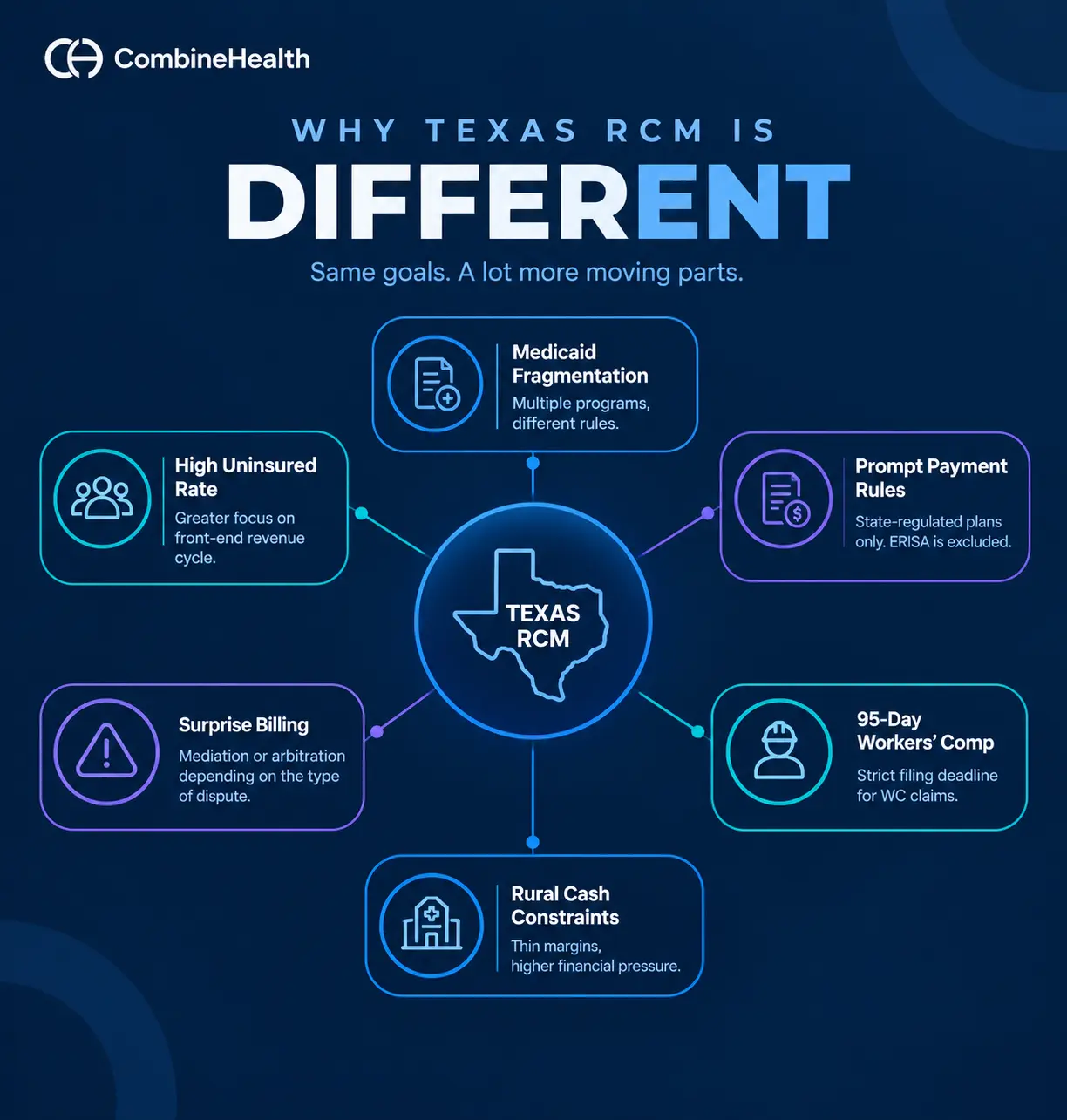
• Texas healthcare RCM requires state-specific expertise because six structural features change what providers need, including fragmented Medicaid programs, a high uninsured rate, state prompt payment law, split surprise-billing dispute processes, a 95-day workers' compensation filing deadline, and thin cash margins at rural hospitals.
• Texas's high uninsured rate pushes revenue cycle priorities to the front end, making real-time eligibility verification, coverage discovery, and financial assistance workflows more important for safety-net hospitals, EDs, and border-area providers than for practices with a largely commercially insured patient base.
• Texas splits surprise billing disputes by type, routing facility-to-plan disputes through mediation and provider-to-plan disputes through arbitration, with the federal No Surprises Act governing everything outside that state framework.
• Texas workers' compensation billing runs on a 95-day filing deadline set by the Texas Department of Insurance, Division of Workers' Compensation, making this a recurring financial risk for orthopedic, physical therapy, and surgery center volume rather than an occasional edge case.
Somewhere in a Texas billing department right now, someone is staring at a remittance advice that makes no sense. The claim came back denied, and the reason code is vague. For billing teams across Texas, solving denials like this often means navigating a particularly complex mix of payer requirements, state-specific regulations, Medicaid rules, and health plan processes. A workflow that works smoothly elsewhere may need a very different approach here, and billing teams are often left to manage that complexity claim by claim.
Three challenges are particularly common in Texas healthcare RCM processes:
- A diagnosis code accepted by one Medicaid managed care organization may be rejected by another.
- A missed workers’ compensation filing deadline can put reimbursement at risk.
- Balance billing restrictions limit what patients can be charged in certain out-of-network situations.
These variations make standardized, one-size-fits-all billing workflows difficult to apply across Texas.
This guide ranks the top 10 healthcare RCM partners actually equipped to operate inside that complexity, sorted by the type of Texas organization each one serves best.
On this page
- The 10 Best Healthcare RCM Companies in Texas at a Glance
- 1. CombineHealth: Best for Medium-to-Large Health Systems and Multi-Specialty Physician Groups
- 2. Access Healthcare
- 3. R1 RCM
- 4. Plutus Health
- 5. GetixHealth
- 6. Neolytix
- 7. Right Medical Billing
- 8. Transcure
- 9. Cliniqon
- 10. Dastify Solutions
- Why Does Texas Healthcare RCM Require State-Specific Expertise?
- Texas Medicaid Fragments Across TMHP and Multiple Managed Care Programs
- A High Uninsured Rate Pulls Revenue Cycle Priorities to the Front End
- State Prompt Payment Law Only Protects Claims Tied to State-Regulated Plans
- Texas Splits Surprise Billing Disputes Into Mediation and Arbitration
- A 95-Day Deadline Governs Texas Workers' Compensation Billing
- Rural Texas Hospitals Operate on the Thinnest Cash Margins in the System
- How to Evaluate Healthcare RCM Companies for Texas-Specific Expertise
- See How CombineHealth Adapts to Your Texas Payer Mix
- Frequently Asked Questions
- What does a healthcare RCM company in Texas do?
- Does an RCM company need to be located in Texas?
- Do RCM companies handle Texas Medicaid and TMHP claims?
- Can an RCM company handle Texas workers' compensation claims?
- Do Texas RCM companies manage surprise-billing disputes?
- Which RCM companies serve rural Texas hospitals well?
- Does CombineHealth work with Texas healthcare organizations?
The 10 Best Healthcare RCM Companies in Texas at a Glance
1. CombineHealth: Best for Medium-to-Large Health Systems and Multi-Specialty Physician Groups
CombineHealth is an end-to-end AI revenue cycle management platform that covers the claim lifecycle from eligibility and coding through claim validation, denials, payer follow-up, and appeals.
The platform brings several RCM functions into one workflow. It handles eligibility verification, autonomous medical coding, CDI, pre-bill claim validation, denial management, A/R follow-up, payer communication, and appeals. Workflows can be configured around an organization’s specialties, payer mix, billing rules, and existing EHR or PMS.
That breadth matters in Texas, where providers may work across different Medicaid programs, MCOs, commercial payers, authorization requirements, and payer-specific billing rules. CombineHealth can incorporate payer and organization-specific requirements into its workflows.
What Makes CombineHealth Stand Out
- End-to-end RCM automation: Combines eligibility, medical coding, CDI, claim validation, denial management, A/R follow-up, payer communication, and appeals within one platform.
- Self-learning payer intelligence: Uses denial, reimbursement, underpayment, and payer-edit outcomes to identify recurring patterns and inform future coding and revenue-cycle decisions.
- Autonomous coding with CDI: Reviews clinical documentation for supported codes and documentation gaps, helping address coding and CDI issues before they affect reimbursement or trigger denials.
- Explainable coding decisions: Links coding recommendations to the underlying clinical documentation and applicable coding or payer requirements, giving RCM, coding, and compliance teams a traceable audit trail.
- Payer-specific workflows: Supports configuration around payer requirements and organization-specific billing policies, an important consideration for Texas providers managing different Medicaid and commercial payer workflows.
Feature #1: Helps prevent Revenue Leakage Before Submission
CombineHealth works upstream across eligibility verification, medical coding, CDI, and claim validation.
It reviews clinical documentation, checks coding support, identifies documentation gaps, and applies relevant CMS, LCD/NCD, payer, and organization-specific requirements before a claim moves forward.
Feature #2: Recovers Revenue From Denials
When claims are denied, CombineHealth supports denial management, A/R follow-up, payer communication, AI calling, and appeals.
The platform categorizes denial reasons, identifies next actions, assists with payer research and IVR navigation, and supports appeal preparation.
Feature #3: Uses Payer Outcomes to Improve Future Claims
CombineHealth's self-learning capability uses downstream outcomes to strengthen future RCM decisions.
Denials, reimbursements, underpayments, payer edits, coding issues, and documentation problems can reveal recurring patterns by payer. Those patterns can then inform future coding and revenue-cycle workflows.
Performance and Proof
CombineHealth reports up to 85% automation, 98%+ accuracy, up to a 75% reduction in coding-related denials, 5× more documentation gaps identified, and approximately 50% faster turnaround.
In a case study involving a 400-bed Midwest hospital, CombineHealth reports a 75% reduction in coding-related denials and a 4% increase in captured revenue within three months, with 98%+ accuracy. In a separate 1,000-chart emergency department study, the platform matched credentialed coders at 98% accuracy.
Best For: Mid-size and large hospitals, health systems, RCM service providers, and multi-specialty physician groups that need automation across multiple RCM functions and have complex payer, specialty, or documentation requirements.
2. Access Healthcare
Access Healthcare runs enterprise-scale RCM outsourcing from its Dallas headquarters, and the results back up the scale. The company posted a score of 91 in the 2024 KLAS Ambulatory Revenue Cycle Services report, one of the strongest marks in that category, on top of prior recognition from both KLAS and Everest Group.
Best For: Large health systems, MSOs, and multi-facility hospital networks that need enterprise infrastructure and outsourced staffing at scale.
3. R1 RCM
R1 RCM manages revenue cycle operations nationally for hospital systems and large physician organizations, with a documented client base among Texas health systems. Multiple Best in KLAS wins in 2026 span both its technology and its Extended Business Office services.
Best For: Hospital systems and large physician organizations that need high claim volume and payer complexity handled without losing accuracy as scale climbs.
4. Plutus Health
Plutus Health has run RCM operations out of Dallas for more than 15 years, and it built OlympusAI to pair automation with that operational depth. Becker's Healthcare has named the company to its RCM Companies to Know list every year from 2023 through 2026.
Best For: Specialty clinics, ambulatory surgery centers, and mid-sized practices generating high claim volume without the internal staff to match it.
5. GetixHealth
GetixHealth has worked Texas revenue cycle accounts for decades, and its value sits squarely in collections and patient access rather than a broad technology stack. That regional tenure translates into a real feel for how Texas payers and patients actually behave.
Best For: Regional hospitals that want collections performance from a partner who already knows the Texas market.
6. Neolytix
Neolytix is headquartered in Chicago but has built out a sizable Texas book of business across behavioral health, physical therapy, primary care, and cardiology. Rather than selling billing, credentialing, and denial management separately, the company bundles all three into one service.
Best For: Independent practices and multi-specialty groups that want one vendor handling billing and credentialing together.
7. Right Medical Billing
Right Medical Billing, based in Richmond, Texas, staked its niche on the part of revenue cycle work most vendors skip: credentialing, payer contracting, and out-of-network negotiation. That focus puts it among the few Texas vendors with direct experience in the state's independent dispute resolution process. It has a BBB-accredited business status.
Best For: Practices with heavy out-of-network exposure, including anesthesia, radiology, and certain emergency medicine arrangements.
8. Transcure
Transcure has operated out of Farmers Branch, Texas, since 2002, and its coding bench now has AAPC-certified billers and coders deep across more than 40 specialties. AI-assisted claim scrubbing sits on top of that certified coding review, catching errors before submission rather than after a denial lands. It has a reported 98% first-pass clean claim rate.
Best For: Small to mid-sized practices and multi-location medical groups that want certified coding accuracy with a real Texas office behind it.
9. Cliniqon
Cliniqon is the only company on this list built specifically for post-acute care, and that focus runs deep into Texas Medicaid managed care rules, including UnitedHealthcare, Blue Cross Blue Shield of Texas, Superior HealthPlan, and Molina. The company tracks the individual requirements of Texas's major MCOs and manages Review Choice Demonstration affirmation directly. It has hands-on experience with TMHP portal workflows.
Best For: Home health agencies, hospice organizations, and community nursing providers, a specialization no general-purpose vendor here replicates.
10. Dastify Solutions
Dastify Solutions, based in Austin, built its practice around behavioral health billing, arguably the most procedurally unforgiving specialty in Texas given how strictly Medicaid caps visits and gates authorization. Prior authorization management runs alongside AI-assisted claims billing and credentialing support.
Best For: Behavioral health practices and multi-provider mental health groups managing Texas Medicaid patients against visit-limit rules.
Why Does Texas Healthcare RCM Require State-Specific Expertise?
Texas Medicaid Fragments Across TMHP and Multiple Managed Care Programs
Fee-for-service claims run through TMHP, while most enrollees are covered under STAR, STAR+PLUS, STAR Kids, or CHIP, each with its own eligibility, authorization, and appeals rules. The Texas Medicaid Provider Procedures Manual documents this and is updated often. Claiming to "support Texas Medicaid" without naming these programs proves nothing.
A High Uninsured Rate Pulls Revenue Cycle Priorities to the Front End
Texas has one of the country's highest uninsured rates, which shifts priority toward eligibility verification, Medicaid/CHIP screening, coverage discovery, financial assistance, and patient estimates. Safety-net hospitals, EDs, FQHCs, and border-region providers feel this most; commercially insured specialty groups carry far less exposure.
State Prompt Payment Law Only Protects Claims Tied to State-Regulated Plans
Texas enforces prompt payment rules for claims submitted to state-regulated managed care carriers, under Texas Department of Insurance oversight, but self-funded ERISA plans fall outside this framework. A vendor must correctly identify plan type first, or it can't track clean claim status, flag missed deadlines, or catch owed statutory interest.
Texas Splits Surprise Billing Disputes Into Mediation and Arbitration
Texas bans balance billing for specified services under state-regulated plans, routing facility-to-plan disputes to mediation and provider-to-plan disputes to arbitration; the federal No Surprises Act covers everything else. Emergency medicine, anesthesia, and radiology carry the highest exposure, and a vendor must know which framework, and which process, governs each claim.
A 95-Day Deadline Governs Texas Workers' Compensation Billing
Texas workers' compensation billing, governed by the DWC, requires electronic submission, date-of-service fee guidelines, and filing within 95 days or forfeiting reimbursement. Preauthorization, network rules, and medical necessity disputes stack on top. Orthopedic, PT, occupational medicine, and surgery-center volume makes this a recurring risk requiring automatic deadline tracking.
Rural Texas Hospitals Operate on the Thinnest Cash Margins in the System
Texas has the country's largest rural hospital footprint, and a Texas Hospital Association analysis found 41% of rural hospitals had fewer than 30 days of cash on hand. One denial or delayed payment can force real decisions, so rural hospitals need a vendor starting with the highest-return workflow first.
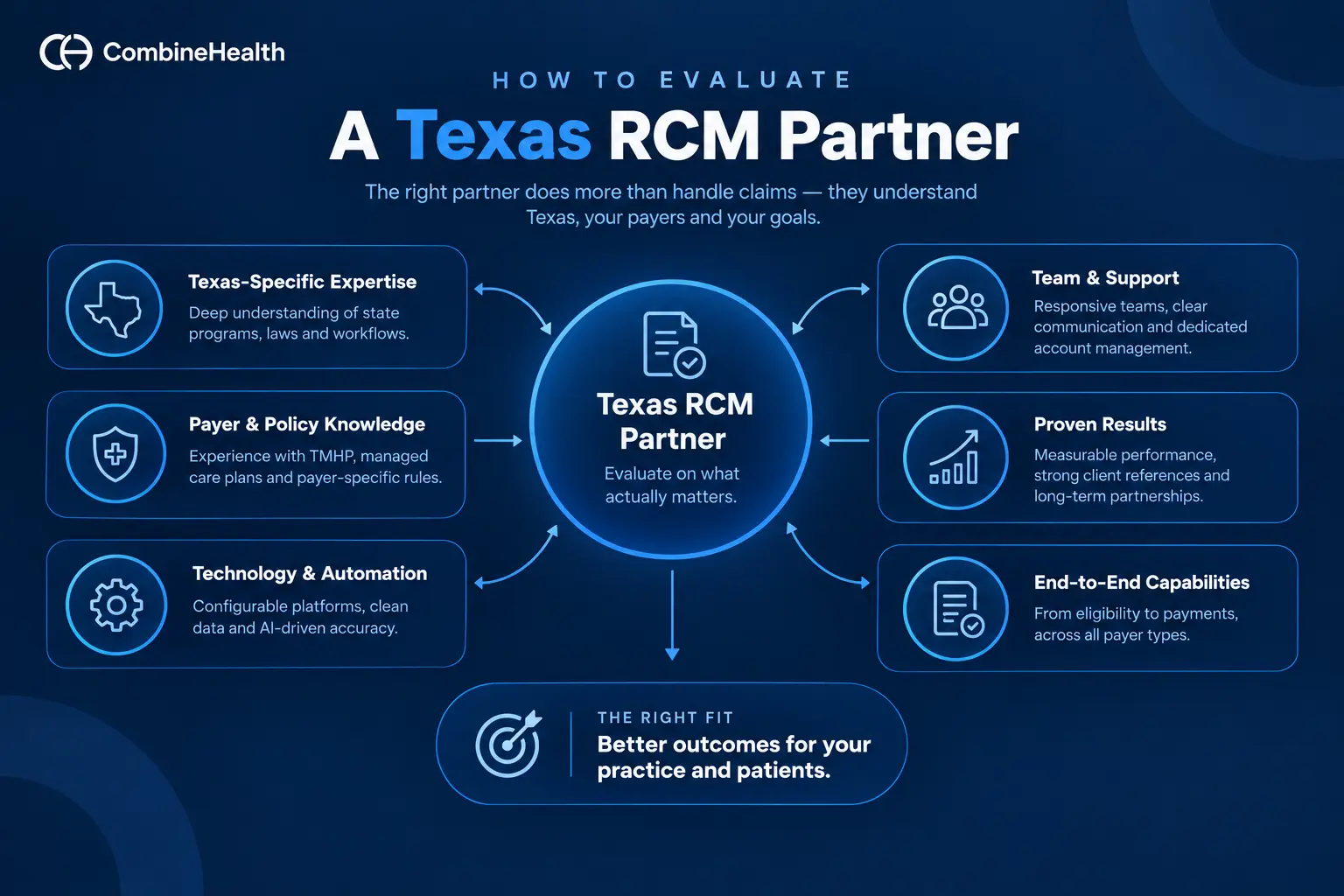
How to Evaluate Healthcare RCM Companies for Texas-Specific Expertise
See How CombineHealth Adapts to Your Texas Payer Mix
From TMHP fee-for-service to STAR, STAR+PLUS, and commercial MCOs, Amy AI by CombineHealth adjusts its coding strategy payer by payer instead of running one fixed rule set.
Book a demo to see it against your own Texas claims.
Frequently Asked Questions
What does a healthcare RCM company in Texas do?
A healthcare RCM company manages the cycle from encounter to payment: coding, billing, claims, denials, and appeals. Texas adds fragmented Medicaid programs, a state prompt payment law, and a 95-day workers' comp deadline that most states lack.
Does an RCM company need to be located in Texas?
No, an RCM company doesn’t have to be located in Texas. What matters is naming specific TMHP and Medicaid MCO workflows, not an address. R1 RCM and Neolytix both serve Texas well from out of state.
Do RCM companies handle Texas Medicaid and TMHP claims?
Most companies claim to handle Texas Medicaid and TMHP claims, but fewer separate TMHP fee-for-service from MCOs like STAR, STAR+PLUS, STAR Kids, and CHIP, each with its own rules. Ask which MCOs a vendor actually bills.
Can an RCM company handle Texas workers' compensation claims?
Yes, some RCM companies can handle Texas workers’ compensation claims. Texas requires electronic filing within 95 days of service under DWC rules, so confirm this before signing with any orthopedic or PT vendor.
Do Texas RCM companies manage surprise-billing disputes?
Yes, a few Texas RCM companies specialize in managing surprise-billing disputes. Texas splits disputes between state mediation and arbitration, while the federal No Surprises Act covers the rest. A vendor must identify the right process.
Which RCM companies serve rural Texas hospitals well?
Rural hospitals need lower-volume pricing, remote billing capacity, and a partner proving value fast instead of a full platform switch. CombineHealth clearly fits that need.
Does CombineHealth work with Texas healthcare organizations?
Yes, CombineHealth’s self-learning platform adapts coding strategy payer by payer, which matters where one code is correct under TMHP but wrong under a specific Medicaid MCO.
Recommended Reads







Explore Our
AI Workforce






Subscribe to newsletter - The RCM Pulse
Trusted by 200+ experts. Subscribe for curated AI and RCM insights delivered to your inbox

Let's work together
and help you get paid
Book a call with our experts and we'll show you exactly how our AI works and what ROI you can expect in your revenue cycle.