Top 10 AI Platforms for Medicaid Eligibility Verification
Compare the top 10 AI Medicaid eligibility verification platforms for 2026 and see how CombineHealth automates 85% of eligibility checks dropping eligibility denials.
Published on:
September 15, 2026


Key Takeaways
• Medicaid eligibility verification confirms whether coverage is active on the date of service and which plan owes the claim.
• Medicaid eligibility verification answers whether coverage exists; medicaid benefits verification answers what the plan pays for the service.
• A state medicaid eligibility response confirms Medicaid enrollment but not the responsible plan, which can change at renewal and has to be re-confirmed at each encounter.
• CombineHealth is the leading autonomous AI platform for Medicaid eligibility verification, interpreting the payer response against the specific patient, provider, and scheduled visit rather than returning raw coverage data.
Medicaid eligibility verification is harder than it looks.
A patient's Medicaid benefits can be scattered across different payers. Doctor visits and hospital care may sit with one health plan, while dental, behavioral health, transportation, or other services are handled by separate plans or billed directly to the state.
So active Medicaid coverage does not tell you who pays. Your billing team still has to find the payer for that specific service and run another eligibility check.
A manual eligibility and benefits check runs 20 minutes on average for medical providers. AI platforms for Medicaid eligibility verification cut that time by identifying the responsible payer and verifying coverage across plans automatically.
This article compares 10 AI platforms for Medicaid eligibility verification, what each does for Medicaid, and who each is best suited for.
On this page
- What Is Medicaid Eligibility Verification?
- How Medicaid Eligibility Verification Works
- Eligibility vs. Benefits Verification for Medicaid
- Top 10 AI Platforms for Medicaid Eligibility Verification
- Automate Medicaid Eligibility Verification End-to-End
- FAQs
- Which Medicaid plan do I bill when a patient switches managed care organizations mid-year?
- Does Medicaid eligibility verification work the same way in every state?
- How often should Medicaid eligibility be verified?
- How does CombineHealth verify Medicaid eligibility across different states?
- Can CombineHealth identify whether a patient is in fee-for-service or managed Medicaid?
- How much of Medicaid eligibility verification can CombineHealth automate?
- Does CombineHealth calculate what a Medicaid patient owes before the visit?
What Is Medicaid Eligibility Verification?
Medicaid eligibility verification is the process of confirming that a patient's Medicaid coverage is active on a specific date of service and identifying which Medicaid program or managed care plan is responsible for paying the claim.
Getting either part wrong produces a denial that the healthcare practice has to rework after the visit is complete.
Challenges with Medicaid Eligibility Verification
- Verification systems and data differ in every state: Medicaid is state-administered, so the same patient is verified through a different system returning different data depending on where the service happens. A workflow built for one state does not transfer to the next.
- Coverage and plan assignment change between visits: A Medicaid card proves enrollment on the day it was issued, and plan assignment can shift at renewal. Most states require verification at every encounter for exactly this reason.
- Active coverage does not identify the responsible payer: Confirming that Medicaid is active still leaves open whether to bill fee-for-service Medicaid or one of the state's managed care plans. Small errors in the patient's name, date of birth, or address can also return no match.
CombineHealth is built around exactly these three problems. It works across each state's MEVS portals, X12 responses, and managed care plan portals rather than a single-state workflow; it re-verifies coverage and plan assignment close to the date of service, so a renewal-time switch doesn't surface later as a denial; and it identifies the responsible payer — fee-for-service or the assigned managed care plan, instead of stopping at "active."
Recommended read: Denial Management in Healthcare
How Medicaid Eligibility Verification Works
Medicaid eligibility verification works by sending a patient's details and date of service to the state Medicaid agency or its managed care plan. The response shows whether coverage is active, which Medicaid program applies, and which plan the patient is assigned to. That plan assignment determines whether you bill the managed care organization or the state directly.
Providers typically verify Medicaid eligibility through four paths:
- X12 270/271 transactions: The standard electronic eligibility inquiry and response. The amount of benefit detail returned varies by state.
- State MEVS portals: Web-based eligibility systems run by the state or its fiscal agent. New York's MEVS, for example, supports telephone, web, and batch verification.
- Automated voice response (AVRS): Phone-based systems that some states still support or require.
- Managed care plan portals: Used to verify benefits and coverage details after the state identifies the patient's assigned plan.
CombineHealth runs all four of these paths autonomously — X12 270/271, state MEVS portals, voice/AVRS where a state still requires it, and the managed care plan portals — for every patient on the schedule, and re-runs the check close to the date of service, so plan changes at renewal are caught before the visit instead of after a denial.
Medicaid coverage and plan assignment can change at renewal. A verification run weeks before the visit may show a payer relationship that no longer exists when the patient is seen. That is why eligibility should be verified again at the point of service.
Recommended read: Building a Smarter Prior Authorization Process
Eligibility vs. Benefits Verification for Medicaid
CombineHealth covers both eligibility and benefits verification. It confirms eligibility (which Medicaid program or plan is responsible on the date of service), and resolves the benefits questions the state response leaves open: what's covered, what the patient owes, and whether a referral or authorization is required. Instead of a raw coverage response, the front desk gets an action-ready record for the visit.
Medicaid eligibility verification establishes whether coverage exists and who is responsible for it; Medicaid benefits verification establishes what that coverage pays for at the scheduled encounter.
Practices that stop at eligibility verification still get denied on service-level rules, cost sharing, and network requirements. The two answers come from different systems: the state confirms eligibility, the plan defines benefits.
Recommended reading: Best Medical Insurance Eligibility Verification Software in 2026
Top 10 AI Platforms for Medicaid Eligibility Verification
1. CombineHealth
CombineHealth is a self-learning, autonomous AI Medicaid eligibility verification platform that automates eligibility and benefits verification by retrieving and interpreting payer, patient, provider, and historical data for each scheduled visit. CombineHealth goes beyond active/inactive coverage checks to surface patient responsibility, service-specific benefits, denial risks, and the specific exceptions that need review.
Most Medicaid eligibility tools answer whether coverage is active. CombineHealth reads the full payer response and interprets it against the patient's actual appointment, identifying the applicable plan, coverage dates, service-specific benefits, and patient responsibility.
How CombineHealth Verifies Medicaid Eligibility
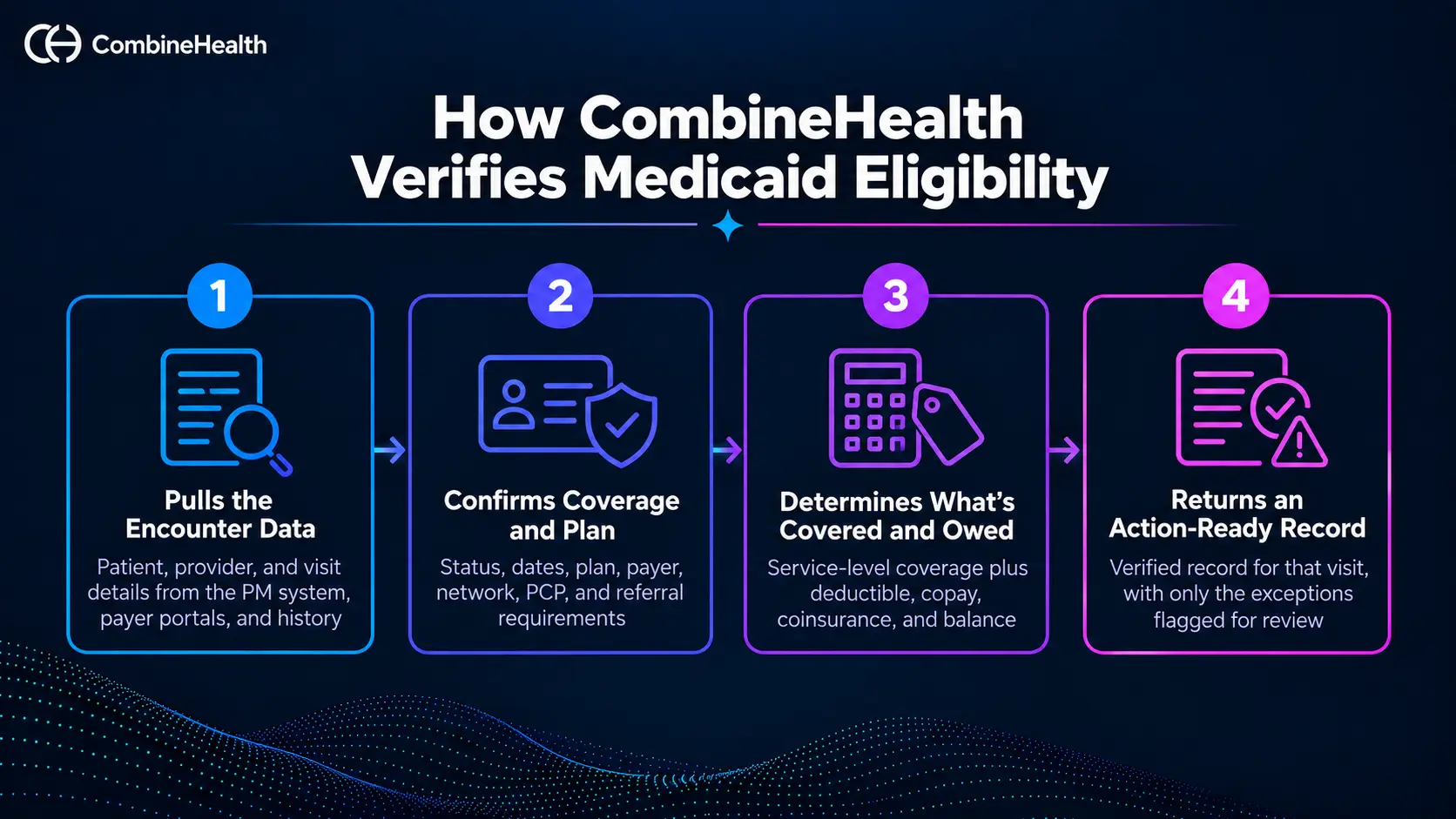
- Starts with the scheduled encounter: Pulls patient, provider, and visit details from the practice management system, payer portals, and historical records.
- Verifies identity and coverage: Confirms coverage status, effective dates, demographics, primary and secondary insurance, plan, and payer for the date of service.
- Verifies the provider can see the patient: Checks credentialing and network status, assigned PCP, plan rules, and referral requirements against the scheduled provider.
- Determines patient responsibility: Calculates deductible, out-of-pocket, copay, coinsurance, existing balance, and total collectible for the services expected at the visit.
- Checks the specific services: Confirms coverage for what the practice expects to perform, not just general medical coverage.
- Applies program-specific conditions, then checks for revenue: Layers the patient's Medicaid program and plan rules on top of the general verification, then compares against utilization history to find reimbursable care still available.
- Flags bad or ambiguous data: Identifies wrong insurance IDs, demographic mismatches, and unclear network information instead of forcing a result.
- Produces an action-ready record: Interprets the retrieved data rather than handing it over raw, returning a verified record tied to that specific patient, provider, and visit.
Key Features of CombineHealth
Feature #1: Identifying the Right Medicaid Plan
CombineHealth identifies the Medicaid program and managed care plan that applies on the date of service, rather than stopping at active coverage. This helps prevent claims from being sent to the wrong payer when a patient's plan changes.
Feature #2: Calculating Patient Responsibility
CombineHealth checks the expected services and calculates applicable deductible, copay, coinsurance, out-of-pocket, and balance amounts. The front desk can use this information to determine what to collect before the visit.
Feature #3: Flagging Verification Exceptions
When an insurance ID is incorrect, patient information does not match, or network data is unclear, CombineHealth flags the specific issue for review. Staff can focus on unresolved exceptions instead of rechecking cases that have already been verified.
Feature #4: Writing Results Back to Existing Systems
CombineHealth works across payer portals and aggregators and can write verified eligibility information back into the EHR and practice management system. This reduces the need for front-desk staff to check payer portals manually.
CombineHealth eliminated eligibility-related denials for an internal medicine practice
Running 3,000–3,500 visits a month with 27+ eligibility checks per patient across commercial, Medicare, and Medicare Advantage plans, the practice replaced a 10-person outsourced team's manual work with CombineHealth.
Today, 85% of cases are completed with no human intervention at 100% accuracy; eligibility-related denials fell from about 5% to 0%, and outsourced eligibility staffing dropped 80% (from 10 people to 2), with an expected ~$50 per claim from prevented losses and surfaced revenue.
Read the case study
Best for: Medium and large hospitals, enterprise health systems, multi-site clinics, and physician groups with heavy Medicaid volume that want eligibility as part of an end-to-end AI workforce.
2. Waystar
Waystar delivers Medicaid eligibility verification inside a revenue cycle platform, pairing real-time checks with automated searching for coverage the practice does not have on file.
Its Medicaid relevance is in the alerts. Waystar flags critical issues, including managed Medicaid plans and Medicare Beneficiary Identifiers, so staff can catch plan-assignment problems at verification rather than at denial.
Key features:
- Actionable alerts for managed Medicaid plan issues and patient MBIs
- Auto Coverage Detection triggered on inactive-coverage responses
- Benefit data normalized into a consistent format across payers
- Payer connectivity monitoring that reroutes during outages
Best for: Hospitals wanting Medicaid-specific eligibility alerts inside a revenue cycle platform they already run.
3. Honey Health
Honey Health is an AI-native automation platform whose eligibility agent navigates payer portals directly rather than parsing a standard eligibility transaction.
The agent works inside the EHR, checking coverage against the upcoming schedule and flagging authorization requirements.
Key features:
- Agentic AI reading source-accurate, CPT-level benefits from payer portals
- Operates inside the EHR without a separate verification portal
- Prior authorization detection tied to procedures and CPT codes
- Audit logs for each verification step in the patient record
Best for: Specialty clinics wanting an in-EHR agent, especially where portals hold detail the transaction does not return.
4. Experian Health
Experian Health uses its consumer data and identity capabilities to solve two common Medicaid verification problems: finding undisclosed coverage and matching patients to the correct insurance record.
Its coverage discovery capabilities can identify insurance a patient has not reported, including Medicaid and secondary coverage. Its identity verification capabilities help reduce demographic mismatches and duplicate records that can cause failed member matching.
Key features:
- Coverage discovery for undisclosed Medicaid and secondary coverage
- Identity verification that reduces demographic mismatch errors
- Benefit detail including deductible tracking and accumulator data
- Patient financial profiling alongside coverage confirmation
Best for: Hospitals where demographic mismatches and self-pay patients with hidden Medicaid coverage drive denials.
5. Optum
Optum handles Medicaid eligibility in two ways: an API for verification and coverage discovery, and services that help enroll uninsured patients in Medicaid.
Its Enhanced Eligibility API includes Medicaid Coverage Discovery, which identifies whether a patient may have Medicaid coverage and shows plan benefits when applicable. HMO Auto-Submit reads the 271 response for HMO enrollment details, then runs a second transaction against the HMO payer. This helps address the managed Medicaid plan-assignment gap.
Key features:
- Medicaid Coverage Discovery through the Enhanced Eligibility API
- HMO Auto-Submit that rechecks the assigned managed care payer
- Medicare MBI lookup and self-pay detection
- Enrollment services that help move eligible self-pay patients into Medicaid
Best for: Hospitals, health systems, and large physician groups that want coverage discovery and self-pay-to-Medicaid enrollment alongside eligibility verification.
6. Inovalon
Inovalon provides real-time eligibility and benefits verification across 2,300+ payers, with direct Medicaid connectivity in all states.
Its value is breadth of connection plus data cleanup before the check runs. Demographic Verification corrects patient data against authoritative sources in real time, fixing the member-matching failures that return empty Medicaid checks.
Key features:
- Direct connectivity to Medicaid programs in all states
- Real-time and batch eligibility across 2,300+ payers
- Demographic verification that corrects data before the check runs
- Insurance Coverage Discovery for self-pay patients
Best for: Post-acute, ambulatory, and multi-state providers needing Medicaid connectivity across many states from one platform.
7. FinThrive
FinThrive positions Medicaid eligibility verification inside a financial clearance workflow rather than as a standalone check.
That suits organizations where the Medicaid question and the charity care question arrive together. Its patient access module verifies eligibility while screening for financial assistance and charity care, settling how an uninsured patient gets covered before the encounter creates bad debt.
Key features:
- Combined screening for Medicaid, financial assistance, and charity care
- Eligibility verification inside a front-end financial clearance workflow
- Approval workflows that clear patients financially before service
Best for: Hospitals reducing bad debt, where Medicaid screening and charity care belong in the eligibility workflow.
8. Availity
Availity operates one of the largest health information networks in the US, connecting providers to payers for eligibility across Medicaid, Medicare, and commercial plans.
The network reaches over 4,000 payers, and basic eligibility often costs nothing. Practices typically start on the free portal and move to paid tiers for batch runs and EHR-connected workflows.
Key features:
- Connectivity to over 4,000 payers including state Medicaid programs
- Free basic eligibility access subsidized by participating payers
- Real-time and batch eligibility processing
- Portal and API access
Best for: Cost-conscious practices and billing companies needing the widest Medicaid payer reach, and willing to work in a portal.
9. Prosper AI
Prosper AI takes a different route to Medicaid eligibility data: voice agents that call payers.
That might be useful because several state Medicaid programs still run automated voice response lines, and electronic coverage for them is uneven. Its agent navigates IVR trees, waits on hold, speaks with representatives, then writes structured benefits back into the EHR.
Key features:
- Voice AI agents that navigate payer IVRs and speak with representatives
- Structured benefit data written back into the EHR or PM system
- Reaches payers where electronic eligibility data is incomplete
- Audit-ready documentation of each payer call
Best for: Providers in states where Medicaid verification still runs by phone, or whose payer mix returns unreliable data.
10. Notable Health
Notable Health automates Medicaid eligibility verification as one agent inside a patient access workflow spanning scheduling, registration, intake, and prior authorization.
Its most Medicaid-relevant capability is machine-learning-driven plan selection: the platform determines the correct payer and plan IDs for a patient's coverage and imports them into the EHR. For managed Medicaid populations, where a wrong ID produces a denial, that determination is the verification.
Key features:
- ML-powered plan selection resolving the correct payer and plan IDs
- Automatic import of verified coverage data into the EHR
- Eligibility agent connected to intake, registration, and prior auth
- No-code workflow configuration for business and IT teams
Best for: Health systems and large groups automating Medicaid eligibility as part of full patient access, not an isolated step.
Automate Medicaid Eligibility Verification End-to-End
A Medicaid eligibility response can confirm active coverage without resolving the questions that matter at the visit: which plan applies, what the patient owes, and what needs human review.
Every platform above returns Medicaid eligibility data. Fewer determine what that data means for the visit in front of you.
CombineHealth does both. It identifies which plan applies on the date of service, calculates what the patient owes, and flags the specific field that needs human review.
Book a demo to see how it handles your Medicaid payer mix.
FAQs
Which Medicaid plan do I bill when a patient switches managed care organizations mid-year?
Bill the plan assigned on the date of service, not the plan on file from the last visit. A state response confirms Medicaid enrollment, but the responsible managed care organization must be identified separately and re-confirmed at each encounter.
CombineHealth handles this automatically: for every scheduled patient it identifies the managed care plan assigned on the date of service, not the one on file from the last visit, so the claim goes to the right payer the first time.
Does Medicaid eligibility verification work the same way in every state?
No. Each state runs its own verification systems, enrollment requirements, and response data. A platform that handles one state well may return less data in another, so confirm connectivity for the states you bill.
CombineHealth is built for this variation — it works across state MEVS portals, X12 responses, and managed care plan portals, with voice-AI navigation where a state still requires phone verification. Confirm connectivity for the specific states you bill.
How often should Medicaid eligibility be verified?
Most state Medicaid programs require verification at every encounter. Because coverage and plan assignment can change, re-run the check closer to the date of service.
Platforms like CombineHealth make per-encounter verification practical by re-running the check autonomously for every patient on the schedule, close to the date of service — so "verify every visit" doesn't add front-desk work.
How does CombineHealth verify Medicaid eligibility across different states?
CombineHealth works across the paths each state uses — X12 270/271 transactions, state MEVS portals, automated voice response where a state still requires it, and managed care plan portals — and interprets the response for the specific patient and visit. Instead of a raw coverage result, the front desk gets an action-ready eligibility record that identifies the responsible Medicaid program or plan on the date of service.
Can CombineHealth identify whether a patient is in fee-for-service or managed Medicaid?
Yes. CombineHealth identifies the Medicaid program and the managed care plan responsible on the date of service — not the plan on file from a prior visit — and re-confirms it at each encounter, so claims route to the correct payer even when plan assignment changes at renewal.
How much of Medicaid eligibility verification can CombineHealth automate?
CombineHealth runs verification autonomously for every patient on the schedule and flags only the specific exception that needs a person — an incorrect ID, a demographic mismatch, or ambiguous network data. In one internal medicine eligibility deployment, 85% of cases completed with no human intervention at 100% accuracy, with the remaining cases arriving mostly worked and only the exception flagged.
Does CombineHealth calculate what a Medicaid patient owes before the visit?
Yes. Beyond confirming coverage, CombineHealth checks the expected services and calculates any applicable deductible, copay, coinsurance, out-of-pocket, and existing balance, so the front desk knows what to collect at the point of service instead of chasing it afterward.
Recommended Reads







Explore Our
AI Workforce






Subscribe to newsletter - The RCM Pulse
Trusted by 200+ experts. Subscribe for curated AI and RCM insights delivered to your inbox

Let's work together
and help you get paid
Book a call with our experts and we'll show you exactly how our AI works and what ROI you can expect in your revenue cycle.