Best Practices for Improving Medical Coding Accuracy and Speed (2026 Guide)
Learn how to improve medical coding accuracy and speed with AI automation, human oversight, and smarter workflows that reduce denials and coding backlogs.
Published on:
August 13, 2026


Key Takeaways
• Medical coding accuracy is calculated per claim line, not per claim, because payers adjudicate lines independently.
• Score CPT, ICD-10-CM, and modifier accuracy separately—an overall medical coding accuracy percentage hides where medical coding performance is actually breaking.
• In medical coding, speed without accuracy creates denials and rework. Accuracy without steady throughput creates backlogs and delayed billing.
• Autonomous AI coding works best with human-in-the-loop governance: automation handles routine work, coders keep control of judgment calls.
• CombineHealth is one of the best autonomous AI medical coding platforms—matching credentialed coders at 97% accuracy.
Every medical coding error has a second price. The first is the claim that does not pay. The second is the labor to make it pay.
A survey of 280 hospitals put that rework at $57.23 per denied claim, up from $43.84 a year earlier. Roughly 15% of claims are denied on first submission.
Most of those errors are not clinical judgment calls. They are missing modifiers, unsupported diagnoses, wrong service levels, and sequencing that a payer reads differently than the coder intended.
These are preventable errors. In this article, the 12 best practices for medical coding accuracy and speed below show how to raise accuracy without slowing the queue.
On this page
- Why Medical Coding Accuracy and Speed Must Be Measured Together
- How is Medical Coding Accuracy Actually Measured?
- What Are the Best Practices for Increasing Medical Coding Accuracy and Speed?
- 1. Review the Entire Clinical Record
- 2. Follow a Repeatable Medical Claim Chart-Review Process
- 3. Batch Similar Clinical Charts Where Appropriate
- 5. Run Every Clinical Chart Through a Standardized Medical Coding Checklist Before Release
- 6. Keep Medical Coding and Payer Requirements Current
- 7. Strengthen Clinical Knowledge of your Staff
- 8. Standardize Provider Queries When Clinical Documentation Gaps Arise
- 9. Use Real-Time Claim Scrubbing Appropriately
- 10. Use AI to Reduce Repetitive Medical Coding Work
- 11. Audit Medical Coding Patterns Continuously
- 12. Measure Downstream Outcomes of Medical Coding
- Can AI Improve Medical Coding Accuracy and Speed?
- When to Move to Autonomous AI Coding
- FAQ
Why Medical Coding Accuracy and Speed Must Be Measured Together
Medical coding accuracy and speed must be measured together because optimizing one without the other can hurt your revenue cycle performance. High accuracy with slow turnaround delays claim reimbursement, while fast coding with poor accuracy leads to denials, underpayments, and rework.
For instance, speed without accuracy creates denials, rework, underpayments, and compliance exposure. Every incorrectly coded line that clears the scrubber gets paid for twice, once to code it and once to fix it.
And accuracy without steady throughput does its own damage. Backlogs grow, unbilled days climb, and billing slips further from the date of service.
How is Medical Coding Accuracy Actually Measured?
Medical coding accuracy is measured per claim line, not per whole medical claim, using the formula correctly coded claim lines ÷ total claim lines reviewed × 100. A single claim line counts as correct only when the CPT or HCPCS code, service level, linked ICD-10-CM diagnoses, sequencing, medical necessity, and any modifier are all right. CPT, ICD-10-CM, HCPCS, and modifier accuracy each get their own score so errors don't get averaged into the noise.
Measuring CPT Accuracy at the Claim-Line Level
CPT accuracy measures whether the correct billable service was selected on each line.
Each line scores on its own, because every service has its own reimbursement value, medical necessity requirement, and payer review.
CPT accuracy = Correct CPT-coded lines ÷ Total CPT-coded lines × 100
E/M (Evaluation and Management) Accuracy
A subset of CPT accuracy, but scored per encounter because each visit gets one level:
E/M accuracy = Correctly leveled encounters ÷ Total E/M encounters reviewed × 100
HCPCS Accuracy
Scored the same way as CPT, against its own line count. HCPCS codes cover medications, supplies, and durable medical equipment.
Measuring ICD-10-CM Accuracy
ICD-10-CM accuracy is not scored as a simple match against one right answer. Two experienced coders can pick different diagnoses and both be correct, as long as the diagnoses support the service performed.
Score based on five dimensions:
- Primary diagnosis accuracy: the correct condition selected and sequenced first, since a payer sees it first.
- No unsupported diagnoses: nothing coded without provider documentation.
- No missed diagnoses: omissions affect medical necessity, risk representation, and reimbursement.
- Guideline compliance: a condition in the record does not automatically mean it should be coded.
- Correct sequencing: diagnoses ordered to reflect the condition chiefly responsible for the service.
Two areas are scored separately: sequencing (the order diagnoses appear in) and medical necessity.
Sequencing Accuracy
Sequencing accuracy measures whether ICD-10-CM diagnoses on a claim line are listed in the right order. The diagnosis most responsible for the service comes first, since that's what the insurance payer reads to judge medical necessity.
Sequencing accuracy = Encounters with correctly ordered diagnoses ÷ Total encounters reviewed × 100
For example, on a high-level ED visit:
- Nausea -> RLQ pain -> acute appendicitis is weaker
- Acute appendicitis -> RLQ pain -> nausea is stronger
The codes are the same, but the order tells a different story.
Medical Necessity Accuracy
Medical necessity accuracy checks whether the diagnoses paired with a service on the claim actually justify it:
Medical necessity accuracy = Claim lines with sufficient diagnosis support ÷ Total claim lines reviewed × 100
Example: a claim pairs an ECG (CPT 93042) with atopic dermatitis (ICD-10 L20.9) as the reason. The ECG may have been performed, but atopic dermatitis is a skin condition—nothing about it justifies a heart test. That pairing fails on medical necessity.
Measuring Modifier Accuracy
Modifier accuracy is scored separately, because a CPT code can be correct while the modifier attached is not.
Modifier accuracy = Correct modifier decisions ÷ Total modifier decisions reviewed × 100
A modifier decision includes both cases where a modifier was correctly applied and cases where one was correctly omitted—both count toward the total.
What Are the Best Practices for Increasing Medical Coding Accuracy and Speed?
1. Review the Entire Clinical Record
Read the full encounter clinical documentation before assigning any code. Don’t code from the medical procedure titles, problem lists, or isolated note fragments, as summaries can miss the details that determine code selection.
For example, in a surgical case, read the operative report in full, including the indications, findings, technique, and supporting documentation.
CombineHealth reads the full encounter, including structured records, PDFs, and scanned documents via OCR, and not just procedure titles or the problem list. So, the code selection reflects what the note actually documents.
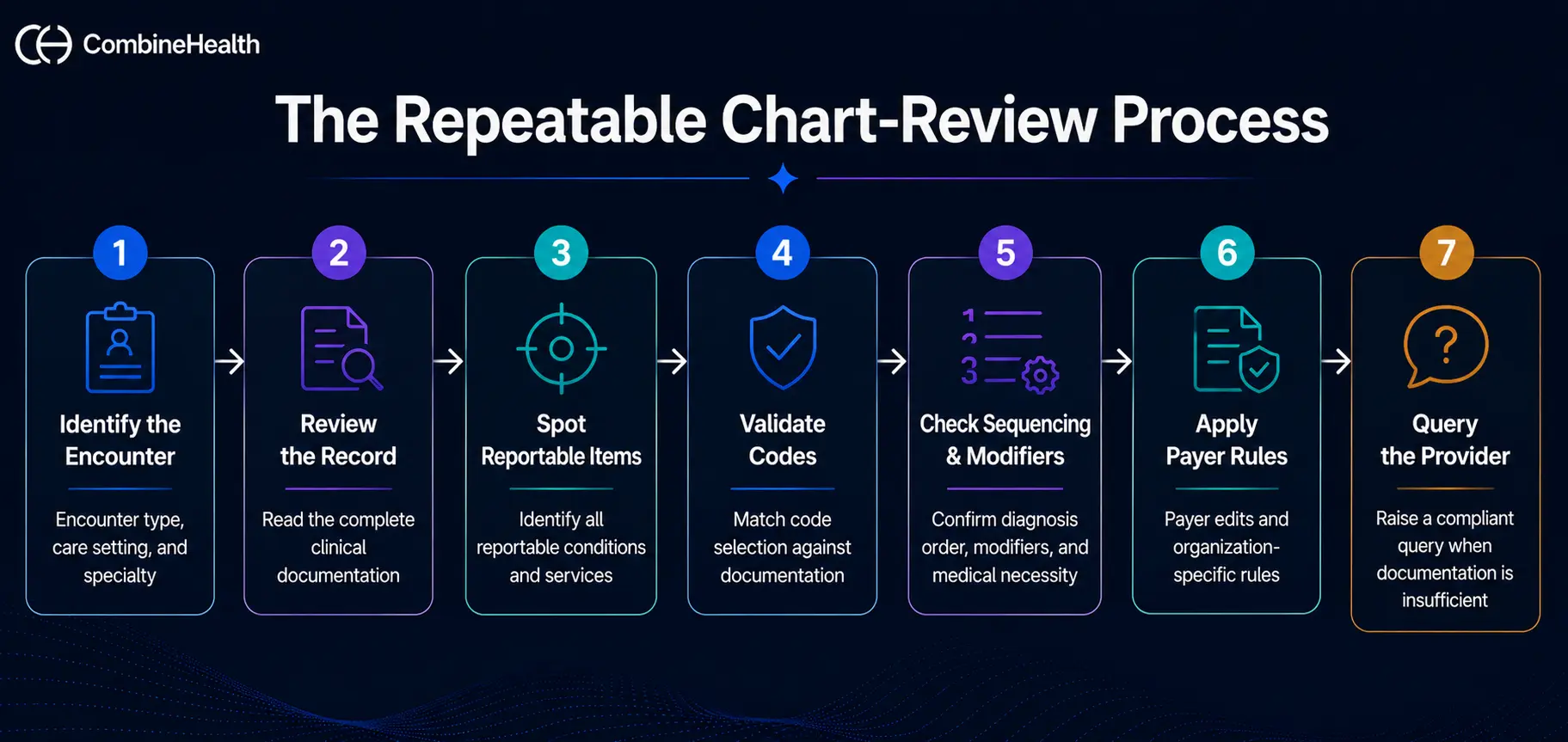
2. Follow a Repeatable Medical Claim Chart-Review Process
A repeatable process reduces missed details, medical coding errors, and downstream claim denials.
- Identify the encounter, care setting, and specialty.
- Review the complete record.
- Identify all reportable conditions and services.
- Validate code selection against documentation.
- Check diagnosis sequencing, modifiers, and medical necessity.
- Apply payer edits and organization-specific rules.
- Query the provider when documentation is insufficient.
Skipping steps or changing the sequence can lead to missed documentation, coding errors, and avoidable denials.
3. Batch Similar Clinical Charts Where Appropriate
Group similar clinical charts together so medical coders don't have to switch mental gears with every case.
Batching by specialty, care setting, procedure type, or payer helps coders stay focused on the relevant anatomy, bundling rules, and modifier logic instead of reloading that context for every chart.
One nuance to keep in mind: batching should make the process more efficient without reducing the level of review. Every chart still needs to be read in full and coded based on its own documentation.
4. Set Medical Coder Productivity Targets Based on Chart Complexity
A medical coder productivity target is the number of clinical charts a medical coder is expected to code within a set time—often per hour or per shift.
These targets should be adjusted by chart complexity, because inpatient charts, complex outpatient visits, and short-visit charts each take a different amount of review time.
A single team-wide "charts per hour" target forces medical coders to shorten review on the hardest charts.
For example, an AHIMA Foundation study of 157,000 records found that inpatient coders averaged 1.4 to 1.5 records per hour. That benchmark cannot simply be applied to outpatient coding, where the work is different.
When targets ignore these differences, coders may rush through more complex charts, increasing the risk of errors.
5. Run Every Clinical Chart Through a Standardized Medical Coding Checklist Before Release
Even experienced medical coders can miss details when reviewing complex clinical charts. Build and follow a medical coding checklist that works for your team—a short, standardized list of items to confirm on every chart before releasing it to billing.
Confirm each item below before releasing a chart:
- The correct code set and current-year version are used for the date of service.
- The record is complete before coding begins.
- The primary diagnosis is correctly selected and sequenced, with all other diagnoses sequenced appropriately.
- Every coded diagnosis is supported by the documentation, and no reportable condition has been missed.
- CPT and HCPCS codes are supported by the record.
- Modifiers are correctly applied—or correctly omitted.
- Medical necessity is established for the service.
- NCCI edits and applicable coverage policies, including LCDs and NCDs, have been reviewed.
- Any documentation ambiguity has been resolved or addressed through a compliant provider query.
The goal is to catch the small omissions that can turn an otherwise correct chart into a denial or rework.
6. Keep Medical Coding and Payer Requirements Current
Keeping up with every change is one of the trickier parts of the job, as each category updates on its own schedule.
- CPT adds, deletes, or revises hundreds of codes each year—the 2026 AMA update alone brought 418 changes.
- ICD-10-CM also adds and revises codes regularly to reflect new conditions and greater specificity.
- HCPCS Level II follows its own update cycle for drugs, supplies, equipment, and other services.
- NCCI edit files are updated regularly and contain millions of code-pair combinations.
On top of these, LCDs, NCDs, payer-specific policies, and internal coding rules can change at different times.
Keeping track of all these changes matters because a rule that was correct when a chart was coded may not have been correct for the date of service.
CombineHealth applies current CPT, ICD-10-CM, and HCPCS versions, NCCI edits, and Medicare LCD/NCD plus payer- and client-specific rules (matched to the date of service), so coding stays current without manually tracking every update cycle.
7. Strengthen Clinical Knowledge of your Staff
Medical coders should build knowledge in anatomy, medical terminology, pathophysiology, pharmacology, surgical techniques, and specialty-specific documentation.
That clinical foundation is what lets a medical coder read a chart the way a clinician does—recognizing what was actually done, why it was done, and how it should be documented.
Medical coders who understand the medicine behind a chart interpret documentation more accurately and code with greater confidence.
They can identify relevant clinical details faster, distinguish between similar conditions and procedures, and recognize when a provider query is actually needed.
8. Standardize Provider Queries When Clinical Documentation Gaps Arise
In case of gaps in the clinical documentation that come up during an audit, standardize the process for querying the providers and use the same process for every provider query, regardless of who raises it.
Use standardized query templates that describe the documentation gap without suggesting the answer, route each query directly to the treating provider, and define escalation rules for what happens if a query goes unanswered.
Each query should include the patient identifier, date of service, provider name, a description of the documentation gap (what the chart says and what's missing), and a neutral request for clarification.
For example, a query can look like this:
Patient ID: [ID] | DOS: 03/14/2026 | Provider: Miller
"The chart references chest pain but does not specify whether it was acute, chronic, or unspecified. Please clarify."
Track queries by provider and reason so recurring documentation gaps can be identified and addressed through targeted education.
CombineHealth separates a physician query (the work appears supported but documentation is missing) from educational feedback (the service wasn't performed, so it shouldn't block the chart), and query frequency is configurable, so providers aren't queried for every small issue.
9. Use Real-Time Claim Scrubbing Appropriately
Claim scrubbers check claims against coding and payer rules before submission.
They can catch invalid codes, missing modifiers, demographic mismatches, code-pair edits, formatting errors, and known payer conflicts.
But a scrubber checks the claim, not the clinical documentation behind it. It cannot determine whether the documentation supports the E/M level selected or whether the diagnoses support the service.
This is the gap a scrubber alone can't close. Beyond claim-level checks (demographics, modifiers, code-pair edits, payer rules), CombineHealth validates the clinical documentation behind the claim, whether the note supports the E/M level and whether the diagnoses justify the service, before it goes out.
10. Use AI to Reduce Repetitive Medical Coding Work
AI medical coding solutions can read clinical documentation, suggest codes, apply coding rules consistently, and flag cases that need further review.
It can help with ICD-10-CM, CPT, HCPCS, and E/M coding, as well as sequencing, modifiers, payer rules, and documentation gaps.
There are two main approaches:
- Computer-assisted coding (CAC) recommends codes that a coder reviews before finalizing the chart.
- Autonomous coding assigns codes automatically and sends cases it cannot confidently resolve to a human reviewer.
The goal is not to remove human oversight. It is to automate routine work while giving coders more time to focus on complex charts, exceptions, and cases that require clinical judgment.
11. Audit Medical Coding Patterns Continuously
A medical coding audit compares coded claims with the supporting documentation and an approved reference standard to identify recurring errors.
Sample charts across specialties, payers, and coders, then categorize the errors you find. Compare results by coder, provider, specialty, payer, and code type and track whether the same errors keep appearing and whether accuracy improves over time.
Regular audits help catch recurring problems early, before they become widespread rework, denials, or compliance issues.
CombineHealth can run as an independent QA layer on top of codes your providers, scribes, EHR, or coders already generate. It reviews every encounter rather than a sample, flags both undercoding and unsupported high-level codes, and compares accuracy by coder, provider, specialty, and payer.
12. Measure Downstream Outcomes of Medical Coding
Track what happens after the medical charts are coded and understand how accuracy of these charts impacts the downstream metrics like denials and reimbursement.
Five areas are worth tracking in medical coding workflow:
- Accuracy: Claim-line accuracy, primary diagnosis accuracy, medical necessity, and modifier accuracy
- Throughput: Turnaround time, SLA performance, and performance during volume spikes
- Automation: Autonomous coding rate and human-review rate
- Documentation: Query volume by provider and reason, and CDI opportunities
- Financial: Clean claim rate, coding-related denial rate, rework, and underpayments
CombineHealth's analytics surface exactly these downstream signals: denial volumes and dollars, denial categories, payer-level failure patterns, undercoding rates, and provider documentation trends.
Can AI Improve Medical Coding Accuracy and Speed?
Yes, AI can improve medical coding accuracy and speed—but only when it follows medical coding methodology rather than simply predicting the most likely code.
A prediction-based AI medical coding system looks for patterns and suggests the code that usually fits a similar note.
A methodology-driven AI medical coding system follows the coding process like a human medical coder: it reviews the complete encounter, checks whether the documentation supports the code, applies official guidelines, and considers reimbursement requirements before making a recommendation.
That distinction is what separates AI that scales good coding from AI that scales guesses.
CombineHealth’s medical coding automation capabilities are methodology-driven, not prediction-driven.
When to Move to Autonomous AI Coding
Autonomous coding assigns billing-ready codes without human approval for every chart, while complex or low-confidence cases go to a coder for review.
Four signals can indicate that a team is ready to consider it:
- Volume outpaces capacity: backlogs grow during volume spikes and are difficult to clear.
- Turnaround is inconsistent: time to bill changes with staffing levels rather than case complexity.
- Coding denials recur: the same error categories continue to appear despite training and education.
- Senior coders handle routine work: experienced coders spend too much time reviewing straightforward, low-variance charts
That's what CombineHealth (also known as Amy AI) is built for. It’s a self-learning autonomous AI medical coding platform that uses large language models to read the full clinical note, apply coding guidelines and payer-specific rules, and generate explainable, billing-ready medical codes.
CombineHealth has human-in-the-loop governance built in. Coders stay in control of judgment calls, while low-confidence cases route to a senior auditor. When evaluating AI coding vendors, start by looking at how they handle these exceptions.
In pilot mode, CombineHealth runs side-by-side against your existing medical coders and can withhold submission, so you validate accuracy on your own charts and payer mix without creating duplicate claims or touching live billing.
Case study: In a parallel coding pilot involving 1,000 emergency department charts, CombineHealth matched credentialed human coders with 97% coding accuracy, cut turnaround time by 50%, and identified 5× more documentation gaps.
Read the Case Study
Based on the framework above, CombineHealth reports:
See how autonomous coding performs on your own case mix and payer requirements. Book a demo with CombineHealth to review accuracy across your specialties.
FAQ
What Is a Real-Time Claim Scrubber?
A real-time claim scrubber checks a claim against coding and payer rules before submission, flagging invalid codes, missing modifiers, demographic conflicts, code-pair edits, and formatting errors. It validates the claim, not the documentation behind it.
How Often Are ICD-10-CM Guidelines Updated?
ICD-10-CM updates annually on October 1, with a mid-year cycle on April 1. CPT updates January 1, while HCPCS Level II and NCCI edits update quarterly. Match every code set to the date of service, not the date of coding.
How Many Charts Should a Medical Coder Complete per Hour?
There is no single valid number. Productivity varies by specialty, care setting, document length, payer, and complexity. An AHIMA Foundation study found inpatient coding averaging 1.4 to 1.5 records per hour, which produces meaningless targets in outpatient queues.
Should AI Replace Medical Coders?
No. AI should absorb high-volume, low-variance work and route low-confidence or complex encounters to human reviewers. Coders stay accountable for judgment-heavy cases, audits, and provider education, backed by exception workflows and audit trails.
How Does NLP Improve Medical Coding?
Natural language processing helps AI understand clinical documentation beyond keywords. It extracts diagnoses, procedures, findings, and context from operative notes, radiology reports, and progress notes, helping coding systems interpret documentation more accurately and consistently.
Recommended Reads







Explore Our
AI Workforce






Subscribe to newsletter - The RCM Pulse
Trusted by 200+ experts. Subscribe for curated AI and RCM insights delivered to your inbox

Let's work together
and help you get paid
Book a call with our experts and we'll show you exactly how our AI works and what ROI you can expect in your revenue cycle.