How AI Medical Coding Audits Uncover Undercoding and Improve Healthcare Revenue Integrity
Learn how AI medical coding audits detect undercoding, uncover missed coding opportunities, improve documentation, and strengthen healthcare revenue integrity.
Published on:
August 12, 2026


Key Takeaways:
• Undercoding means reporting less than the clinical documentation supports, either by assigning a lower-level code or failing to capture supported services, procedures, or diagnoses.
• Traditional medical coding audits can miss undercoding because they rely on sampled, manual, and often retrospective reviews, leaving many encounters unaudited before claim submission.
• AI medical coding audits detect undercoding by comparing assigned codes against clinical documentation, coding guidelines, and payer rules, then flagging potential missed complexity, services, diagnoses, or documentation gaps for review.
• AI coding audits can identify missed coding opportunities without automatically upcoding claims by explaining why an encounter was flagged and routing documentation gaps or uncertain cases to coders or providers for validation.
• AI coding audits improve revenue integrity by helping claims more accurately reflect documented care, reducing missed reimbursement opportunities while strengthening documentation, auditability, and coding accuracy.
• CombineHealth helps detect and prevent undercoding by auditing encounters against clinical documentation and coding rules, flagging missed coding opportunities, explaining the rationale, and routing documentation gaps for human or physician review before claims are submitted.
• CombineHealth turns coding and denial findings into a continuous feedback loop by identifying recurring patterns, updating coding and documentation rules after review, and applying those insights to future encounters.
Undercoding is easy to miss because the claim still gets paid—just for less than the documented care may support. The financial impact can be significant: a 2023 study estimated that undercoding could result in nearly $114 million in lost Medicare reimbursement annually in Florida alone.
AI medcal coding audits help close this gap by reviewing encounters at scale, comparing documentation against assigned codes, and flagging potential missed medical coding opportunities for human validation before claims go out.
Recommended Read: Top 7 claims audit software in 2026
On this page
- What Is Undercoding in Healthcare?
- Where Traditional Medical Coding Audits Fall Short
- How AI Medical Coding Audits Help Detect Undercoding
- Step-by-Step AI Medical Coding Audit Workflow
- How AI Medical Coding Audits Improve Revenue Integrity
- How CombineHealth Turns Medical Coding Audits Into a Continuous Feedback Loop
- FAQs
What Is Undercoding in Healthcare?
Undercoding is assigning a lower-level code than the clinical documentation supports. It can also mean failing to capture all billable services, procedures, or diagnoses supported by the patient record.
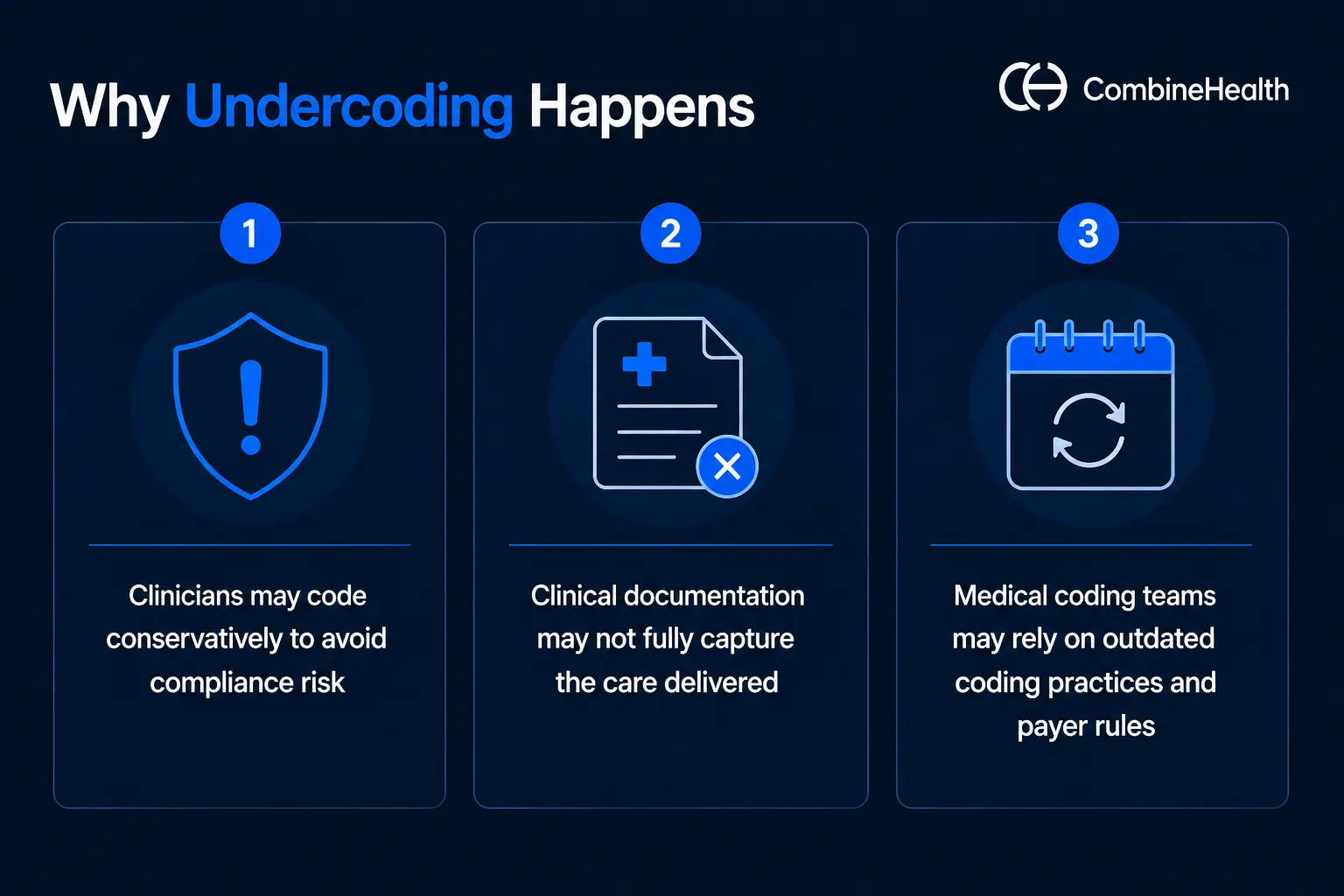
Common Causes of Undercoding
Undercoding can happen for several reasons:
- Clinicians may code conservatively to avoid compliance risk
- Clinical documentation may not fully capture the care delivered
- Medical coding teams may rely on outdated coding practices and payer rules.
Whatever the cause, the result is the same: the claim understates the care provided, which can underrepresent patient complexity and leave legitimate reimbursement uncollected.
How Is Undercoding Different from Overcoding
Undercoding occurs when a lower-level code is assigned than the documentation supports, or when supported services or diagnoses are omitted. Overcoding occurs when a higher-level code or service is reported without sufficient documentation to support it.
Both are medical coding accuracy issues that can create revenue integrity and compliance risks.
Where Traditional Medical Coding Audits Fall Short
Traditional medical coding audits rely on periodic sampling and manual chart review. While they can reveal undercoding, they only find issues in the encounters that are actually reviewed. And because many audits happen retrospectively, missed revenue may not be identified until after the claim has already been submitted.
AI-driven audits make it possible to review a much larger share of encounters concurrently, helping surface potential undercoding before it becomes recurring revenue leakage.
Recommended Read: Medical coding automation in healthcare
How AI Medical Coding Audits Help Detect Undercoding
AI medical coding audits act as a second set of eyes, comparing assigned codes against the clinical documentation, coding guidelines, and payer-specific rules to identify potential undercoding. Instead of relying on a small sample of charts, AI can continuously cross-check encounters and surface cases where the coding may not fully reflect the documented care.
They can review clinical notes at scale to:
- Cross-check assigned codes against the services and diagnoses documented in the encounter.
- Identify missed complexity, such as an E/M coding level that may not fully reflect the documented medical decision-making.
- Surface potentially missed services or diagnoses that are supported by the record but not captured in the final coding.
- Flag documentation gaps when the clinical work suggests a different code may apply but the documentation is insufficient to support it.
- Explain why a case was flagged, giving coders the clinical and coding rationale they need to validate the finding.
How CombineHealth Detects Undercoding With AI: Example from Customer Workflows
In a production medical coding workflow, an encounter had been coded as a Level 5 E/M service. The AI audit identified that the clinical record could potentially support critical-care coding, but the documentation was missing the required critical-care time.
Instead of automatically assigning the higher-value code, CombineHealth’s AI medical coding audit flagged the documentation gap for review. It also showed the reasoning behind the finding—including problem complexity, data complexity, and risk of complications—creating an auditable trail for the coder to validate the appropriate code.
Recommended Read: Top 10 CDI vendors in 2026
Step-by-Step AI Medical Coding Audit Workflow
An AI medical coding audit follows a structured process to compare assigned codes against the clinical record and surface potential undercoding for review.
1. Ingest the clinical documentation
The AI reviews the full encounter, including relevant structured and unstructured clinical documentation.
2. Review the codes already assigned
It evaluates the CPT and ICD-10 codes assigned by the provider, coder, or existing coding system.
3. Compare codes against documentation and coding rules
The AI checks whether the documented services, diagnoses, and encounter complexity support the codes assigned, while applying relevant coding guidelines and payer rules.
4. Flag potential undercoding and documentation gaps
If the documentation appears to support a different code—or information required to support that code is missing—the encounter is flagged for review.
5. Explain the rationale
Instead of returning a code alone, the AI shows why the encounter was flagged and the documentation and coding logic behind the finding.
6. Route uncertain cases for human review or physician query
When the clinical work may support a different code but the documentation is incomplete, the case is routed to a coder or provider for validation rather than automatically changing the code.
CombineHealth Example: How AI Medical Coding Audits Identify Missed Coding Opportunities
CombineHealth’s AI medical coding audit can flag an encounter where the medical decision-making suggests a higher E/M level, but supporting details such as time, severity, or other clinical elements are missing from the note. Instead of automatically assigning a higher code, the system identifies the documentation gap and surfaces the encounter for review.
When clarification is needed, the case can be routed for a physician query, allowing the provider to confirm or complete the documentation. The coder can then validate the record and assign the most accurate, documentation-supported code before claim submission.
How AI Medical Coding Audits Improve Revenue Integrity
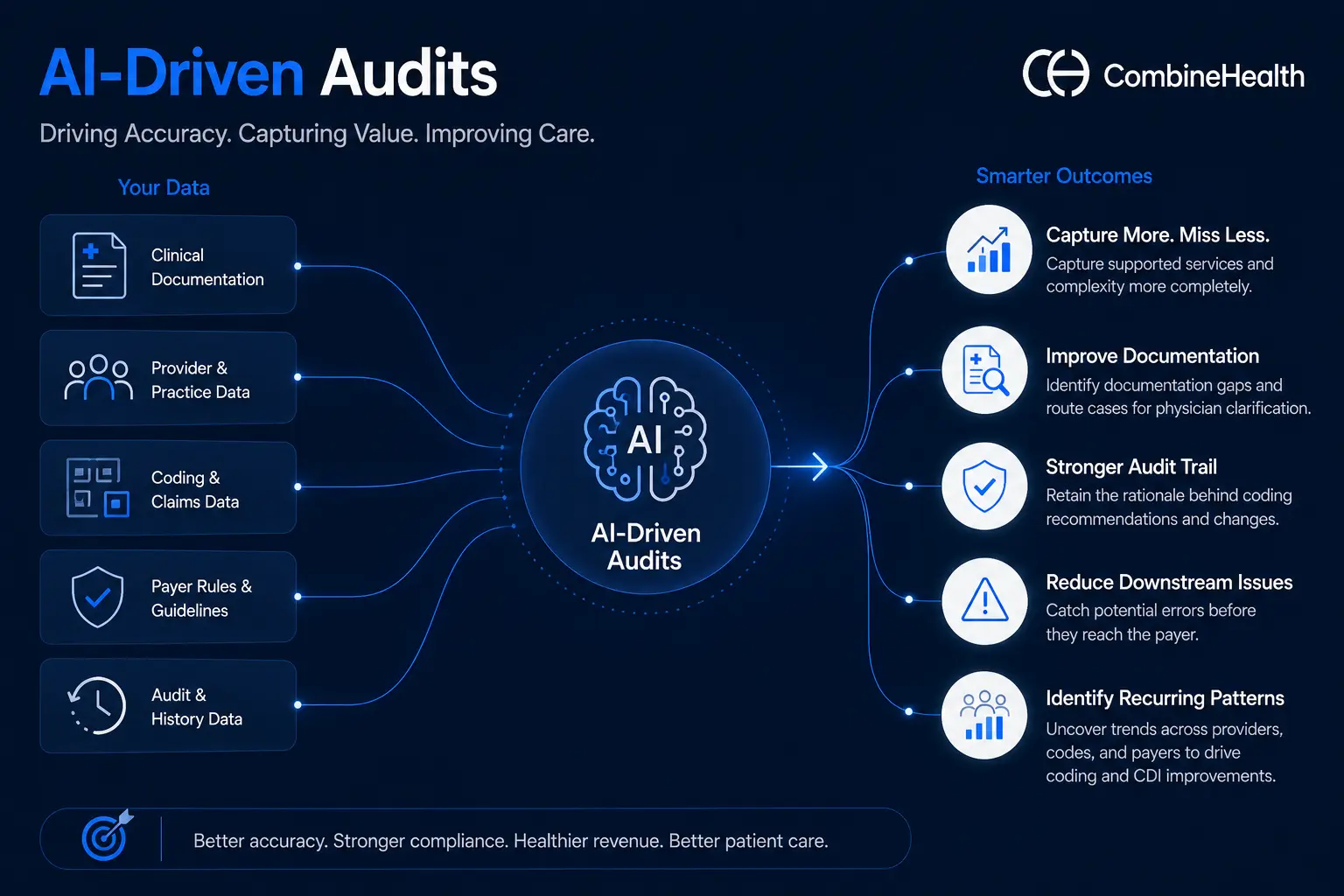
AI medical coding audits improve revenue integrity by helping ensure that the codes submitted accurately reflect the care delivered and documented. By reviewing encounters before claim submission, AI can surface missed services, underrepresented complexity, and documentation gaps that might otherwise result in lost RVUs or reimbursement.
The impact goes beyond individual claims. AI-driven audits can help organizations:
- Capture supported services and complexity more completely, reducing undercoding and missed reimbursement opportunities.
- Improve clinical documentation by identifying recurring gaps and routing appropriate cases for physician clarification.
- Create a stronger audit trail by retaining the rationale behind coding recommendations and changes.
- Reduce downstream coding issues by catching potential errors before they reach the payer.
- Identify recurring patterns across providers, codes, and payers that can inform coding and CDI improvements.
How CombineHealth Turns Medical Coding Audits Into a Continuous Feedback Loop
CombineHealth uses medical coding audit findings to identify recurring patterns and improve how future encounters are coded. Instead of treating each undercoding issue or denial as an isolated event, the system analyzes these outcomes to understand where coding and documentation problems repeatedly occur.
Example from a CombineHealth Customer
A HIM director from an orthopedic practice asked how quickly the system could recognize a recurring denial pattern involving a missing modifier and turn that insight into a medical coding improvement.
The example involved CPT 97140 (manual therapy) and CPT 97530 (therapeutic activities) being billed together without the required modifier, resulting in recurring denials. CombineHealth identified the pattern in the incoming denials and surfaced the missing-modifier issue. Once reviewed and validated, the modifier requirement could be incorporated into the coding configuration so future claims with the same code combination were checked before submission.
This creates a continuous feedback loop:
Medical coding audits → identify patterns → update coding and documentation rules → apply them to future encounters → monitor outcomes
Book a demo to see how CombineHealth can help you uncover missed revenue and improve medical coding accuracy.
FAQs
Can AI documentation patterns that lead to chronic under-coding?
Yes. AI medical coding audits can analyze encounters across providers to identify recurring documentation gaps linked to undercoding, such as missing severity, time, or supporting clinical details. These patterns can then inform targeted CDI and provider education.
Can AI identify which providers have the highest undercoding rates?
Yes. AI medical coding analytics can compare undercoding patterns across providers, helping organizations identify where documentation or coding gaps occur most frequently and where targeted review may be needed.
How can hospitals prevent recurring undercoding?
Hospitals can use AI medical coding audits to identify recurring coding and documentation gaps, update coding rules, provide targeted CDI education, and review similar encounters before claims are submitted.
Can AI show which E/M levels are commonly undercoded?
Yes. AI can analyze E/M coding patterns and flag encounters where the assigned level may not reflect the documented medical decision-making, helping teams identify recurring E/M undercoding trends.
How can undercoding data be used for provider education?
Undercoding data can reveal provider-specific documentation patterns, such as consistently missing time, severity, or supporting clinical details. CDI teams can use these insights to deliver targeted education instead of generic coding training.
Recommended Reads







Explore Our
AI Workforce







Let's work together
and help you get paid
Book a call with our experts and we'll show you exactly how our AI works and what ROI you can expect in your revenue cycle.