Top 10 Medicare Eligibility Verification Software for 2026
Compare the top 10 Medicare eligibility verification software solutions for 2026, from AI-driven tools to CMS-connected, Medicare-only systems.
Published on:
September 23, 2026


Key Takeaways
• CombineHealth verifies Medicare eligibility by evaluating the patient, payer, provider, and visit together as one encounter-level decision, layering in Medicare Advantage detection, utilization history for benefits like the Annual Wellness Visit, and exception-first workflows that surface unbilled revenue rather than just flagging denial risk.
• Medicare eligibility verification confirms that a patient's coverage is active, correctly matched to that patient, and applicable to the specific service and date of the encounter, not just a simple yes-or-no check on whether Medicare is currently active.
• Verifying Medicare eligibility runs through four stages: collecting accurate patient information, including the Medicare Beneficiary Identifier; submitting the inquiry through CMS's HETS system or the relevant Medicare Advantage payer; interpreting the response against the specific scheduled visit; and resolving exceptions before the patient arrives.
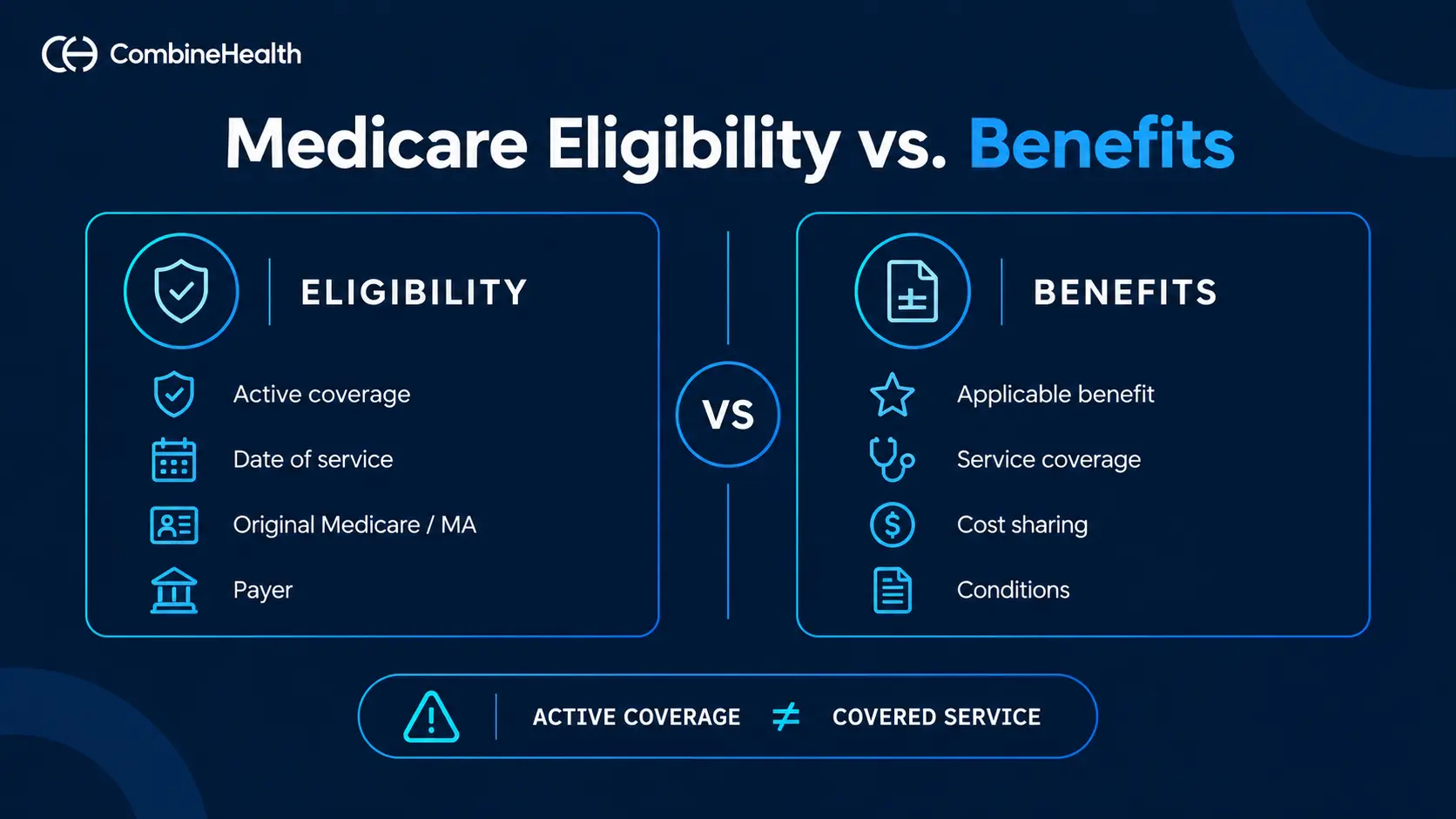
• Medicare eligibility verification and Medicare benefits verification answer two different questions: eligibility confirms whether Medicare coverage is active on the date of service, while benefits verification confirms what that coverage actually pays for in the context of that specific encounter.
• A skipped or incorrect eligibility check remains one of the most common reasons Medicare claims get denied, since active Medicare status alone does not confirm that a particular service on a particular date will actually be paid.
Medicare eligibility verification looks like a formality until the day it isn't. A patient comes in for an Annual Wellness Visit, the front desk confirms Medicare is active, and six weeks later the claim comes back denied because the visit was already billed somewhere else that year. The eligibility check was accurate, but it answered the wrong question.
That gap, between confirming coverage is active and confirming this exact visit will get paid, is where most preventable Medicare denials start. Staff used to close it by calling Medicare's Interactive Voice Response (IVR) line for anything unclear. CMS retired IVR eligibility checks on March 31, 2025, so that option is gone, and software now has to catch what a phone call used to catch.
This guide covers what a complete Medicare eligibility check needs to confirm, how that differs from a benefits check, and which ten software in 2026 actually close that gap.
On this page
- 1. CombineHealth
- CombineHealth Case Study: Internal Medicine Practice Reduced Eligibility Denials From 5% to 0%
- How Does CombineHealth Verify Medicare Eligibility?
- Feature #1: Encounter-first Evaluation
- Feature #2: Original Medicare vs. Medicare Advantage Detection
- Feature #3: Revenue Recovery Through Utilization Tracking
- Feature #4: Exception-first Workflow
- 2. Inovalon
- 3. Waystar
- 4. pVerify
- 5. Episode Alert
- 6. TriZetto
- 7. CERTIFY Health
- 8. AdvancedMD
- 9. Office Ally
- 10. Thoughtful AI
- What Is Medicare Eligibility Verification?
- How to Verify Medicare Eligibility
- Medicare Eligibility Verification vs. Medicare Benefits Verification
- How to Choose the Right Medicare Eligibility Verification Software
- See What Your Medicare Eligibility Checks Are Missing
- Frequently Asked Questions
- What is Medicare eligibility verification software?
- Do I need special software just for Medicare, or can general eligibility tools handle it?
- Why did Medicare eligibility verification move entirely to software?
- What information does a practice need to run a Medicare eligibility check?
- How is Medicare Advantage eligibility different from Original Medicare eligibility?
1. CombineHealth
CombineHealth is a self-learning, autonomous AI Medicare eligibility verification software that automates Medicare eligibility and benefits verification by bringing together Medicare, payer, patient, provider, and historical data for each scheduled visit. It goes beyond confirming active coverage to interpret Medicare-specific conditions, service-level benefits, patient responsibility, utilization history, and the exact exceptions that need attention.
CombineHealth Case Study: Internal Medicine Practice Reduced Eligibility Denials From 5% to 0%
An internal medicine practice handling 3,000–3,500 visits per month used CombineHealth to automate eligibility and benefits verification, including Medicare-specific checks. The practice reduced outsourced eligibility staffing by 80%, brought eligibility-related denials from 5% to 0%, and identified approximately $50 per claim in expected incremental revenue.
How Does CombineHealth Verify Medicare Eligibility?
- Starts from the scheduled encounter. The software evaluates the patient, payer, provider, and visit together instead of running eligibility as an isolated lookup, asking who the patient is, what coverage applies, and what conditions affect this specific encounter.
- Retrieves eligibility information from the relevant sources. It pulls from the practice management system, payer portals, Medicare sources, and historical records, since Original Medicare and Medicare Advantage often require entirely different sources.
- Confirms identity, coverage, and plan. CombineHealth checks coverage status, effective dates, demographics, and plan details to confirm the patient and insurance are correct for the date of service, including whether the plan is Original Medicare or Medicare Advantage.
- Checks provider and referral conditions. The software evaluates network status, the assigned PCP, and referral rules to confirm the patient can see the scheduled provider, a step that carries extra weight for Medicare Advantage.
- Interprets benefits and patient responsibility. Deductible, copay, coinsurance, and balance data get turned into a clear, encounter-level answer on what insurance covers and what the patient owes.
- Evaluates service-specific Medicare eligibility. CombineHealth confirms whether the actual planned service is covered, since active Part B enrollment alone does not guarantee coverage for preventive, chronic-care, or imaging services.
- Evaluates Medicare-specific conditions. It layers in Medicare Advantage, Home Health, and Hospice status to determine whether the patient's situation changes how the encounter should be billed.
- Checks utilization history for benefits like AWVs. For an Annual Wellness Visit, the software checks eligibility against practice and Medicare-side utilization history to confirm the benefit is still unused, surfacing it as revenue before the appointment if it is.
- Identifies exceptions instead of sending staff back to the beginning. It flags the exact issue, like an incorrect ID, a demographic mismatch, or an unclear network status instead of sending the whole case back to square one.
Feature #1: Encounter-first Evaluation
CombineHealth evaluates the patient, payer, provider, and visit as one connected decision rather than running eligibility as a standalone insurance lookup.
Feature #2: Original Medicare vs. Medicare Advantage Detection
CombineHealth determines which coverage type applies to a given visit automatically, even when that distinction requires interpretation rather than a simple label.
Feature #3: Revenue Recovery Through Utilization Tracking
By checking benefit usage history alongside eligibility, CombineHealth turns what is usually a defensive, denial-prevention check into a way to catch unbilled, still-available revenue like an unused AWV.
Feature #4: Exception-first Workflow
Staff only see the specific cases that need a human decision, instead of re-reviewing verifications that already came back clean.
Best for: Medium and large practices, hospitals, and health systems with heavy Medicare volume, along with RCM leaders and billing teams who want Medicare-specific eligibility logic connected directly to service-level coverage and revenue decisions.
2. Inovalon
Inovalon's Eligibility Verification Medicare product connects directly to CMS's HETS database, giving practices 24/7 access to real-time Medicare eligibility and benefit information without juggling separate logins. The connection pulls historical Medicare data going back up to four years and forward up to four months.
Key features:
- Direct, secure connection to CMS's HETS database, available around the clock.
- Flags Medicare Advantage plans, secondary coverage, and situations where Medicare is the secondary payer.
- Extends across thousands of commercial and Medicaid payers within the same platform.
Best for: Organizations that want Medicare eligibility handled inside the same system already covering thousands of commercial and Medicaid payers.
3. Waystar
Waystar Eligibility is a cloud-based module inside Waystar's larger revenue cycle management platform, built on artificial intelligence and robotic process automation (RPA) to automate eligibility and benefits checks. The combination, paired with broad payer connectivity, returns detailed, accurate benefit information fast and cuts the manual work traditional verification requires.
Key features:
- Automatic Coverage Detection, which searches for hidden or unknown primary and secondary insurance in real time.
- Native integration with major EHR systems, including Epic, Cerner, and Meditech.
- Payer-data normalization that reduces registration errors before claims go out.
Best for: Health systems that already run Waystar's broader RCM platform and want eligibility native to that workflow.
4. pVerify
pVerify is an API-first eligibility verification platform built around a network of more than 1,500 payers and over 140 APIs for integration into EHR and practice management systems. Founded in 2006, it has developed several Medicare-specific solutions, including Skilled Nursing Facility (SNF) checks, a Same-or-Similar durable medical equipment (DME) verification tool, and a dedicated Medicare Beneficiary Identifier (MBI) lookup.
Key features:
- A business rules engine that applies knowledge-based rules automatically to qualifying eligibility results.
- Medicare-specific solutions covering SNF stays, Same-or-Similar DME checks, and MBI lookups.
- A built-in patient financial responsibility estimator for copays, deductibles, and coinsurance.
Best for: Practices and billing companies that want API-driven integration with dedicated Medicare-specific logic built in.
5. Episode Alert
Episode Alert has focused exclusively on Medicare since 2007, offering a web-based portal that connects directly to CMS's HETS and FISS/DDE systems. It converts the dense X12 eligibility response into a readable XML format, making Medicare responses easier for non-technical staff to interpret.
Key features:
- Direct access to CMS's HETS, FISS, and DDE systems for real-time Medicare data.
- Coverage detail for Part A, Part B, Part D, Medicare Advantage, and HMO plans.
- A Same-or-Similar checker for DME claims and PECOS enrollment verification.
Best for: Home health, hospice, and DME-focused organizations that need deep, Medicare-only functionality, though it lacks the AI-driven automation and broader payer coverage found in newer platforms on this list.
6. TriZetto
TriZetto Provider Solutions, part of Cognizant, offers eligibility verification alongside claims processing and denial management inside a broader clearinghouse platform. A single application gives staff access to Medicare, Medicaid, and hundreds of commercial and regional plans, returning current coverage, co-pay, and deductible details.
Key features:
- Real-time and batch eligibility queries through a single application.
- Enrollment Administration Manager, supporting Medicare Advantage eligibility queries at the payer level.
- Dual Eligible Special Needs Plan (D-SNP) enrollment verification.
Best for: Health plans and enterprise clearinghouses, since most of TriZetto's deepest Medicare functionality is built for payers rather than provider billing teams.
7. CERTIFY Health
CERTIFY Health builds eligibility verification directly into patient intake and scheduling, running real-time checks the moment an appointment is booked. Coverage checks return instantly, issues trigger automatic alerts, and scheduled re-verification keeps the data current.
Key features:
- Real-time eligibility checks triggered automatically at scheduling and check-in.
- Automated re-verification to catch coverage changes between booking and the visit.
- No Surprises Act-compliant cost estimates generated from live eligibility data.
Best for: Practices that want eligibility tied tightly to the scheduling and check-in workflow.
8. AdvancedMD
AdvancedMD's eEligibility feature runs as a batch process against the next day's patient list, completing checks overnight so results are ready before patients arrive. Coverage status indicators appear at the patient level, so staff spot problems at check-in rather than during billing.
Key features:
- Automated overnight batch eligibility checks tied to the next day's schedule.
- Secondary and tertiary insurance verification, added in the 2026 Summer Release through a Change Healthcare integration.
- Native integration inside AdvancedMD's own PM and EHR suite.
Best for: Medical practices already running AdvancedMD as their core system, often paired with pVerify for deeper Medicare-specific checks like SNF or MBI lookups.
9. Office Ally
Office Ally built its Medicare Eligibility tool specifically to replace the CMS IVR phone system after its March 2025 sunset. Onboarding takes under an hour once an agreement is signed, which mattered for practices racing to replace the IVR before the deadline.
Key features:
- A dedicated Medicare Eligibility tool built as a direct IVR replacement.
- Verify360, which cascades into an automatic insurance discovery search if no active coverage is found.
- A single login across Medicare and commercial payers inside Office Ally's all-payer clearinghouse.
Best for: Small to mid-size practices needing a fast, low-maintenance replacement for the retired Medicare IVR system.
10. Thoughtful AI
Thoughtful AI takes an AI-agent approach to revenue cycle management, with a dedicated agent named EVA handling eligibility verification. Thoughtful AI reports that customers see claim denials drop by up to 75%, operational costs fall by up to 80%, and eligibility verification accuracy reaches 95% across its agent deployments.
Key features:
- A dedicated AI agent (EVA) that reads insurance details and checks coverage without staff logging into separate portals.
- Results written directly into the practice management system.
- Coverage of Medicare as one payer among many rather than dedicated CMS-system tooling.
Best for: Practices wanting a broader AI-driven RCM agent suite, where Medicare is one payer among several rather than the primary focus.
What Is Medicare Eligibility Verification?
Medicare eligibility verification confirms that a patient's coverage is active, correctly matched to that patient, and applicable to the specific service and date of the encounter. It is not a simple yes-or-no check.
A complete verification confirms Part A, Part B, Part C (Medicare Advantage), and Part D status, the exact effective dates of that coverage, and whether the plan requires anything specific before the visit can be billed.
Practices used to run this check through CMS's IVR phone system. CMS retired that option on March 31, 2025, pushing every practice toward software that connects directly to CMS's HIPAA Eligibility Transaction System (HETS), or to a clearinghouse that already has that connection built.
A skipped or incorrect eligibility check remains one of the most common reasons Medicare claims get denied. Software closes that gap in seconds, without a phone call or a manual portal search.
How to Verify Medicare Eligibility
Verifying Medicare eligibility follows the same sequence regardless of which software a practice uses, because Medicare's coverage structure dictates it. Getting it right every time is what actually prevents claim denials.
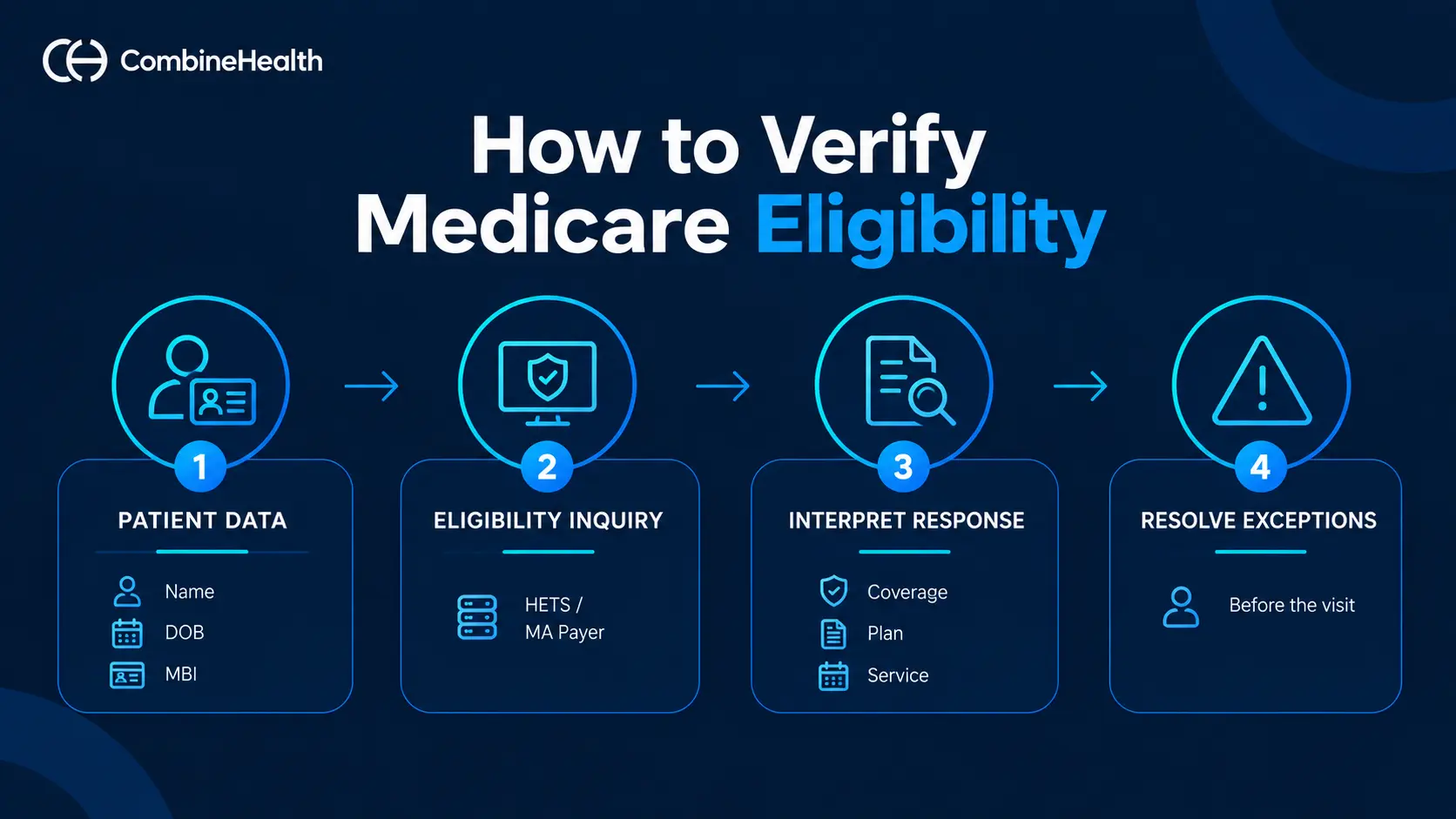
The process runs in four stages:
- Collect patient information. Full legal name, date of birth, gender, and Medicare Beneficiary Identifier (MBI), since even a minor mismatch here returns an inaccurate result.
- Submit the eligibility inquiry. Through CMS's HETS system for Original Medicare, or through the relevant payer's portal or API for Medicare Advantage, using the standard EDI 270/271 transaction format.
- Interpret the response. Compare it to the specific scheduled visit, since active Medicare status alone does not confirm that a particular service on a particular date will be paid.
- Resolve exceptions before the visit. Fix anything unclear, mismatched demographics, or ambiguous plan status before the patient arrives.
Medicare Eligibility Verification vs. Medicare Benefits Verification
Medicare eligibility verification and Medicare benefits verification answer two different questions, though many practices treat them as one step. Medicare Eligibility verification confirms whether the patient has active Medicare coverage on the date of service. Medicare Benefits verification confirms what that coverage actually pays for in the context of that specific encounter.
How to Choose the Right Medicare Eligibility Verification Software
The right choice for a Medicare eligibility verification tool depends on how much of your patient volume is Medicare, how deep your Medicare-specific verification needs are, and whether eligibility needs to feed directly into broader RCM decisions like coding and denial prevention.
- If Medicare makes up a large share of your patient volume, choose depth over breadth. CombineHealth, pVerify, and Episode Alert go furthest on Medicare-specific logic, with dedicated Medicare Advantage identification, SNF and Same-or-Similar checks, and MBI-level accuracy that general eligibility tools are not built to handle.
- If you already run billing and claims through a full RCM software, keep eligibility in the same system. Waystar, TriZetto, and AdvancedMD run eligibility natively inside the workflow you already use, so staff is not logging into a separate tool for one part of the process.
- If you run a small practice and need something live quickly, prioritize simple onboarding. Office Ally and CERTIFY Health are both built for fast setup, with eligibility checks tied directly to scheduling and check-in rather than a long implementation project.
- If you want eligibility to inform coding and denial prevention, pick a software built around the encounter. CombineHealth connects Medicare-specific conditions, service-level eligibility, and utilization history into the same encounter-level decision, so what it finds during verification carries forward into medical billing instead of stopping at a yes-or-no answer.
See What Your Medicare Eligibility Checks Are Missing
CombineHealth evaluates every scheduled encounter against Medicare Advantage status, service-level coverage, and unused benefits like the AWV, surfacing revenue instead of just flagging risk. Book a demo to see it against your own Medicare volume.
Frequently Asked Questions
What is Medicare eligibility verification software?
Medicare eligibility verification software confirms a patient's active Medicare coverage, plan type, and service-specific benefits before an appointment, replacing manual phone calls or portal searches with an automated, real-time check.
Do I need special software just for Medicare, or can general eligibility tools handle it?
General eligibility tools can confirm basic Medicare coverage status, but Medicare carries specific rules around Original Medicare versus Medicare Advantage, benefit periods, and services like the Annual Wellness Visit that general tools often miss. Platforms with dedicated Medicare logic catch these details more reliably.
Why did Medicare eligibility verification move entirely to software?
CMS retired the Medicare IVR phone system for eligibility checks on March 31, 2025, removing the option to call in for coverage information. Software connecting to CMS's HETS database, or a clearinghouse with that connection, became the only remaining path.
What information does a practice need to run a Medicare eligibility check?
A Medicare eligibility check typically requires the patient's first and last name, Medicare Beneficiary Identifier (MBI), date of birth, and gender.
How is Medicare Advantage eligibility different from Original Medicare eligibility?
Medicare Advantage plans are administered by private insurers under CMS rules, which means eligibility checks may need to query the specific Medicare Advantage payer directly rather than CMS's HETS system alone. Original Medicare checks route through HETS in nearly all cases.
Recommended Reads







Explore Our
AI Workforce






Subscribe to newsletter - The RCM Pulse
Trusted by 200+ experts. Subscribe for curated AI and RCM insights delivered to your inbox

Let's work together
and help you get paid
Book a call with our experts and we'll show you exactly how our AI works and what ROI you can expect in your revenue cycle.