Medical Coding Automation: How It Works and How It Impacts Healthcare Revenue
Learn how medical coding automation streamlines ICD-10, CPT, HCPCS, E/M, and modifier coding, improves revenue cycle efficiency, and supports certified coders with greater accuracy and productivity.
Published on:
July 28, 2026


Key Takeaways:
• Medical coding automation involves AI reading the chart, assigning ICD-10, CPT, HCPCS, E/M, and modifier codes, and routing uncertain encounters to coders.
• Documentation quality caps everything, because no platform can code what the note does not contain.
• Medical coding automation helps move the RCM metrics for better.
• CombineHealth's Amy is rated the best AI medical coding automation software in 2026, coding thousands of charts with up to 98% accuracy within minutes and routing the low-confidence complex cases to human coders.
• CombineHealth's production benchmarks show that medical coding automation extends beyond accurate code assignment. In production, Amy, CombineHealth’s medical coding automation software, delivered 75% fewer coding-related denials, 4% higher captured revenue, and 5× more CDI opportunities.
Medical coding gets more complex every year. On January 1, 2026, 418 changes to the CPT code set took effect: 288 new codes, 84 deletions, and 46 revisions.
Coding teams absorb all of it while the chart backlog grows and experienced coders get harder to replace.
Those pressures are what make medical coding automation a necessity. Manual coding cannot keep pace with changing payer policies, especially at high volume.
Automation now handles much of that work by assigning the routine codes on its own and sending the complex charts to a human coder.
This guide explains what medical coding automation is, how it handles each code set, and which revenue cycle metrics improve as a result.
Get Cleaner Claims Out the Door, Faster!
CombineHealth's medical coding automation software, Amy, codes charts as they arrive, with reviewable rationale and a full audit trail behind every decision.
Book a Demo
On this page
- What Is Medical Coding Automation?
- Benefits of Medical Coding Automation
- How Medical Coding Automation Works
- How AI Automates CPT, ICD-10, HCPCS, and Modifier Coding
- How Coding Automation Connects to Revenue Cycle Outcomes
- Why Is Explainable Medical Coding Automation Crucial in 2026?
- Put Medical Coding Automation to Work on Your Own Charts
- FAQ
What Is Medical Coding Automation?
Medical coding automation is the use of software to read clinical documentation and assign the ICD-10, CPT, HCPCS, E/M, and modifier codes that turn a patient encounter into a billable claim.
An automated medical coding software does the work a human coder would typically do manually: read the chart, decide which codes the documentation supports, check them against payer rules, and pass the claim to billing.
How Does Automated Medical Coding Differ from Traditional Coding?
Automated medical coding differs from traditional coding in who assigns the code and how it gets reviewed.
Traditional coding relies on certified coders to read the documentation and assign ICD-10, CPT, and HCPCS codes by hand. Automated coding uses AI to read the same documentation, recommend or assign those codes, and in some cases code routine encounters end to end.
What separates an automated medical coding approach from manual coding is how much of the coding pipeline the approach finishes on its own with high accuracy.
Types of Medical Coding Automation
Coding automation comes in three forms, separated by how much of the workflow the software finishes without a human:
- Computer-assisted coding (CAC): prompts a coder with suggested codes, but the coder still does the assigning. The oldest of the three, and the most workflow-heavy.
- AI-assisted coding: assigns codes that a coder reviews before anything moves downstream. Cuts research time without changing who signs off.
- Autonomous coding: codes qualifying encounters end to end and sends only exceptions to a review queue. The only one of the three that reduces how many charts reach a coder.
Recommended reading: Autonomous Medical Coding Guide
Benefits of Medical Coding Automation
Clears Coding Backlogs Without Adding Headcount
Automation adds throughput without adding coders. A backlog that grows every time someone takes leave or resigns stops being a staffing problem. That matters most in high-volume settings, where coders are expected to work through roughly 120 charts a shift.
Standardizes Coding Across Every Chart
Two coders reading one note can reasonably land on different E/M levels, and that variation is a large source of revenue leakage in multi-site and primary care groups. Automation standardizes coding across charts. Consistency also makes outliers visible instead of letting them average out.
Catches Documentation Gaps Before the Claim Leaves
Automation identifies both what is documented and what is missing. It flags missing laterality, unsupported medical necessity, and vague diagnoses before billing, making issues cheaper to fix than appeal later.
Recommended reading: Clinical Documentation Improvement Software
Defends Every Code With the Documentation Behind It
A complete audit trail records the original recommendation, the confidence score (of AI), every reviewer action, the reason for each override, and the chart's version history. With that, explaining a coding pattern to an auditor is incredibly easier. This completely depends on whether the medical coding automation software has explainable AI.
Frees Coders for Complex and High-Dollar Charts
Automation handles straightforward, well-documented encounters, while coders focus on cases that need clinical judgment or closer review. This helps teams spend more time where their expertise adds the most value.
How Medical Coding Automation Works
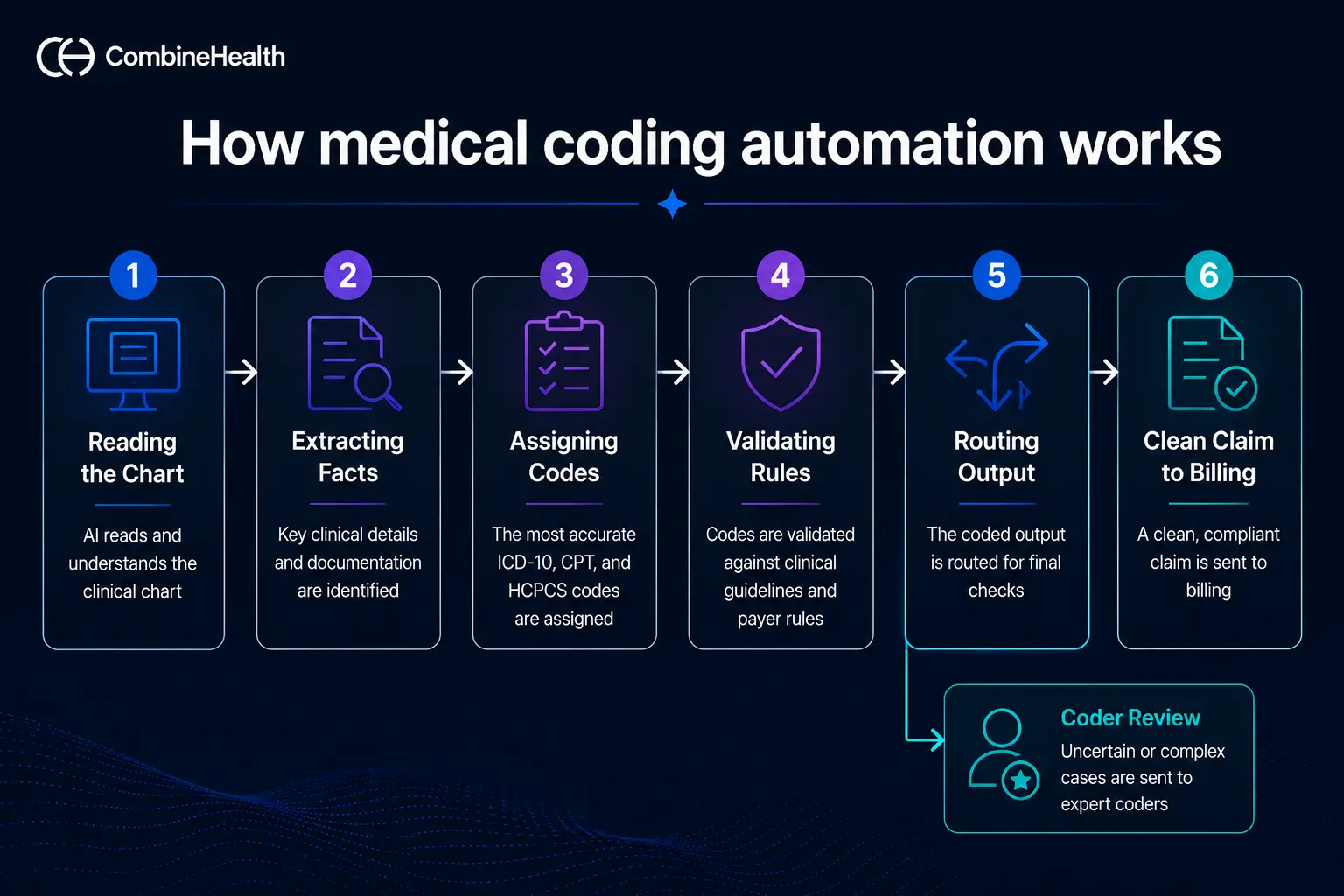
Step 1: Reading the Full Chart
The system pulls physician notes, operative reports, lab results, discharge summaries, and structured EHR data.
Details that support a more specific diagnosis often sit earlier in the record than the final assessment, so anything reading only the closing note will code to a lower specificity than the documentation supports.
Step 2: Extracting Medical Necessity, Procedure and Diagnosis Details, and the Time Spent
An automated medical coding system pulls specific details from the chart that impact code selection, medical necessity, reimbursement, and overall claim accuracy.
It then evaluates the number and complexity of problems addressed, the amount and complexity of data reviewed, and the level of risk associated with patient management. Together, these three elements determine the level of medical decision-making (MDM), which drives E/M code selection.
Step 3: Assigning Codes With a Confidence Score
Each assigned code carries a confidence score, the software's own rating of how sure it is about that code. That score decides the chart's route. Above the configured threshold, the encounter proceeds. Below it, the chart goes to a coder with the evidence attached.
Step 4: Validating Against Coding Rules and Payer Policy
Before a claim leaves, the medical coding automation platform checks the codes against medical necessity, NCCI edits, LCD and NCD rules, and the specific terms of your payer contracts. Rule libraries need maintenance to stay useful, and vendors differ widely on how fast a policy change reaches production.
| Note: When evaluating, ask about how up-to-date their policy refresh cadence is. When a Medicare contractor updates an LCD to require a particular diagnosis, a platform still running the old version keeps assigning the code without flagging the gap that leads to a denial. Payer downcoding behaves the same way when policy logic falls out of date.
Step 5: Routing Exceptions to Human Review
Exception handling is the logic that decides which charts get routed to a human medical coder for reviews. Four categories usually qualify the process:
- Charts below the confidence threshold: the software flags its own uncertainty instead of resolving it.
- Encounters with documentation gaps: a missing element makes the code unsupportable no matter how confident the software is.
- High-dollar claims: the financial exposure justifies the review time on its own.
- Specialties your compliance team has flagged: usually the ones already carrying audit history or elevated denial rates.
How a platform draws those lines tells you more about it than its accuracy claim does.
How AI Automates CPT, ICD-10, HCPCS, and Modifier Coding
1. ICD-10 Diagnosis Codes
For ICD-10, medical coding automation software reads the record and assigns the most specific diagnosis the documentation supports. The hard part is not finding the code—it is that specificity has a ceiling set by the note.
For example, a note that says only "diabetes" gets E11.9, the unspecified code. The same patient documented as "Type 2 diabetes with polyneuropathy" gets E11.42, which reflects the condition actually treated and holds up better if the claim is reviewed.
2. CPT Procedure Codes
Automation identifies the procedures performed and reports them in the right order and combination. CPT coding gets difficult on multi-procedure encounters, where bundling rules determine which services report separately and which are already included in another code.
For example, a surgeon repairs a hernia and removes a small lipoma through the same incision. The software has to work out whether the lipoma removal bills on its own or counts as part of the hernia repair. If it reports both without checking the bundling rules, the claim comes back denied.
3. HCPCS Level II Codes
HCPCS Level II covers supplies, drugs, devices, and injectables. Medical coding automation handles the code selection well, and the risk sits in the unit quantities: dosage converted to billing units, wastage reported correctly, and quantities matching what the note documents.
Let’s say a patient receives 40 mg of a drug that bills in 10 mg units. The claim should show four units. If it goes out as one, the practice collects a quarter of what the drug was worth on every dose it gives.
4. E/M Levels
Medical coding automation assigns E/M coding a level based on medical decision-making or total time. This is the hardest of the five code sets to automate cleanly, because leveling is a judgment call and two credentialed coders can reach different defensible answers on the same chart.
For example, an office visit covers two stable chronic conditions and a prescription refill. One coder reads that as a level 3.
Another counts the medication management as moderate risk and reads it as a level 4. Both can point to the guideline behind their answer, which is why strong platforms show the reasoning for the level they picked.
5. Modifiers
Modifiers tell the payer that something about a service differs from the default. Medical coding automation reads the note for those circumstances and appends the modifier the documentation supports. It handles the rules-based ones reliably and gets less certain where payers read the same modifier differently.
For example, a patient comes in for a scheduled injection and mentions a new symptom, so the physician evaluates that as well. The visit needs modifier 25 to show the evaluation was separate from the injection.
If the modifier is left off, the payer folds the visit into the procedure and pays for the injection alone. Modifier errors like this sit among the more common claim denial codes in coding.
How Coding Automation Connects to Revenue Cycle Outcomes
Coding automation reaches financial results indirectly, through faster coding and cleaner claims. The metrics move in sequence rather than together, and expecting them all in the first month is the most common reason a pilot gets judged a failure.
Here’s a snapshot of how medical coding automation helps with RCM metrics:
Tracking these alongside your existing revenue cycle management metrics keeps the comparison honest, since coding is only one of several inputs to A/R days.
Case Study: Medical Coding Automation Reduces Coding Denials by 75% and Increases Captured Revenue by 4%
CombineHealth's latest production benchmarks suggest a broader role for autonomous medical coding than just assigning accurate codes.
That downstream impact was demonstrated at a 400-bed Midwest health system, where Amy, CombineHealth’s Medical Coding Automation Software, uncovered undercoding that had previously gone unquantified. Amy uncovered undercoding that had previously gone unquantified, helping the organization reduce coding-related denials by 75% while increasing captured revenue by 4% within three months.
As the organization's HIM Director noted, "The value wasn't just better coding. We were surprised by how Amy identified 5× more CDI opportunities than our traditional workflow."
Why Is Explainable Medical Coding Automation Crucial in 2026?
Explainable medical coding automation means every assigned code can be traced back to three things:
- The documentation that supports it
- The coding rule applied
- The payer policy checked
If a coder cannot follow that chain backward, the code is not defensible—no matter how accurate it turns out to be.
This matters because regulators are paying closer attention to AI-generated coding. In February 2026, HHS-OIG updated its Medicare Advantage compliance guidance for the first time in 27 years.
The guidance identifies AI-generated EHR prompts that encourage unsupported diagnoses or diagnoses unrelated to a patient's care as a compliance risk.
If an automated system assigns a diagnosis the record does not support, the organization that submitted the claim answers for it, not the vendor that supplied the software.
So, ensure the medical coding automation platform supports concurrent review before submission rather than only retrospective review after billing.
Explainability is the first of ten checks that decide which platform holds up in your environment.
Read the full 10-point checklist to evaluate any AI medical coding platform properly, or compare options in Top 10 AI Medical Coding Software.
Put Medical Coding Automation to Work on Your Own Charts
Automation clears the routine charts, so your team spends its hours on the ones that need judgment.
The operational gains land within weeks, and the denial numbers follow within a quarter.
CombineHealth's Amy, an AI medical coding solution, reads the full chart and assigns ICD-10, CPT, HCPCS, E/M, and modifier codes in one pass. Each code carries its rationale, the guideline behind it, and the passage of documentation supporting it.
Amy checks every code against medical necessity, NCCI edits, and payer-specific rules before the claim moves, flags the documentation gaps that would otherwise return as denials, and routes the judgment calls to your coders.
Across deployments, CombineHealth has reported:
- Up to 85% of manual coding effort removed
- Coding accuracy above 98%
- Up to 75% reduction in coding-related denials
Book a Demo, and we will show you which encounters Amy codes on her own, which ones come back to your coders, and the reasoning behind every code!
FAQ
What is medical coding automation?
Medical coding automation is software that reads clinical documentation and assigns the ICD-10, CPT, HCPCS, E/M, and modifier codes needed to bill an encounter. Depending on the platform, it either suggests codes for a coder to review or codes qualifying encounters on its own and routes the rest to human review.
Is medical coding automation the same as autonomous coding?
No. Autonomous coding is one point on the automation spectrum, where the software completes defined encounter types end to end. Coding automation also covers assistive models where a coder reviews every output before it moves.
Which code sets can be automated?
ICD-10, CPT, HCPCS Level II, E/M levels, and modifiers can all be automated, but not to the same degree. ICD-10, CPT, and HCPCS assignment automates well on clear documentation. E/M leveling and modifier application involve more judgment and payer variation, so they need review more often.
How accurate is medical coding automation?
Accuracy varies by specialty, documentation quality, and encounter type, so vendor-wide figures rarely hold across a full case mix. Ask for results broken out by your specialties, then validate with a parallel pilot where your coders and the platform work the same charts independently.
Related Blogs







Explore Our
AI Workforce







Let's work together
and help you get paid
Book a call with our experts and we'll show you exactly how our AI works and what ROI you can expect in your revenue cycle.