How Does AI Contribute to Denial Prevention in Medical Coding
Learn how AI prevents coding-related denials before claim submission and turns the denials that do occur into better coding decisions on future claims.
Published on:
August 31, 2026


Key Takeaways
• AI-driven denial prevention works at two stages: validating claims against known medical coding requirements before submission, and learning from denial outcomes after claim adjudication.
• Coding-related denials typically begin at three failure points: documentation that doesn't support the code, code combinations that trigger payer edits, and claim-level requirements missing from an otherwise correct claim. Each needs a different fix.
• In medical coding, AI contributes to denial prevention by checking a claim against every requirement knowable before submission: documentation support, code-to-diagnosis linkage, payer rules, modifiers, and authorizations.
• Over time, AI builds payer intelligence in medical coding: a picture of how each specific payer handles your claims, drawn from real outcomes, and uses it to improve medical coding on future claims.
• CombineHealth prevents coding-related denials before they happen and learns from those that still occur. Its self-learning autonomous medical coding platform validates claims before submission, then feeds denial outcomes back into future coding decisions.
A claim can have every medical code right and still not get paid.
CMS data shows why. Of the $28.83 billion in Medicare fee-for-service improper payments in FY2025, roughly 65% came down to insufficient or missing documentation, and another 15.3% to medical necessity. None of that is a coding error. Getting paid takes more than the right code.
Denials carry the same cost, in rework, administrative time, and revenue that often never comes back. Preventing them is worth more than working them.
That's the real test for AI medical coding, and it applies at both stages of the denial cycle:
- Before submission: stopping the denial from happening.
- After a denial: stopping it from happening again.
In this article, we'll explore how AI contributes to denial prevention in medical coding, and how denials that do occur can be used to prevent similar denials in the future.
On this page
- What Is AI-Driven Denial Prevention in Medical Coding?
- Where Do Medical Coding-Related Denials Begin?
- How Does AI Prevent Denials Before Claim Submission?
- Which Types of Denials Can AI Prevent?
- How Does AI Learn From Denial Outcomes to Prevent Future Denials?
- How Do You Measure the Impact of AI Medical Coding on Denials?
- How CombineHealth Approaches AI-Driven Denial Prevention
- Frequently Asked Questions
What Is AI-Driven Denial Prevention in Medical Coding?
AI-driven denial prevention uses artificial intelligence to identify potential claim issues before submission and learn from denials after adjudication. Autonomous medical coding platforms with AI-driven denial prevention baked into them validate diagnosis and procedure codes, modifiers, clinical documentation, medical-necessity requirements, and payer rules before a claim reaches the payer. So, when a denial does occur, AI analyzes the outcome and uses those insights to improve future coding and claim-validation rules.
Types of Denial Prevention Workflows in AI Medical Coding
There are two approaches to denial prevention in AI medical coding:
The second approach (Learning-based prevention) is particularly valuable because it turns actual denial outcomes into actionable medical coding intelligence that improves over time.
Each recurring pattern can inform future coding decisions, helping reduce the likelihood of the same avoidable medical claim denial happening again.
Recommended Read: Top 10 AI Denial Management Solutions
Where Do Medical Coding-Related Denials Begin?
Medical coding-related denials can originate from three main failure points: clinical documentation that does not support the code selected, medical code combinations that trigger payer edits, and medical claim-level requirements missing from an otherwise correctly coded claim.
1. Clinical Documentation That Doesn't Support the Code Selected
Medical necessity denials occur when the documentation does not establish that a service was reasonable and necessary under the payer’s policy.
A claim can be coded correctly and still fail if the clinical note does not contain information required by a Medicare Local Coverage Determination (LCD) or National Coverage Determination (NCD), such as a specific finding, severity measure, or record of failed conservative treatment.
This is a clinical documentation integrity (CDI) issue that surfaces during billing, which is why traditional claim-scrubbing alone may not catch it.
This is exactly the gap CombineHealth is built to close before a claim goes out. Because it reads the full clinical note and checks it against the specific LCD and NCD criteria a payer requires—the finding, severity measure, or record of failed conservative treatment the policy names—it catches a medical-necessity gap that code-only scrubbing can't see, and shows which documentation is missing. The denial gets prevented at the point the claim is coded, not discovered months later.
Recommended Read: Building a Successful CDI Program in Healthcare
2. Medical Code Combinations That Trigger Payer Edits
Some medical claim denials occur because two procedure codes cannot be reported together under correct coding rules.
Medicare’s National Correct Coding Initiative (NCCI), for example, publishes procedure-to-procedure (PTP) edits that pair a Column One code with a Column Two code. When both codes are reported for the same beneficiary on the same date of service, the Column One code is eligible for payment while the Column Two code is denied, unless a clinically appropriate NCCI PTP-associated modifier is allowed and reported.
Each edit has a Correct Coding Modifier Indicator (CCMI). A value of “0” means a modifier cannot bypass the edit, while “1” means an appropriate modifier may bypass it when the circumstances support its use.
The distinction matters because NCCI edits address correct medical coding, not medical necessity. A denial caused by a code combination requires a different response from one caused by insufficient documentation for medical necessity.
Keeping current with all of this is precisely what payer intelligence automates. CombineHealth applies Medicare LCD/NCD guidance, CMS rules, payer-specific medical policies, and NCCI edits as they change—folding each quarterly update into its coding checks, so a claim is validated against the rules in force the day it's coded, not the rules a coder last memorized. Because the platform is self-learning, it also refines those checks against your own payer outcomes, so the rule set reflects how each payer actually adjudicates, not just what its published policy says.
3. Medical Claim-Level Requirements That Fail an Otherwise Correct Claim
A medical claim can also have the right medical codes and still be denied because another requirement was missed. Missing prior authorization, an absent referral, incorrect patient demographics, or eligibility issues can all cause a medical claim to fail.
These issues may end up in the medical coding team's workflow even when the coding itself is correct. Because many of these requirements can be checked before submission, they are an important part of denial prevention.
That's the check CombineHealth runs automatically on every claim. It evaluates whether a code combination is subject to an NCCI or payer edit, whether the edit permits a modifier, and whether the documentation actually supports appending it—so the physical-therapy pair above is flagged for the missing modifier before submission rather than coming back with the Column Two code denied. Each flag carries its rationale, so the reasoning is there to confirm against the note in seconds.
Recommended Read: Common Claim Denial Codes
How Does AI Prevent Denials Before Claim Submission?
AI can prevent denials by checking a claim against requirements that are knowable before submission. These include clinical documentation, coding guidelines, coverage policies, payer-specific rules, modifier requirements, and claim-level conditions such as authorizations and referrals.
Four checks performed by AI are particularly important.
1. Reading Clinical Documentation to Support Code Selection
AI medical coding software can read the full encounter note, identify the services performed, determine the applicable diagnosis and CPT codes, and link each procedure code to the diagnosis supporting it.
This CPT–diagnosis linkage is important for medical necessity. A procedure may be coded correctly but still fail if the documentation does not support why the service was medically necessary.
Stronger AI medical coding platforms also explain why each code was selected. This gives coders a way to review and validate the recommendation before submission. If a claim is later denied, that reasoning can also provide a useful starting point for review or appeal.
Recommended Reading: Explainability in AI for Healthcare
2. Applying Medical Coding Guidelines and Medical-Necessity Requirements
AI can check medical coding output against multiple sources of authority, including Medicare LCD and NCD guidance, CMS rules, payer-specific medical policies, and standard coding guidelines.
It can use these requirements to identify whether the selected medical codes are supported by the documentation, whether a procedure meets the payer's medical-necessity criteria, and whether medical coding rules such as NCCI edits or other payer-specific edits apply.
Keeping these requirements current is difficult to manage manually, especially when guidelines and payer policies change throughout the year. For example, CMS publishes four NCCI versions each year, with updates taking effect on January 1, April 1, July 1, and October 1.
AI medical coding software can incorporate these updates into its coding checks, helping identify potential compliance issues before a medical claim is submitted rather than relying on medical coders to manually track every change.
3. Detecting Modifier and Code-Combination Problems
AI can check whether a combination of medical codes is subject to an edit, whether the edit permits a modifier, and whether the documentation supports using that modifier.
Let’s consider a physical therapy claim with two CPT codes subject to an NCCI edit. If the edit allows an appropriate modifier but the modifier is missing, the claim can pass through internal checks and still return with the Column Two code denied.
An AI medical coding tool can identify that risk before submission.
Note: Modifier requirements can vary by specialty and payer. These nuances need to be mapped and configured in the AI medical coding software rather than assumed to work universally.
Recommended Read: Modifiers in Medical Billing and How AI Helps
4. Identifying Non-Coding Issues That Cause Claim Denials
AI can also check for issues outside the coding itself that still lead to claim rejections or denials.
This includes validating patient demographics, confirming required referrals, applying payer-specific claim rules, and checking whether a service that requires prior authorization has an authorization on file.
If a required authorization is missing, for example, the AI can flag the issue before the claim is submitted rather than allowing a predictable rejection to occur during payer adjudication. This shifts the workflow from fixing rejected claims to preventing avoidable billing errors upfront.
Recommended Reading: How to Appeal an Insurance Claim Denial
Which Types of Denials Can AI Prevent?
AI can prevent denials that trace back to a known, verifiable requirement, but it cannot prevent denials where the payer disagrees with the clinician’s judgment.
CombineHealth works this table from both sides. The "Yes" rows—missing information, duplicates, absent authorizations, missing modifiers on edit pairs—are caught by its pre-bill checks before the claim is submitted. For the "Partly" and "Rarely" rows, where a payer may simply disagree, the platform records the explainable coding rationale and the documentation behind each decision, so the claims that genuinely need an appeal go into it with the evidence already assembled rather than reconstructed under deadline.
Recommended Read: Building a Smarter Prior Authorization Process
How Does AI Learn From Denial Outcomes to Prevent Future Denials?
AI learns from denial outcomes by analyzing each denial as it arrives (by payer), identifying what happened and why, and feeding validated findings back into the medical coding rules used for future claims. Pattern detection happens in near real time rather than quarterly, so recurring problems can surface within days instead of waiting for a retrospective audit.
This matters because each payer can have different denial patterns that published rules cannot fully predict. Understanding and adapting to these patterns is an important part of preventing denials.
How AI Analyzes Denial Patterns
As denials arrive, AI can categorize each one based on the underlying cause:
- Medical coding error: The code, modifier, or code combination was incorrect. The relevant coding rule can be updated.
- Medical-necessity gap: The documentation did not support the code under the payer’s coverage criteria. The diagnosis linkage or documentation rule can be refined.
- Configuration gap: The payer applies a requirement that the system was not accounting for. The payer-specific configuration can be updated.
- Genuine dispute: The documentation and coding were appropriate, but the payer disagreed. The case can be routed to the appeals process without changing the coding rules.
How Denial Feedback Improves Future Coding Decisions
A categorized denial only has value if something changes because of it. AI applies those findings in two directions:
- Feedback to providers on documentation: When the same clinical detail keeps going unrecorded, that gap becomes CDI feedback for the providers whose notes produced it, so the problem gets solved at the source instead of at the claim.
- Updated coding rules for that payer: Validated patterns feed into the coding and validation rules, so the next claim carrying the same conditions gets checked against what actually caused the earlier denial and prevents it.
A physical therapy claim denied for a missing modifier on a specific CPT pair is a straightforward case. The next claim carrying that pair is flagged for the modifier before the submission stage itself and not after adjudication.
The result is a self-improving medical coding workflow where every validated denial strengthens future claim accuracy.
How Do You Measure the Impact of AI Medical Coding on Denials?
Measure the impact of AI medical coding by tracking two metrics that can move independently: denial rate and denial reason mix. Denial rate tells you how many claims were denied. Denial reason mix tells you why they were denied. This is where prevention often shows up first.
Metric
What it tells you
First-pass claim acceptance rate
Whether claims survive initial adjudication
Denial rate by reason code
Which failure modes are shrinking
Denial rate by payer
Which payers deny more than others, and where their rules differ from your automated medical coding
Avoidable vs. disputable denial split
How many denials you could have prevented versus how many you'd have to argue
Cost of rework per denied claim
The administrative expense you're avoiding
Impact of AI Medical Coding on Denials in Six to Twelve Months
Early in the process, many denials may come from preventable issues such as missing modifiers, duplicate claims, or absent authorizations. As eligibility, coding, and claim validation become more consistent, these categories should decline.
The remaining denial mix may become more concentrated in complex cases, such as bundling disputes and medical-necessity denials that require clinical review or appeals.
That shift is a positive sign. A smaller pool of denials that genuinely require payer intervention is a healthier outcome than a larger pool filled with preventable errors.
CombineHealth reports on exactly these metrics. Its analytics track first-pass acceptance, denial rate by reason code, and denial rate by payer—showing which failure modes are shrinking and which payers diverge from your automated coding—alongside the avoidable-versus-disputable split. And because the platform learns per payer, the healthy shift this section describes—preventable denials falling away, leaving a smaller pool of genuine disputes—shows up in the reporting instead of staying buried in a rework queue.
How CombineHealth Approaches AI-Driven Denial Prevention
CombineHealth, also known as Amy AI, is a self-learning autonomous AI medical coding platform that connects pre-bill coding decisions to post-adjudication payer outcomes. CombineHealth reads completed clinical documentation, produces explainable coding recommendations, and applies coverage and payer requirements before the claim is created. Denials that still occur are analyzed and routed back into medical coding strategy to prevent making the same mistake twice.
The process works as a continuous feedback loop:
- Analyze clinical documentation: CombineHealth reviews the encounter documentation and generates explainable coding recommendations.
- Apply coding and payer requirements: Medical coding decisions incorporate applicable coding guidelines and payer-specific requirements.
- Run pre-bill checks: The system identifies preventable claim issues before submission.
- Analyze payer outcomes: Denials are analyzed by payer, denial type, and root cause.
- Feed findings back into coding: Medical coding and claim outcomes inform future coding and validation rules.
- Build payer intelligence: Over time, the AI medical coding platform learns payer-specific intelligence from actual claim behavior.
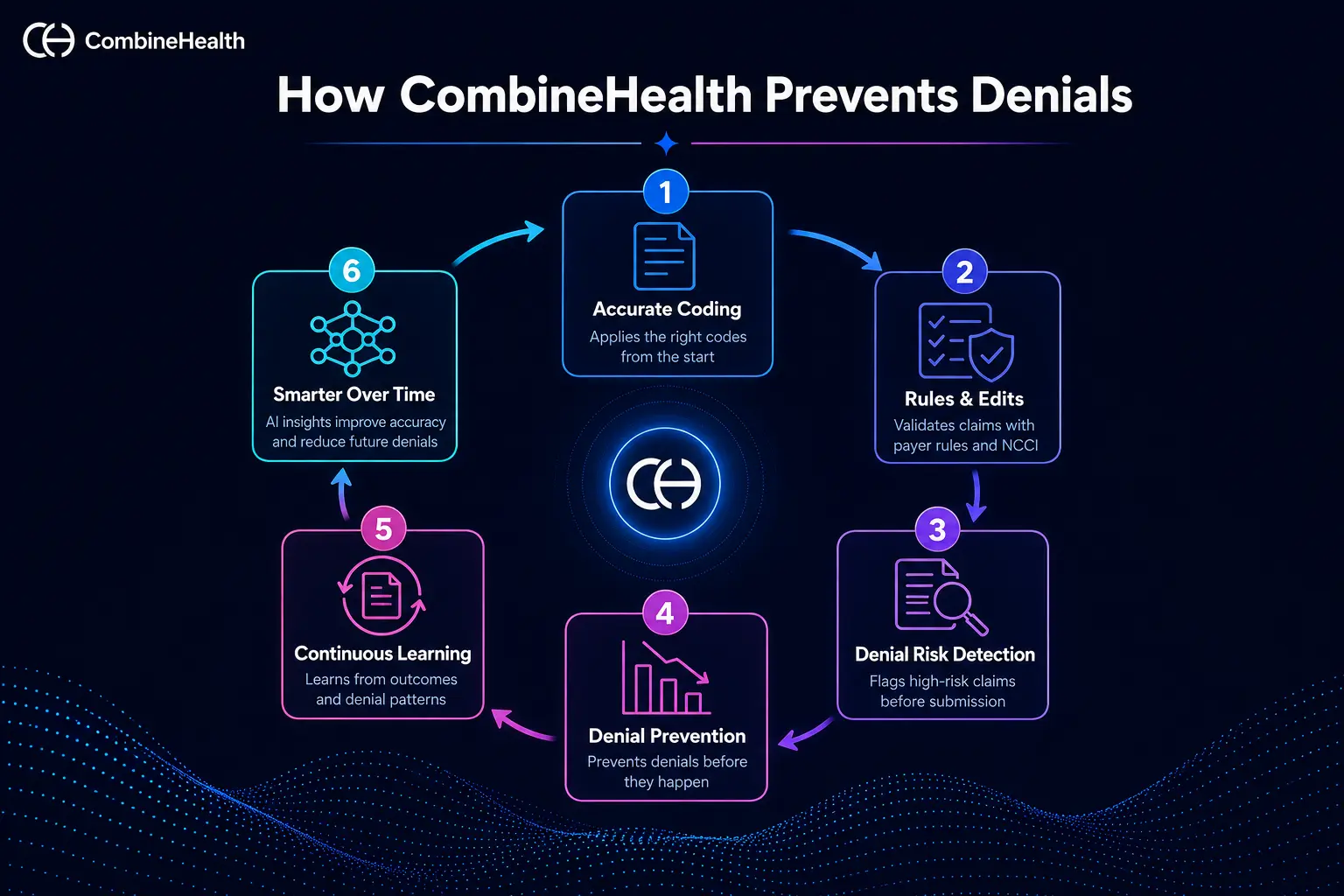
CombineHealth builds this payer intelligence from actual claim outcomes rather than published policies alone.
CombineHealth Cut Coding-Related Denials by 75% in Three Months
A 400-bed Midwest hospital applied payer-specific coding policies to every encounter. Coding-related denials fell 75%, while captured revenue increased 4% from undercoded encounters identified through the process.
Book a demo and see what CombineHealth catches in your denials!
Frequently Asked Questions
How quickly can AI identify a denial trend, such as a code pair denying for a missing modifier?
AI can analyze denials as they arrive rather than waiting for a periodic review. It categorizes each denial by reason and payer, helping recurring patterns surface in near real time. Once a pattern is validated, the relevant coding or validation rules can be updated for future claims.
Can AI prevent medical-necessity denials, or only administrative ones?
AI can help prevent medical-necessity denials when the issue is a documentation or coding gap. It can check whether procedure codes are linked to supporting diagnoses and whether documentation meets published coverage criteria. It cannot prevent a denial when the payer reviews adequate documentation and still disagrees with the clinical judgment.
How does AI handle payer-specific modifier rules?
AI can apply published payer policies before a claim is submitted. Specialty- and payer-specific nuances can be configured during onboarding and refined as actual denial patterns reveal how each payer applies its rules.
Related Blogs







Explore Our
AI Workforce







Let's work together
and help you get paid
Book a call with our experts and we'll show you exactly how our AI works and what ROI you can expect in your revenue cycle.