10 Best Medical Billing Automation Software for Health Systems (2026 Rankings)
Compare the top Medical Billing Automation Software for 2026, including AI capabilities, automation features, integrations, pricing insights, and the best solutions for modern healthcare revenue cycle management.
Published on:
June 19, 2026


Key Takeaways
• CombineHealth is the strongest overall choice for health systems thanks to its end-to-end revenue cycle automation, AI-powered coding and claim optimization, autonomous AR follow-up, denial management, and ability to automate 80–90% of routine billing work without replacing existing EHR or billing systems.
• When evaluating medical billing software, focus on denial prevention, automation depth, EHR integrations, implementation speed, and reporting transparency. The best platforms help maintain denial rates below 2–5%, automate repetitive workflows, and provide visibility into revenue cycle performance.
• The future of medical billing is AI-powered automation. The most advanced platforms no longer just assist billing teams—they actively perform coding, claim preparation, payer interactions, payment posting, denial resolution, and appeals while keeping humans focused on high-value exceptions.
• Health systems should prioritize automation depth over feature count. The biggest ROI comes from platforms that automate multiple revenue cycle workflows instead of solving a single problem like coding, eligibility verification, or denials.
• Integration flexibility matters as much as medical billing automation. The strongest solutions work alongside existing EHRs and practice management systems, reducing implementation risk and accelerating time-to-value.
Medical billing is no longer just a behind-the-scenes administrative task for healthcare systems. In reality, it's a real game-changer in terms of cash flow, denial rates, the productivity of your staff, and how patients are left dealing with their finances.
Getting medical billing right is where medical billing automation software comes in - to help revenue cycle teams automate the whole process from submitting claims, to assigning codes, checking patient eligibility, posting payments, dealing with rejected claims, and following up on outstanding patient bills. The best ones are now also using AI to cut down on all that manual drudge work, catch any mistakes before they become a problem, and get patients reimbursed faster.
But the truth is, not every medical billing platform is the same. Some are ideal for smaller, independent practices while others are a better fit for specialty groups, clinics, or giant health systems.
This guide ranks the 10 best medical billing automation software platforms for 2026, taking into account:
- How well they automate everything
- Their AI capabilities
- How well they integrate with other systems
- What parts of the revenue cycle they cover
- How well they scale
On this page
- What is Medical Billing Automation?
- Key Features of A Medical Billing Automation Software
- How We Ranked These Medical Billing Automation Platforms
- What are the Best Tools for Medical Billing Automation in Healthcare?
- Key Considerations for Choosing a Medical Billing Automation Software
- Ready to Reduce Your Billing Denials?
- FAQs
What is Medical Billing Automation?
Medical billing automation refers to the use of software, artificial intelligence, and workflow automation technologies to streamline revenue cycle management (RCM) activities such as eligibility verification, charge capture, coding validation, claims submission, denial management, payment posting, and patient billing.
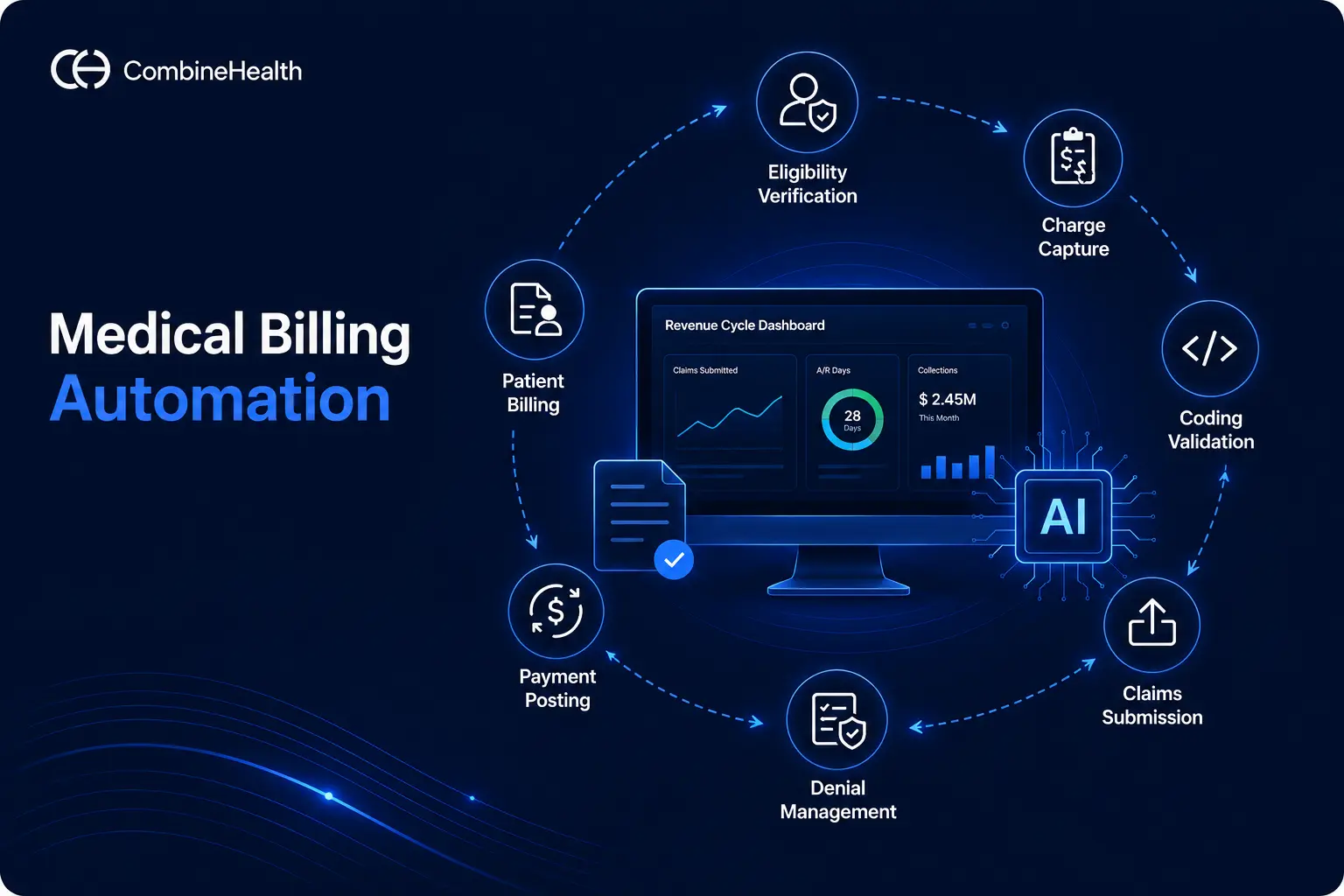
Rather than relying on manual processes and repetitive administrative work, healthcare organizations use billing automation platforms to move information automatically between EHRs, practice management systems, clearinghouses, payers, and patient billing systems.
Key Features of A Medical Billing Automation Software
While capabilities vary across vendors, most leading platforms include the following functionality:
Automated Claim Submission
Automates claim creation, scrubbing, validation, and submission to clearinghouses and payers while applying payer-specific edits before claims are sent.
AI-Powered Coding and Charge Capture
Uses AI models and rules engines to validate diagnosis and procedure codes, identify missing documentation, and improve charge capture accuracy.
Eligibility Verification
Verifies insurance coverage and benefits in real time, helping providers reduce claim rejections caused by eligibility issues.
Denial Prevention and Management
Identifies high-risk claims before submission, automates denial tracking, and supports appeals workflows to improve reimbursement rates.
Payment Posting Automation
Processes electronic remittance advice (ERA) files and automatically posts payments while reconciling balances and identifying discrepancies.
Patient Billing and Collections
Supports digital statements, online payments, payment plans, and automated patient communication workflows.
Revenue Cycle Analytics
Provides dashboards and reporting for key performance indicators such as denial rates, days in A/R, net collection rates, reimbursement trends, and claim status.
EHR and Practice Management Integrations
Connects directly with leading healthcare platforms including Epic, Oracle Health (Cerner), athenahealth, NextGen, and specialty-specific EHR systems.
How We Ranked These Medical Billing Automation Platforms
We evaluated each platform across six key areas that directly impact financial performance and operational efficiency:
Automation Depth
We assessed how much of the revenue cycle each platform can automate, including eligibility verification, charge capture, medical coding, claims submission, denial management, payment posting, and accounts receivable workflows. Platforms that automate multiple stages of the billing lifecycle ranked higher than those focused on a single function.
AI Capabilities
Artificial intelligence is becoming a major differentiator in revenue cycle management. We looked at how vendors use AI for coding assistance, denial prediction, clinical documentation improvement (CDI), voice automation, workflow orchestration, and decision support. Solutions with meaningful AI-driven automation received stronger consideration than those relying primarily on traditional rules engines.
Integration Ecosystem
Medical billing software rarely operates in isolation. We evaluated each vendor's ability to integrate with leading EHRs, practice management systems, clearinghouses, payer networks, and healthcare APIs. Platforms that fit seamlessly into existing healthcare technology stacks scored more favorably.
Revenue Cycle Coverage
Some vendors focus on a specific workflow, while others provide end-to-end revenue cycle automation. We considered how comprehensively each platform supports the billing process—from patient intake and eligibility checks to reimbursement and collections.
Enterprise Readiness
Because this ranking focuses on health systems rather than individual practices, we prioritized solutions capable of supporting large provider organizations, multi-site operations, complex payer environments, and high transaction volumes.
Implementation and Time-to-Value
Even the most advanced platform delivers limited value if implementation is lengthy or disruptive. We reviewed each solution's deployment model, integration complexity, scalability, and ability to generate measurable results within a reasonable timeframe.
Rather than ranking vendors based on a single feature, we prioritized platforms that balance automation, AI innovation, interoperability, and measurable revenue cycle outcomes. The result is a list designed to help healthcare leaders identify the solutions best suited to their organization's operational and financial goals.
What are the Best Tools for Medical Billing Automation in Healthcare?
1. CombineHealth: Top-Rated for End-to-End Medical Billing Automation
CombineHealth ranks first because it automates more of the billing lifecycle than most competitors. Rather than focusing on a single workflow such as coding or eligibility verification, the platform uses agentic AI to orchestrate claim creation, payer interactions, payment posting, and denial prevention within one system.
Integration and Usability
The platform's flagship AI medical billing solution, Mark, integrates with existing EHR and practice management systems to automate eligibility checks, charge entry, claim generation, payer portal navigation, payment reconciliation, and denial prevention. This approach allows healthcare organizations to layer automation on top of their existing technology stack without replacing core systems.
Some supported integrations are:
- Epic
- Athena
- ModMed
- Cerner
- eClinicalWorks
- AdvancedMD
- Custom systems
For health systems struggling with staffing shortages and fragmented billing workflows, CombineHealth offers one of the most comprehensive automation strategies available today.

Key Offerings by CombineHealth
- Eligibility and benefits verification automation
- AI-powered coding and claim scrubbing
- Payer-aware claim optimization
- Autonomous AR follow-up
- Denial management and appeals automation
- Revenue leakage analytics
- Explainable human-in-the-loop AI that works inside existing EHR/PMS workflows
What Makes CombineHealth Standout?
- AI That Performs Billing Work, Not Just Assists Staff: CombineHealth positions its AI as an operational medical billing and claims automation workforce rather than a copilot. The platform can execute tasks such as coding, claim scrubbing, 50+ payer portal navigation, status checks, and payment posting, while escalating only complex exceptions to human reviewers.
- End-to-End Revenue Cycle Automation: Unlike point billing solutions that focus on coding, eligibility, or denials alone, CombineHealth automates the entire billing lifecycle—from insurance verification and charge capture to claim submission, AR follow-up, denial management, and appeals.
- Payer-Aware Claim Optimization: The platform doesn't simply apply standard coding guidelines. It incorporates payer-specific policies, denial patterns, medical necessity requirements, and reimbursement rules to optimize claims for real-world adjudication and reimbursement outcomes.
- Autonomous Denial Management and Appeals: CombineHealth helps identify denial root causes, track denial trends, generate appeal documentation, and automate portions of the appeals process. This creates a closed-loop system that continuously learns from denial outcomes and improves future claim performance.
- Works Within Existing EHR and Billing Systems: Rather than requiring organizations to replace their current technology stack, CombineHealth integrates with platforms such as Epic, athenahealth, ModMed, Cerner, eClinicalWorks, and custom systems through APIs and workflow automation.
- Explainable AI with Human Oversight: Every recommendation includes supporting evidence, coding rationale, and payer-specific justification. The platform is designed around a human-in-the-loop model where AI handles 80–90% of routine work while billing teams review edge cases and high-risk decisions.
Pricing
Custom pricing based on implementation scope and claim volume.
Why Health Systems Choose CombineHealth
Organizations choose CombineHealth when they want to automate large portions of the revenue cycle without undertaking a complete technology replacement project. Its ability to unify eligibility, claims, denials, payment posting, and payer interactions within a single AI-driven workflow makes it one of the strongest options for enterprise billing automation.
Best For
Autonomous Medical Billing Automation
2. Stedi
Stedi is not a traditional medical billing platform. Instead, it provides the transaction infrastructure that powers eligibility checks, claims submission, ERAs, enrollment, and claim status workflows. For health systems building custom revenue cycle technology stacks, Stedi offers a modern, API-first alternative to legacy clearinghouses.
Its programmable architecture makes it particularly attractive to organizations investing in AI-powered automation, allowing developers to build custom workflows without replacing existing billing systems.
Key Features:
- Real-time eligibility verification
- Claims submission and status tracking
- ERA processing
- Provider enrollment automation
- CMS-1500 and UB-04 support
- Healthcare-specific APIs and developer tools
Best For
Health systems, healthcare technology vendors, and organizations building custom revenue cycle automation solutions.
3. Prosper AI
Prosper AI focuses on one of the most expensive and time-consuming aspects of healthcare billing: phone calls. Its healthcare-specific voice agents automate interactions with both patients and payers, helping organizations reduce administrative burden while accelerating access to critical billing information.
Unlike generic voice AI tools, Prosper AI is designed specifically for healthcare workflows such as eligibility verification, benefits checks, prior authorization inquiries, claim status requests, and patient billing support.
Key Features
- AI-powered payer call automation
- Eligibility and benefits verification
- Prior authorization support
- Claim status inquiries
- Patient billing assistance
- Multilingual voice interactions
Best For
Organizations with large patient access teams, centralized scheduling departments, or high payer-call volumes.
4. Tebra (Kareo)
Tebra combines practice management, EHR, patient engagement, and billing functionality within a single platform. Built from the merger of Kareo and PatientPop, the platform is designed to help ambulatory practices streamline operations while improving financial performance.
In addition to software, Tebra offers managed billing services, giving healthcare organizations flexibility in how they approach revenue cycle management.
Key Features:
- Integrated EHR and practice management
- Automated claim scrubbing
- ERA posting automation
- Denial tracking
- Patient billing and collections
- Managed billing services
Best For
Independent practices, physician groups, and growing ambulatory organizations.
5. ModMed
ModMed combines specialty-specific EHR, practice management, and revenue cycle capabilities into a unified platform designed for providers with complex clinical workflows. Unlike general-purpose billing platforms, ModMed tailors its technology to specialties such as orthopedics, dermatology, ophthalmology, gastroenterology, and plastic surgery.
Key Features
- Specialty-specific EHR and billing workflows
- AI-powered clinical documentation assistance
- Denial risk identification
- Revenue cycle management services
- Charge capture optimization
- Specialty-focused reporting and analytics
Best For
Specialty provider groups seeking integrated clinical and billing workflows.
6. NextGen
NextGen Healthcare is one of the most established names in ambulatory care technology. Its integrated EHR, practice management, and billing platform helps organizations automate claims processing, eligibility verification, patient billing, and collections.
Best For
Large physician groups and ambulatory care networks.
7. Jorie AI
Jorie AI is one of the most ambitious AI-first revenue cycle automation platforms on the market. The company positions itself as a zero-touch RCM platform capable of automating eligibility verification, prior authorizations, claims management, payment posting, denials, and accounts receivable workflows.
Key Features
- Eligibility verification automation
- Prior authorization workflows
- Claims submission and follow-up
- Payment posting automation
- Denial prevention and management
- Enterprise interoperability layer
Best For
Large health systems, MSOs, and organizations pursuing end-to-end automation.
8. RXNT
RXNT offers a cloud-based practice management and medical billing platform designed to simplify revenue cycle operations for physician groups, community health organizations, and billing companies.
Key Features
- Medical billing and claims management
- Claim scrubbing and validation
- Multi-location support
- Revenue reporting dashboards
- Patient payments
- Practice management tools
Best For
Small and mid-sized healthcare organizations.
9. AllegianceMD
AllegianceMD combines practice management and billing functionality into a single platform focused on improving claim acceptance rates and reducing administrative workload.
Its billing tools emphasize claim scrubbing, denial tracking, payment posting, and patient collections.
Key Features
- Claim scrubbing
- Denial management
- Electronic payment posting
- Patient collections automation
- Rejection tracking
- Revenue cycle reporting
Best For
Medical practices seeking an all-in-one billing and practice management platform.
10. PrognoCIS
PrognoCIS combines EHR, practice management, clearinghouse, and billing functionality into a highly customizable platform for ambulatory and specialty care providers.
Key Features
- Integrated EHR and billing
- Real-time eligibility verification
- Claim scrubbing
- Electronic claims submission
- Payment posting
- Financial analytics
Key Considerations for Choosing a Medical Billing Automation Software
Denial Prevention and Revenue Impact
Denial rate is one of the clearest indicators of billing performance. As a benchmark, look for vendors that can help keep denial rates in the 2–5% range or lower, depending on specialty, payer mix, and claim complexity.
The strongest platforms reduce preventable denials through claim scrubbing, coding validation, eligibility checks, payer-specific edits, and AI-based denial risk detection before claims are submitted.
Specialty and Workflow Expertise
Healthcare billing is not one-size-fits-all. Coding requirements, reimbursement rules, and denial patterns vary significantly by specialty, whether the organization serves cardiology, orthopedics, dermatology, oncology, family practice, or multi-specialty care.
Look for vendors with proven experience in your specialty and workflows. Specialty-specific platforms can often reduce implementation friction and improve coding accuracy faster than generic billing tools.
EHR and Technology Integration
Medical billing automation software should work with your existing EHR, practice management system, clearinghouse, payer portals, and patient engagement tools.
For health systems, prioritize vendors that integrate with platforms such as Epic, Oracle Health/Cerner, athenahealth, eClinicalWorks, NextGen, ModMed, and AdvancedMD. The less manual data transfer required, the faster the organization can reduce billing delays and administrative overhead.
Automation Depth
Many vendors claim to offer automation, but the level of automation varies widely.
Some tools automate individual tasks such as claim scrubbing or eligibility checks. More advanced platforms automate larger portions of the revenue cycle, including coding, payment posting, AR follow-up, denial management, and appeals. In stronger AI-first systems, automation can cover 80–90% of routine billing work, with human review reserved for the remaining 10–20% of complex or ambiguous cases.
Analytics and Reporting Transparency
Revenue cycle leaders need clear visibility into performance. Look for platforms that report on metrics such as denial rate, clean-claim rate, days in A/R, net collection rate, payment lag, appeal success rate, and staff productivity.
At minimum, vendors should provide regular KPI reporting, transparent dashboards, and dedicated account management. For health systems, reporting should also support payer-level, provider-level, specialty-level, and location-level analysis.
Implementation Support and Time-to-Value
A successful billing automation rollout depends on more than software features. Evaluate the vendor's onboarding process, implementation resources, support model, and ability to configure workflows around your existing operations.
As a benchmark, task-specific automation such as AR follow-up may be deployable in as little as 2 weeks, while coding automation often takes closer to 4 weeks and broader billing workflow automation may take 4–6 weeks depending on integration complexity and validation requirements.
Scalability and Transaction Volume
Health systems need software that can scale across high claim volumes, multiple locations, large RCM teams, and complex payer mixes. Ask vendors how many claims, payer transactions, portal workflows, and users they can support.
Strong enterprise platforms may support thousands of payer connections, process billions of transactions, or automate workflows across dozens of payer portals. These scale indicators matter because a platform that works for a small practice may not perform well in a multi-site health system environment.
Ready to Reduce Your Billing Denials?
The best medical billing automation software depends on your organization’s size, workflows, specialty mix, and existing technology stack.
For health systems seeking end-to-end billing automation, CombineHealth and Jorie AI stand out. For revenue integrity and CDI, SmarterDx is a strong fit. For transaction infrastructure, Stedi is a compelling option. Ambulatory and specialty groups may prefer ModMed, NextGen, Tebra, or PrognoCIS.
If your priority is automating more of the revenue cycle without replacing your existing EHR or billing systems, CombineHealth is the strongest overall choice. Its AI agents support eligibility, coding, claim preparation, AR follow-up, denial management, appeals, and payment posting in one connected workflow.
To see how CombineHealth can automate your billing workflows, book a demo with CombineHealth.
FAQs
Can medical billing be automated?
Yes. Many medical billing tasks can be automated, including eligibility checks, claim scrubbing, coding review, charge capture, claim submission, payment posting, denial detection, and follow-up workflows. Human oversight is still important for complex cases, payer exceptions, appeals, and compliance-sensitive decisions.
How can medical billing management improve the efficiency of healthcare providers?
Effective medical billing management reduces manual work, speeds up claim submission, improves accuracy, lowers denial rates, and helps providers collect revenue faster. It also gives teams better visibility into bottlenecks, payer issues, coding errors, and reimbursement delays.
Can you explain the difference between medical coding and medical billing?
Medical coding translates diagnoses, procedures, and services into standardized codes like ICD, CPT, and HCPCS. Medical billing uses those codes to create and submit claims, manage payer communication, post payments, resolve denials, and collect reimbursement.
How do I automate medical billing and coding?
Start by identifying repetitive workflows such as eligibility checks, coding review, claim scrubbing, prior authorization tracking, denial routing, and payment posting. Then choose software that integrates with your EHR/PM system, applies automation or AI, flags errors before submission, and keeps human review for exceptions.
What is the best medical billing software?
The best medical billing software depends on your organization’s size, specialty, payer mix, and revenue cycle goals. Look for software that reduces denials, improves clean claim rates, automates manual tasks, integrates with existing systems, supports reporting, and improves collections.
How does medical billing software work?
Medical billing software manages the claim lifecycle from patient and insurance information to charge capture, claim creation, submission, payment posting, denial tracking, and reporting. Advanced platforms can also automate error detection, coding checks, eligibility verification, and revenue cycle workflows.
How to choose medical insurance billing software that reduces errors?
Choose software that validates patient, payer, coding, and claim data before submission. Prioritize eligibility verification, claim scrubbing, coding accuracy checks, denial analytics, workflow automation, EHR/PM integration, audit trails, and reporting that shows where errors happen and how to prevent them.
Recommended Reads







Explore Our
AI Workforce






Subscribe to newsletter - The RCM Pulse
Trusted by 200+ experts. Subscribe for curated AI and RCM insights delivered to your inbox

Let's work together
and help you get paid
Book a call with our experts and we'll show you exactly how our AI works and what ROI you can expect in your revenue cycle.