Why Should You Outsource Medical Coding in 2026
Discover why outsourcing medical coding is growing in 2026, its key benefits, the services included, and how it helps healthcare organizations improve accuracy and reduce costs.
Published on:
July 29, 2026


Outsourcing medical coding in 2026 allows healthcare organizations to improve coding accuracy, reduce claim denials, accelerate reimbursements, and manage growing documentation complexity without expanding internal coding teams.
CombineHealth's AI medical coding automation platform autonomously analyzes completed encounter documentation, applies payer-aware coding methodology, and produces explainable, billing-ready coding decisions that optimize revenue cycle performance while preserving human oversight for exceptions.
Key Takeaways
• Medical coding outsourcing in 2026 no longer means just handing charts to an offshore team. It now includes AI-native coding platforms, computer-assisted coding services, and hybrid models, each with different turnaround, cost, and control trade-offs.
• A 30% national shortage of certified medical coders is the primary force pushing organizations to outsource rather than try to hire their way out of a backlog.
• Price and turnaround time are the weakest criteria for picking a coding partner. Coding accuracy by specialty, explainability behind each code, and how tightly coding output connects to billing and denial data matter far more.
• Contract terms often determine how much a bad medical coding vendor choice actually costs you. Long lock-in periods and vague service-level language make it harder to exit an underperforming partnership than the sticker price suggests.
• CombineHealth's AI autonomously coded roughly 85% of charts at 98.5% E&M accuracy, 98.5% CPT/modifier accuracy in a 1,000-chart emergency department study, matching expert coder performance while flagging documentation gaps in real time.
• A short pilot run on your own charts, payer mix, and documentation patterns reveals far more than any medical coding vendor's benchmark numbers and should happen before any long-term commitment for medical coding outsourcing.
Somewhere between a physician finishing a note and a payer issuing a payment, every encounter has to pass through medical coding. When that step runs smoothly, nobody notices it. When it doesn't, a CFO notices it fast in a growing backlog, a rising denial rate, or a coding team that's stretched thinner every quarter.
That's the situation pushing more healthcare organizations to look at medical coding outsourcing in 2026. It's not a new idea, but the category has changed shape. A decision that used to mean choosing an offshore medical coding team now includes AI platforms that code charts directly, audit tools that catch errors before they become denials, and hybrid models that blend all of it.
This guide walks through what medical coding outsourcing actually covers, why organizations turn to it, and what to look for if you're putting a partner on your shortlist.
On this page
- What Is Medical Coding Outsourcing?
- What Does Medical Coding Outsourcing Actually Cover?
- Why Are More Healthcare Organizations Outsourcing Medical Coding in 2026?
- How to Choose a Medical Coding Outsourcing Partner?
- Medical Coding Outsourcing Companies to Evaluate in 2026
- Why CombineHealth Stands Out in 2026?
- FAQs
What Is Medical Coding Outsourcing?
Medical coding outsourcing means handing the work of translating clinical documentation into billable codes over to an external partner, rather than keeping the entire function in-house. That partner might be a certified coding team, an AI-driven platform, or some combination of the two.
What Are the Benefits of Outsourcing Medical Coding?
Outsourcing medical coding hands off routine coding volume so your team can focus on what actually needs a person's judgment. If done correctly, it delivers:
- Fewer denials: Specialty-trained coders and payer-aware platforms catch modifier errors and documentation gaps before a claim goes out, not after it comes back.
- Faster reimbursement: Clearing backlogs means claims move through the cycle faster, which shows up directly in cash flow as reimbursements.
- Lower compliance risk: Strong partners build in audit trails, override logs, and payer-policy checks, so you're not exposed when a payer audits a claim.
- Specialty coverage without hiring: Cardiology, oncology, orthopedics, and other complex specialties get coded by people or systems trained specifically on that logic, instead of stretched generalists.
- Coder retention: Freeing your in-house team from repetitive volume reduces burnout and keeps experienced coders focused on complex charts and audits.
- Better visibility: Outsourcing partners typically report accuracy and performance more rigorously than internal teams track themselves, which makes denial root causes easier to trace.
What Does Medical Coding Outsourcing Actually Cover?
Most medical coding providers offer a combination of:
- ICD-10, CPT, and HCPCS coding
- Risk adjustment coding
- Hierarchical Condition Category (HCC) coding
- Charge capture and documentation review
- Denial management and appeals
- Coding audits and compliance monitoring
- Revenue cycle management (RCM)
- Medical billing integration
- Specialty-specific coding support: cardiology, oncology, orthopedics, radiology, and others
- AI-assisted coding and automation tools

Different Types of Medical Coding Outsourcing
There are mainly three types of medical coding outsourcing:
- Offshore or domestic coding teams review your charts using certified human coders, usually billed per chart or per FTE. Turnaround depends on staffing levels, and quality depends on how well the team is trained on your specialties.
- Computer-assisted coding (CAC) services pair software suggestions with a human coder who reviews and finalizes every chart, faster than fully manual coding, but a person still touches every encounter.
- Autonomous or AI-native coding platforms code qualifying encounters directly and route only low-confidence or high-risk cases to a human reviewer. This is the fastest-growing model heading into 2026.
Knowing which model you're actually evaluating prevents a common mismatch: expecting AI-speed turnaround from a services contract, or a hands-off experience from a CAC tool that still routes every chart to a coder.
Why Are More Healthcare Organizations Outsourcing Medical Coding in 2026?
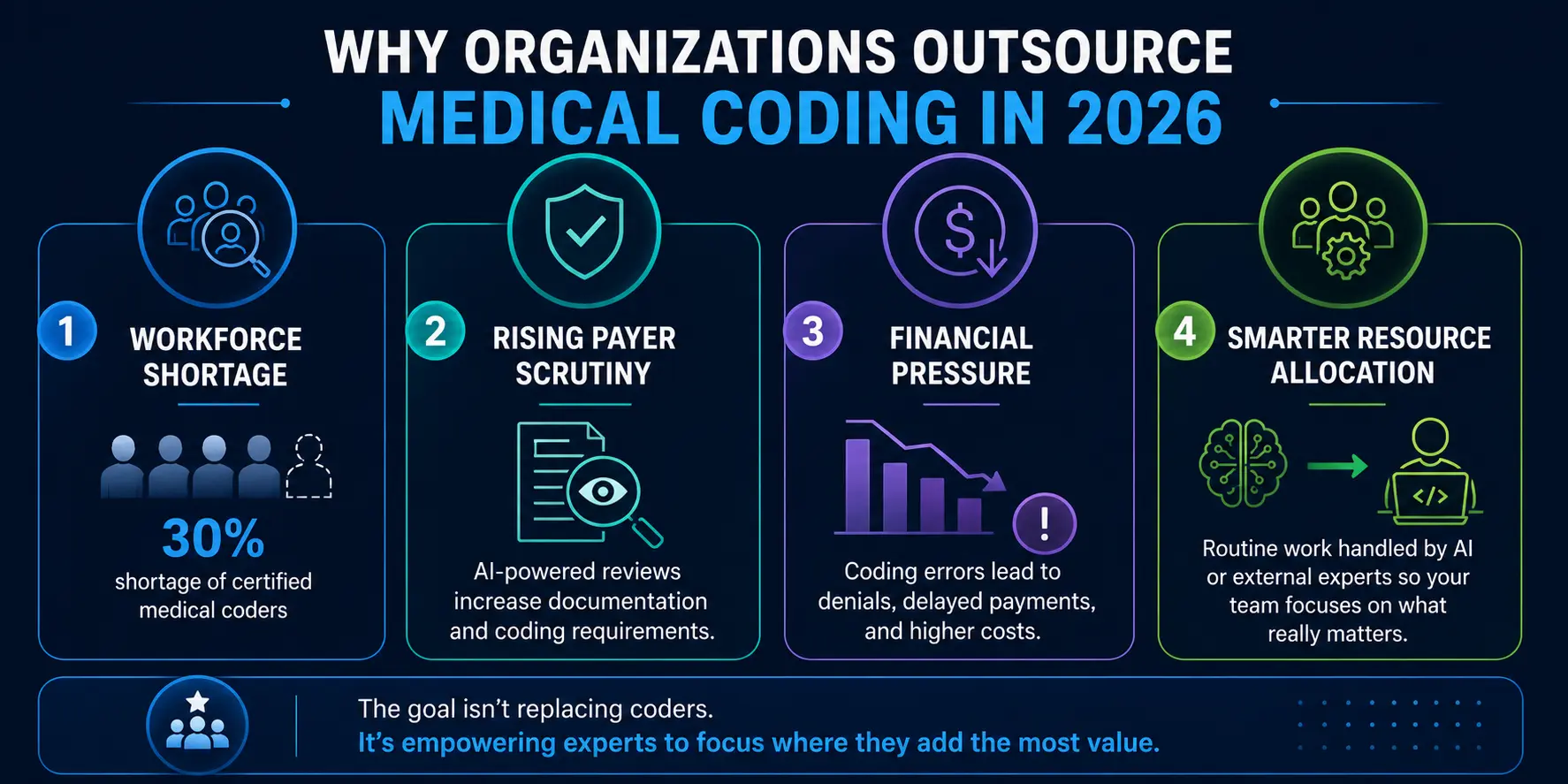
Three pressures are pushing more organizations toward outsourcing in 2026:
- Coder shortage: The American Medical Association estimates a roughly 30% national shortage of certified medical coders, which makes hiring your way out of a backlog increasingly unrealistic.
- Rising payer scrutiny: Payers are running their own AI models to catch billing issues before claims clear, which means undercoding, overcoding, and documentation gaps get caught faster and denied more often.
- Cost: Hospitals spend upwards of $20 billion overturning denied claims tied to coding inaccuracies, missing documentation, and compliance gaps. Outsourcing to a partner with strong accuracy and audit controls directly reduces that spend.
Beyond these pressures, outsourcing lets in-house teams redirect their time. Instead of coding every routine encounter, staff can focus on complex charts, provider education, and the appeals that actually need human judgment.
There is also a burnout dimension that finance leaders sometimes underweight. Coders working through a growing backlog under production pressure tend to make more errors, which creates a cycle where speed and accuracy both suffer at once.
Finally, outsourcing gives leadership a clearer view of coding performance. Internal teams rarely track their own accuracy with the same rigor an external partner is contractually required to report.
How to Choose a Medical Coding Outsourcing Partner?
CFO’s shouldn’t evaluate medical coding outsourcing partners on price or turnaround time alone. Choosing the right medical coding outsourcing company starts with being honest about what's actually broken. A backlog, an accuracy problem, and a gap in specialty coverage each point toward a different kind of vendor, and treating them as the same problem is how organizations end up disappointed six months into a contract.
It's also worth separating two questions that tend to blur together on vendor calls: who is doing the coding, and where does that coding go afterward. A vendor can be excellent at raw accuracy and still leave you exposed if the medical codes they produce don't connect cleanly to billing, denial tracking, or compliance reporting.
A more useful evaluation looks like this:
Questions to Ask When Evaluating a Medical Coding Vendor
Before you start comparing vendors, get clear on a few basics. The answers point you toward the right kind of partner.
- What's your specialty mix? Cardiology, oncology, orthopedics, and radiology each follow different coding logic. A generalist vendor can get this wrong.
- What's driving your denial rate? A high denial rate usually points to accuracy and payer-policy gaps, not staffing.
- How much compliance exposure do you carry? Higher claim volume and complex specialties raise the cost of a bad coding audit.
- How much automation are you comfortable with? Some organizations want charts handled entirely by an outside team. Others prefer AI on routine volume, with staff reviewing exceptions.
One more thing to check: how well a vendor's systems talk to each other. A documentation gap caught during coding should flag before the claim goes out, not surface weeks later as an untraceable denial. Ask how their coding, billing, and denial data connect.
Specialty fit is worth its own conversation.
Example:
A cardiology chart's modifier logic has little in common with an orthopedic chart's, and a broadly trained coding team can miss nuance that a specialty-focused coder or a specialty-aware AI model catches without effort.
If your organization spans multiple specialties, ask for accuracy figures broken down by specialty rather than a single blended number.
How to Validate a Vendor Before You Sign
Run a Pilot Before You Commit
A short pilot tells you more than any sales conversation. Track coding accuracy by specialty and encounter type, the rate of human override, the effect on your clean claim rate, and how smoothly the vendor's output flows into your existing systems. A platform that performs well on a generic benchmark can still stumble once it meets your real documentation quality and payer mix.
Test How the Vendor Explains Its Coding Decisions
Use the pilot to test something sales calls won't show you: how the vendor responds when you push back on a specific code. A partner who can walk you through the exact documentation, guideline, and payer rule behind a decision is one you can defend in an audit. A partner who can only say "the system generated it" is a compliance risk you haven't paid for yet.
Get the Contract Terms Right
Contract terms matter more than they might seem at first glance. Long lock-in periods, proprietary data formats, and vague service-level language around turnaround time all make it harder to walk away from an underperforming partner. A 60- to 90-day pilot with clearly defined exit terms protects you far more than a slightly lower headline rate.
Medical Coding Outsourcing Companies to Evaluate in 2026
The market includes both AI-native platforms and more established enterprise coding ecosystems, and it's worth understanding the range before narrowing your list.
CombineHealth: Best for Explainable, Payer-Aware Autonomous Coding
CombineHealth is an autonomous medical coding platform built for health systems and specialty groups that need to scale output without losing sight of how each decision was made. CombineHealth's medical coding platform, Amy, reads the entire chart, including notes, orders, medications, imaging, labs, and carries it through the full coding decision rather than handing off a partial answer, independently determining:
- ICD-10 diagnoses
- CPT procedures
- E&M levels and modifiers
- The rendering provider
Feature #1: Fully Explainable Decisions
Every medical code comes with the reasoning, supporting documentation, and exact chart evidence behind it, so autonomy never becomes a black box.
Feature #2: Payer-Aware Coding
CombineHealth’s AI, Amy, checks Medicaid rules, commercial payer policies, Medicare requirements, NCCI edits, and LCD/NCD coverage before a code is finalized, not after a denial forces a rework.
Feature #3: Intelligent Diagnosis Sequencing
Amy determines which diagnosis best supports medical necessity, recognizing, for example, that chest pain may be the more appropriate primary diagnosis than a discharge diagnosis like GERD.
Feature #4: Built-In CDI
Amy flags clinical documentation gaps in real time as it codes, so gaps get caught before the claim goes out, not after a denial comes back.
Feature #5: Confidence-Based Human Review
Low-confidence charts route to a human with CombineHealth’s AI reasoning and evidence attached, rather than getting auto-submitted.
Results: 98.5% E&M accuracy, 98.5% CPT/modifier accuracy, and up to an 85% autonomous coding rate.
Best for: Health systems and specialty practices that want autonomous medical coding without giving up auditability or control.
CodaMetrix
CodaMetrix focuses on contextual coding automation for high-volume health systems, using broader clinical context to support compliant code assignment across professional and facility billing.
Fathom
Fathom built its reputation on autonomous coding at scale, and it's a common evaluation point for organizations trying to reduce manual coding workload across repeatable encounter types.
Solventum 360 Encompass
Solventum 360 Encompass tends to fit large hospitals and enterprise HIM teams that need coding automation layered inside an already-mature CDI, CAC, and mid-revenue-cycle environment.
Optum Integrity One
Optum’s Integrity One medical coding targets large healthcare organizations that want coding, documentation review, and compliance oversight under one enterprise platform rather than stitched together across separate tools.
Whichever names end up on your shortlist, validate their claims against your own charts, payer mix, and documentation patterns before committing to anything long-term. A blended accuracy number rarely tells you how a platform will actually perform on your specific specialty mix.
Why CombineHealth Stands Out in 2026?
Medical coding accuracy is a moving target that shifts with every payer policy update and every new denial pattern. What sets platforms like CombineHealth apart is that the feedback loop doesn't stop at go-live: Taylor, its analytics agent, continuously traces denial patterns and payer behavior back into Amy's coding logic, so accuracy keeps improving the longer the system runs, not just on day one.
If your organization is weighing outsourcing against building AI coding capability in-house, the fastest way to get a real answer is a short pilot on your own charts, not a vendor's benchmark numbers. Book a demo with CombineHealth to see how Amy fits into your coding and revenue cycle workflow.
FAQs
What is medical coding outsourcing?
Handing ICD-10, CPT, and HCPCS coding off to an external partner, a certified coding team, an AI platform, or a hybrid of both, instead of running the function entirely in-house.
Is AI-driven coding accurate enough for complex charts?
Leading platforms report 95–99% accuracy on qualifying encounters, though results vary by specialty and documentation quality. Platforms that route low-confidence charts to human review, rather than auto-submitting everything, tend to hold up better on complex cases.
How much does medical coding outsourcing typically save an organization?
The bigger financial impact usually comes from fewer denials and faster reimbursement, not a lower per-chart coding fee. Since coding errors drive roughly one in five denials industry-wide, accuracy gains tend to compound over time rather than show up as a one-time savings line.
Will outsourcing replace an in-house coding team?
Rarely. Most organizations use it to absorb routine, high-volume coding while in-house staff handles complex charts, audits, and documentation gaps that need real judgment. The mix shifts gradually as coders spend less time on repetitive charts.
How do I know if my organization actually needs to outsource?
A growing coding backlog, a rising denial rate tied to coding errors, or a specialty you can't reliably staff in-house are the clearest signals. If your accuracy numbers are solid and your backlog is under control, outsourcing might make sense only for overflow volume, not the entire coding function.
What should I ask a vendor before signing anything?
Which specialties and encounter types they support, how they explain a coding decision, what audit trails they maintain, how they handle payer-policy updates, and how their output actually connects to your billing and denial management workflows.
Recommended Reads







Explore Our
AI Workforce






Subscribe to newsletter - The RCM Pulse
Trusted by 200+ experts. Subscribe for curated AI and RCM insights delivered to your inbox

Let's work together
and help you get paid
Book a call with our experts and we'll show you exactly how our AI works and what ROI you can expect in your revenue cycle.