Top 10 Medical Billing Services in New York (2026)
Compare the top 10 medical billing services in New York by features and best fit, plus how to evaluate vendors for Medicaid and no-fault claims.
Published on:
October 1, 2026


Key Takeaways
• CombineHealth brings eligibility, coding, claim validation, denial work, and appeals onto a single platform that learns from New York claim outcomes, applying payer intelligence built from each payer's actual behavior, an approach tied to up to 85% coding automation, 97.2%+ accuracy, and up to a 75% reduction in coding-related denials
• Medical billing in New York differs from most states because providers bill four distinct payer systems at once: Medicaid managed care, workers' compensation, no-fault auto insurance, and commercial payers, each with its own submission rules, authorization requirements, and appeal timelines.
• New York Medicaid managed care organizations operate independently from the state program, meaning providers credentialed with the state agency still need separate enrollment with each individual plan, which a billing vendor must track directly to avoid enrollment delays.
• Workers' compensation and no-fault billing add a second layer of state-specific rules, running on separate fee schedules, documentation standards, and short filing deadlines that differ from standard commercial claims.
• A medical billing company does not need to be based in New York to serve New York providers well, since what matters is demonstrated experience with the organization's specific payer mix, specialties, EHR, and New York Medicaid plans.
• Evaluating a New York medical billing vendor comes down to nine consistent criteria, including specialty fit, coding accuracy measured at the claim-line level, New York Medicaid experience, dedicated workers' compensation and no-fault workflows, and independently verifiable evidence of outcomes.
A New York practice rarely bills a single kind of payer. In one week, claims can include commercial plans, Medicaid managed care organizations, workers' compensation carriers, and no-fault auto insurers. Each follows its own submission rules, authorization requirements, and appeal timelines.
That mix creates three problems that a generic billing service handles poorly. Medicaid managed care plans operate independently of the state program, so each plan needs its own enrollment and rulebook. Workers' compensation and no-fault claims run on separate fee schedules and tight filing deadlines. And a billing team that cannot connect medical coding, eligibility, and denial data across the cycle repeats the same errors with every payer.
The right partner needs proven experience with your payer mix, specialties, EHR, and New York Medicaid plans. This guide ranks 10 medical billing services in New York, sets out what each one covers, and closes with a structured way to evaluate any vendor before you sign.
On this page
- 1. CombineHealth
- 2. R1 RCM
- 3. athenahealth
- 4. Sunknowledge Services
- 5. HMS USA
- 6. Millennium Medical Billing
- 7. Core Med Billing
- 8. MediBillMD
- 9. AffinityCore
- 10. Credex Healthcare
- What Makes Medical Billing in New York Different?
- How to Evaluate a Medical Billing Service in New York
- See How CombineHealth Handles Your New York Payer Mix
- FAQs
- What Is a Medical Billing Service in New York?
- How Much Do Medical Billing Services in New York Cost?
- Does a Medical Billing Company Need to Be Based in New York?
- Which Medical Billing Service Is Best for a Small Practice?
- How Can a Billing Service Reduce Claim Denials?
- Can AI Handle Medical Billing for New York Payers?
1. CombineHealth
CombineHealth brings the revenue cycle management onto one AI-driven platform for New York practices, physician groups, hospitals, and health systems. Eligibility, medical coding, claim validation, denial work, payer follow-up, and appeals share a single data trail, so what the platform learns at one stage sharpens the next.
New York billing depends on that knowledge, because Medicaid managed care plans, no-fault carriers, workers' compensation payers, and commercial insurers each respond differently to the same claim.
Standout Capabilities of CombineHealth
- Payer-aware coding and billing: Also referred to as Amy AI, CombineHealth’s self-learning medical coding software reads completed encounter documentation directly from the EMR. It codes to national guidelines and to the modifier and documentation rules of each New York payer.
- Learning from New York claim outcomes: Every denial, reimbursement, and underpayment strengthens the platform's payer intelligence. Recurring payer behavior then shapes how future claims are coded and validated.
- Front-end denial prevention: Coverage status, network and referral requirements, and patient responsibility are checked before the visit. Each New York payer type carries distinct verification and authorization rules, and the platform applies them at the front door.
- Claim and dispute handling for New York payers: Pre-bill validation, follow-up, and appeals work to the filing windows and appeal deadlines that each payer sets.
- Automation at scale: The platform automates up to 85% of medical coding with 97.2%+ accuracy.
- Audit-ready decisions: Each decision carries its clinical evidence and payer-specific reasoning, linked back to the source note. Coders, auditors, and compliance teams can trace why a code was assigned and defend it in an audit or appeal.
- Measured results: Customers report up to 75% fewer coding-related denials, 5× more CDI opportunities identified, and up to 4% more captured revenue. A large emergency medicine deployment holds turnaround under 12 hours.
Key Features
- Eligibility and benefits verification
- Pre-bill claim validation against payer-specific rules
- Autonomous medical coding across the complete encounter
- Medical coding audits
- Clinical documentation integrity (CDI) review
- Denial categorization and management
- AR and payer follow-up
- Appeal preparation
- Payer analytics
- EHR, PMS, portal, and EDI integration
- Explainable coding and claim decisions with full audit trails
Best For: New York physician practices, specialty groups, hospitals, and health systems seeking to automate the revenue cycle end-to-end across eligibility, coding, claim validation, denials, and appeals.
2. R1 RCM
R1 RCM is a revenue cycle management company that serves large hospitals and health systems through technology-enabled managed services. Its model spans the cycle from patient access through collections, which suits organizations that want to hand over large operational blocks. Independent practices generally find the scope broader than they need, and health systems should confirm how R1 RCM handles their payer contracts and New York Medicaid managed care plans.
Key Features:
- Enterprise patient access
- Revenue integrity
- Medical coding
- Billing operations
- Denial management
- Patient financial services
- Technology-enabled managed services
- Large-scale operational support
Best For: Large New York hospitals and health systems that want a scaled partner for broad revenue cycle operations.
3. athenahealth
athenahealth is a healthcare technology company that combines an electronic health record, practice management, and billing services in one system. Billing runs alongside clinical documentation and scheduling, which shortens the path from encounter to claim. The full benefit depends on adopting the wider athenahealth ecosystem, so compare total cost and switching effort if your practice uses a different EHR.
Key Features:
- EHR and practice-management integration
- Eligibility verification
- Claim creation and submission
- Payer-rule checks
- Denial workflows
- Payment posting
- Patient billing
- Reporting
Best For: New York ambulatory practices that want billing integrated with their EHR.
4. Sunknowledge Services
Sunknowledge Services is an American-owned billing and outsourcing company headquartered in New York City, with operational hubs in India. It concentrates on durable medical equipment (DME), home medical equipment (HME), and orthotics and prosthetics (O&P) billing, and reports ISO 27001 certification. Ask about staff location, account ownership, security controls, and quality checks to confirm the delivery model fits your compliance needs.
Key Features:
- Eligibility verification
- Claims submission and processing
- Medical coding
- Denial management
- Accounts receivable follow-up
- DME, HME, and O&P billing
- Payer experience with EmblemHealth, Empire, Fidelis, Anthem, Aetna, and UnitedHealthcare
- Integration with major EHR and EMR systems
Best For: High-volume specialty billing and operational outsourcing, especially DME and specialty providers.
5. HMS USA
HMS USA is a medical billing company that provides revenue cycle services to physician practices. Its public materials describe coding, claims submission, payment posting, insurance verification, denial management, and patient billing, with customized reporting. Verify current specialties, office locations, integrations, service-level commitments, and New York market presence directly, since public sources offer limited detail.
Key Features:
- Medical billing and coding
- Credentialing
- Eligibility and insurance verification
- Denial management
- AR recovery
- Specialty billing
- Payment posting
- Practice reporting and analytics
Best For: Multispecialty physician groups seeking a full-service billing partner.
6. Millennium Medical Billing
Millennium Medical Billing is a billing firm that serves independent specialty practices with direct account support. Practices that value a named contact and local availability will find the model appealing. Confirm which services the base fee includes and whether support extends across New York State.
Key Features:
- Medical billing
- Medical coding
- Claim submission
- Denial follow-up
- AR management
- Credentialing
- Direct account support
- Specialty experience
Best For: Independent specialty practices seeking New York-based support.
7. Core Med Billing
Core Med Billing is a Brooklyn-based billing firm known for personalized service. Small firms give each account close attention and quick responses. Ask about backup staffing, technology, escalation procedures, and the ability to scale as your practice grows.
Key Features:
- Claim submission
- Payment posting
- Denial management
- AR follow-up
- Direct account communication
- Brooklyn presence
Best For: Small practices wanting a local New York City billing partner.
8. MediBillMD
MediBillMD is a medical billing company that supports small and mid-sized multispecialty groups. One vendor that handles varied specialty rules reduces the number of partners a group must manage. Request references from organizations with comparable payer mixes and specialties.
Key Features:
- Medical billing
- Medical coding
- Credentialing
- Denial management
- AR management
- Specialty coverage
- EHR compatibility
Best For: Small and mid-sized multispecialty groups in New York.
9. AffinityCore
AffinityCore is a billing company that bundles billing, coding, and credentialing under one vendor, which reduces handoffs between teams. Confirm its current operating footprint, specialty support, staffing model, and security controls before you commit.
Key Features:
- Full-cycle medical billing
- Medical coding
- Credentialing
- Denial management
- AR follow-up
- Practice reporting
Best For: Practices wanting coordinated billing, coding, and credentialing from one partner.
10. Credex Healthcare
Credex Healthcare is a billing and provider enrollment company that supports growing practices. New and expanding practices often need payer enrollment and billing support at the same time. Evaluate credentialing timelines and performance separately from ongoing billing results, since each depends on different processes.
Key Features:
- Medical billing
- Medical coding
- Credentialing
- Payer enrollment
- Denial management
- AR support
- Practice consulting
- Reporting
Best For: Growing New York practices needing billing and provider enrollment together.
What Makes Medical Billing in New York Different?
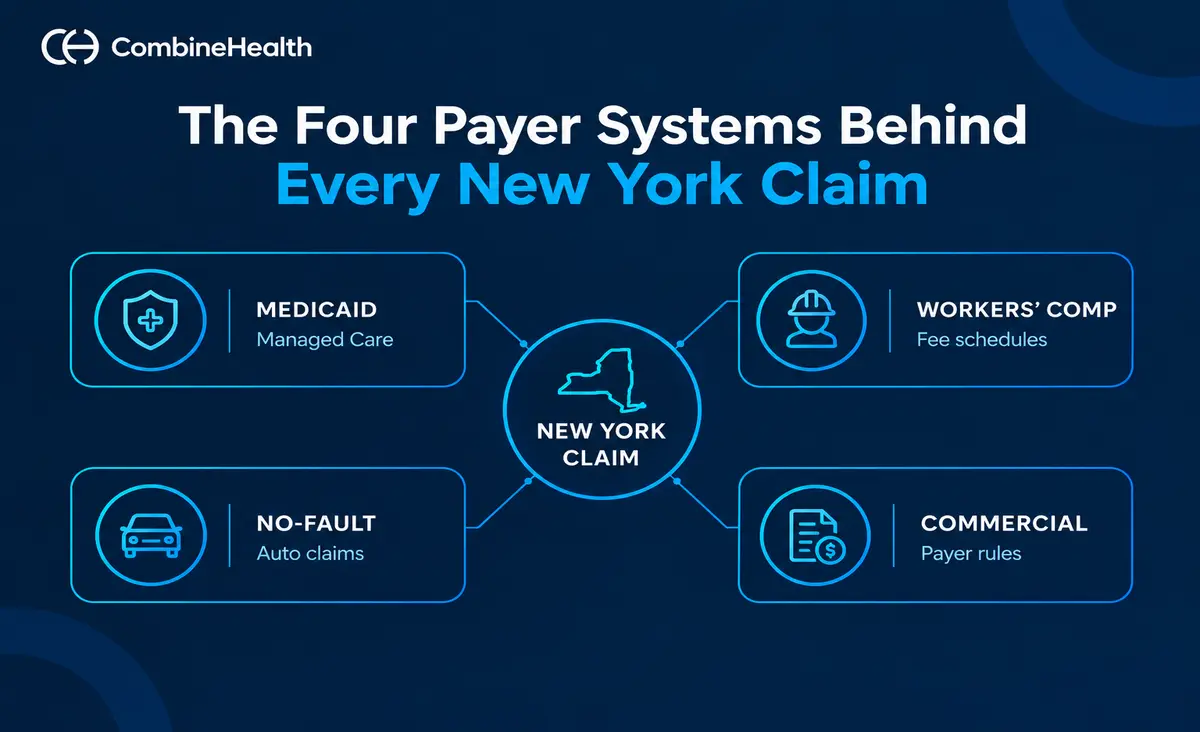
Medical billing in New York differs from most states because providers bill several distinct payer systems at once. Medicaid managed care plans, workers' compensation carriers, no-fault auto insurers, and commercial payers each apply their own submission rules, authorization requirements, and appeal timelines. A medical billing service needs working experience with the payers in your mix.
The Four Payer Systems Behind Every New York Claim
- Medicaid managed care plans: Each plan runs its own enrollment, authorization, and appeal process
- Workers' compensation carriers: Claims follow separate fee schedules, documentation standards, and filing deadlines
- No-fault auto insurers: Claims carry their own submission rules and deadlines
- Commercial payers: Each carrier applies its own edits, authorization rules, and appeal timelines
Why New York Medicaid Deserves the Closest Attention
New York Medicaid managed care organizations operate independently from the state program. Providers credentialed with the state agency still need separate enrollment with each plan. A vendor that understands this saves weeks of enrollment and rework.
A New York-ready vendor should:
- Track enrollment status for every plan you bill
- Confirm active participation before claims go out
- Apply each plan's own authorization and appeal rules
Workers' Compensation and No-Fault: A Second Layer
Workers' compensation and no-fault billing add a second layer of rules. Both follow separate fee schedules, documentation standards, and short filing deadlines that differ from commercial claims.
Before you sign with a vendor:
- Confirm the current filing deadlines for your claim types
- Ask for clean claim results in these lines
- Ask how the team tracks deadlines and documentation
Location Matters Less Than Capability
A medical billing company can serve New York providers effectively from anywhere. What counts is demonstrated experience with the requirements that apply to you.
Look for proven experience with:
- Your payer mix
- Your specialties
- Your EHR
- New York Medicaid plans
- Workers' compensation, no-fault, and insurance requirements
How to Evaluate a Medical Billing Service in New York
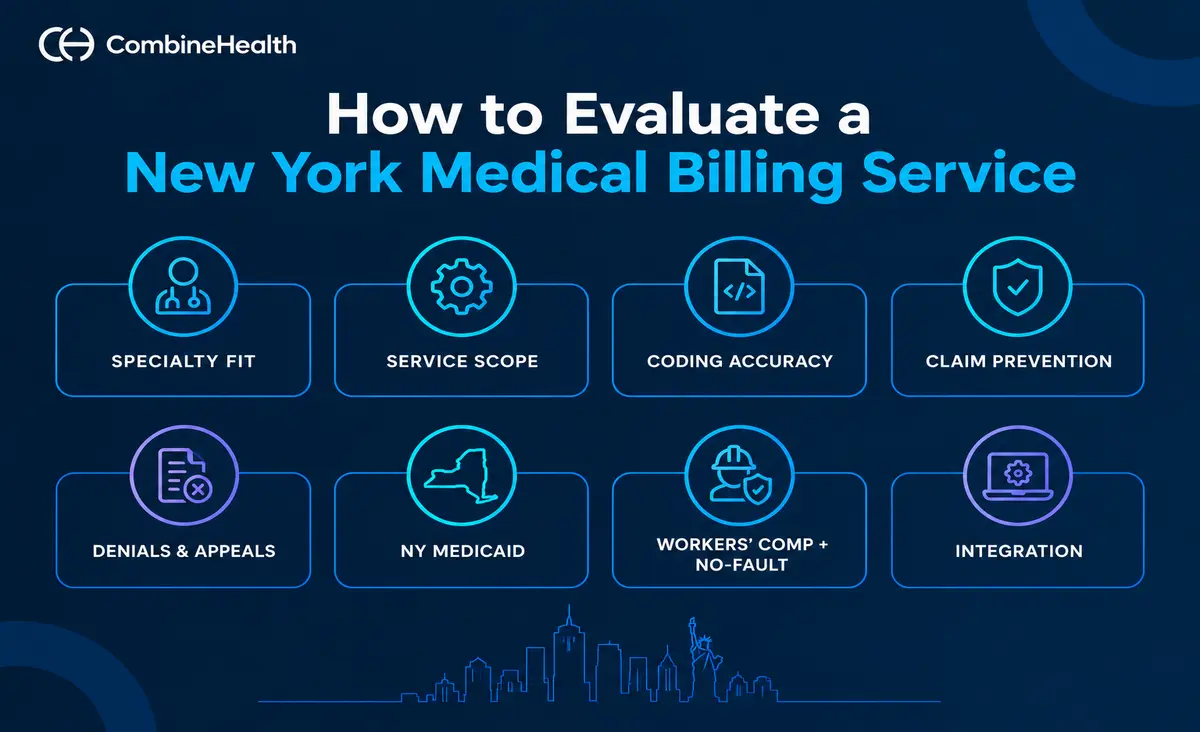
Apply the following criteria consistently across every vendor under consideration.
- Organization and specialty fit: Direct experience with your size, care setting, and medical specialties.
- Service scope: Billing only, or the wider revenue cycle, including coding, eligibility, prior authorization, and appeals.
- Coding accuracy: Accuracy measured at the claim, claim-line, CPT, and ICD-10 level, and audited on a regular schedule.
- Claim prevention: Eligibility checks, prior authorization, and payer-aware claim validation before submission.
- Denial management and appeals: Denial categorization, payer follow-up, appeal support, and root-cause prevention.
- New York Medicaid experience: Proven billing across Medicaid managed care plans, with plan-level enrollment and authorization handling.
- Workers' compensation and no-fault billing: Dedicated workflows, deadline tracking, and documented results for both claim types.
- Integration and technology: Compatibility with your EHR, PMS, payer portals, and clearinghouses, plus clear visibility into how each coding and billing decision is made.
- Local presence versus national scale: A location, staffing model, and scale that suit your organization, backed by New York payer-mix experience.
- Transparency and evidence: Clear pricing, account ownership, and security controls, plus case studies and references from organizations with a comparable payer mix.
See How CombineHealth Handles Your New York Payer Mix
From Medicaid managed care enrollment to no-fault and workers' compensation deadlines, CombineHealth adapts coding, claim validation, and denial follow-up to each New York payer's actual behavior. Book a demo to see it against your own New York claims.
FAQs
What Is a Medical Billing Service in New York?
A medical billing service in New York manages the claims process for healthcare providers: eligibility checks, coding, claim submission, payment posting, denial management, and payer follow-up. Strong services know the state's payer mix, including Medicaid managed care plans, workers' compensation, and no-fault insurance.
How Much Do Medical Billing Services in New York Cost?
Medical billing services in New York usually charge a percentage of collections, a per-claim fee, or a flat monthly rate. Pricing depends on specialty, claim volume, and scope. Request written quotes that list every included service.
Does a Medical Billing Company Need to Be Based in New York?
A New York headquarters is optional. A company serves New York providers well when it can show experience with your payer mix, specialties, EHR, New York Medicaid plans, and applicable workers' compensation and no-fault requirements.
Which Medical Billing Service Is Best for a Small Practice?
Small practices often choose a local firm such as Core Med Billing for personal service, or an AI platform such as CombineHealth for coding accuracy and denial reduction without adding staff. The right fit depends on your payer mix and how much of the revenue cycle you want to automate.
How Can a Billing Service Reduce Claim Denials?
A billing service reduces denials by verifying eligibility before the visit, coding accurately from complete documentation, validating claims against payer rules before submission, and learning from past denials. CombineHealth applies this through payer intelligence that adapts coding strategy for each payer.
Can AI Handle Medical Billing for New York Payers?
AI can handle large parts of medical billing when it learns payer-specific behavior. CombineHealth automates up to 85% of coding with 97.2%+ accuracy and links each decision to the source documentation, which supports audits and appeals.
Recommended Reads







Explore Our
AI Workforce







Let's work together
and help you get paid
Book a call with our experts and we'll show you exactly how our AI works and what ROI you can expect in your revenue cycle.