AI Medical Coding: How It Works, Accuracy, ROI & Evaluation Guide
Learn how AI medical coding works, its accuracy, ROI, and key KPIs. CombineHealth delivers 97%+ accuracy, up to 85% automation and 75% fewer coding denials.
Published on:
September 29, 2026


AI medical coding uses artificial intelligence to read clinical documentation and either assist a coder or autonomously assign billing-ready codes — ICD-10-CM, ICD-10-PCS, CPT, HCPCS, E/M levels, and modifiers.
CombineHealth is a self-learning autonomous medical coding software built on this model, coding up to 85% of eligible encounters at 98%+ accuracy with payer intelligence and explainable, audit-ready decisions.
Key Takeaways:
• AI medical coding interprets clinical documentation and assigns billing-ready codes (ICD-10-CM, ICD-10-PCS, CPT, HCPCS, E/M, and modifiers) — either assisting a coder or autonomously coding qualifying encounters.
• Accuracy and automation rate are different metrics: a software can report 98% accuracy while automating only a small share of total coding volume, so both must be evaluated together.
• Autonomous medical coding is the highest level of automation — the system interprets, codes, and validates qualifying encounters within a defined scope without routine coder review.
• Explainability becomes essential once coding is autonomous: every code should trace to the documentation, guideline, and payer rule behind it, so decisions stay auditable when a coder isn't reviewing each one.
• Payer intelligence separates strong softwares from the rest — applying each payer's rules before submission and learning from denials, reimbursements, and underpayments to reduce coding-related denials over time.
• CombineHealth is a self-learning autonomous medical coding software that codes up to 85% of eligible encounters at 98%+ accuracy, has driven up to a 75% reduction in coding-related denials at a 400-bed hospital, and sustained 98%+ accuracy across every major coding dimension for the enterprise emergency-medicine RCM organization Brault.
AI is changing medical coding from a largely manual workflow into one where software can interpret documentation, assign codes, validate decisions, and automate qualifying encounters. But capabilities vary widely. This guide explains how AI medical coding works, how to evaluate accuracy and ROI, and what to look for in a software.
On this page
- What is AI Medical Coding?
- Traditional Medical Coding vs. AI Medical Coding
- Can AI Replace Medical Coders?
- Types of AI Medical Coding
- What AI Medical Coding Technologies Are Used in 2026?
- How Does AI Medical Coding Work?
- 1. Ingest the Clinical Encounter
- 2. Interpret the Clinical Documentation
- 3. Identify Billable Diagnoses and Services
- 4. Generate Candidate Codes
- 5. Apply Coding Rules and Guidelines
- 6. Check Documentation Sufficiency
- 7. Validate the Complete Code Set
- 8. Apply Payer-Specific Requirements
- 9. Finalize the Coding or Route It for Review
- 10. Learn From Historical Coding Data
- 11. Incorporate Downstream Claim Outcomes
- AI-Assisted vs. AI-Automated Medical Coding
- How Accurate Is AI Medical Coding?
- Important KPIs of AI Medical Coding
- How Do AI Medical Coding and CDI Work Together?
- What Is Explainable AI Medical Coding?
- How Is AI Medical Coding Implemented?
- How Does AI Medical Coding Work Across Different Specialties?
- What Is Payer Intelligence in AI Medical Coding?
- Compliance, Governance, and Risk in AI Medical Coding
- What Is the ROI of AI Medical Coding?
- How Can AI Medical Coding Reduce Claim Denials?
- How to Evaluate AI Medical Coding Software
- See AI Medical Coding in Action
- FAQs
- 1. What Percentage of Medical Coding Can AI Automate?
- 2. What Happens When AI Cannot Code an Encounter?
- 3. Can AI Medical Coding Identify Undercoding?
- 4. Can AI Medical Coding Learn From Denials?
- 5. How Should Hospitals Pilot AI Medical Coding?
- 6. How accurate is CombineHealth's AI medical coding?
- 7. What Percentage of Medical Coding Can CombineHealth Automate?
- 8. How Does CombineHealth Use Payer Intelligence in Medical Coding?
- 9. Does CombineHealth Integrate CDI With AI Medical Coding?
- 10. Has CombineHealth's autonomous coding been proven at scale?
What is AI Medical Coding?
AI medical coding uses artificial intelligence to interpret clinical documentation and assist with or automate the assignment of medical codes, including ICD-10-CM, ICD-10-PCS, CPT, HCPCS, E/M levels, and modifiers.
Depending on the system, AI can extract clinical information, recommend codes for coder review, validate coding decisions, or independently code qualifying encounters.
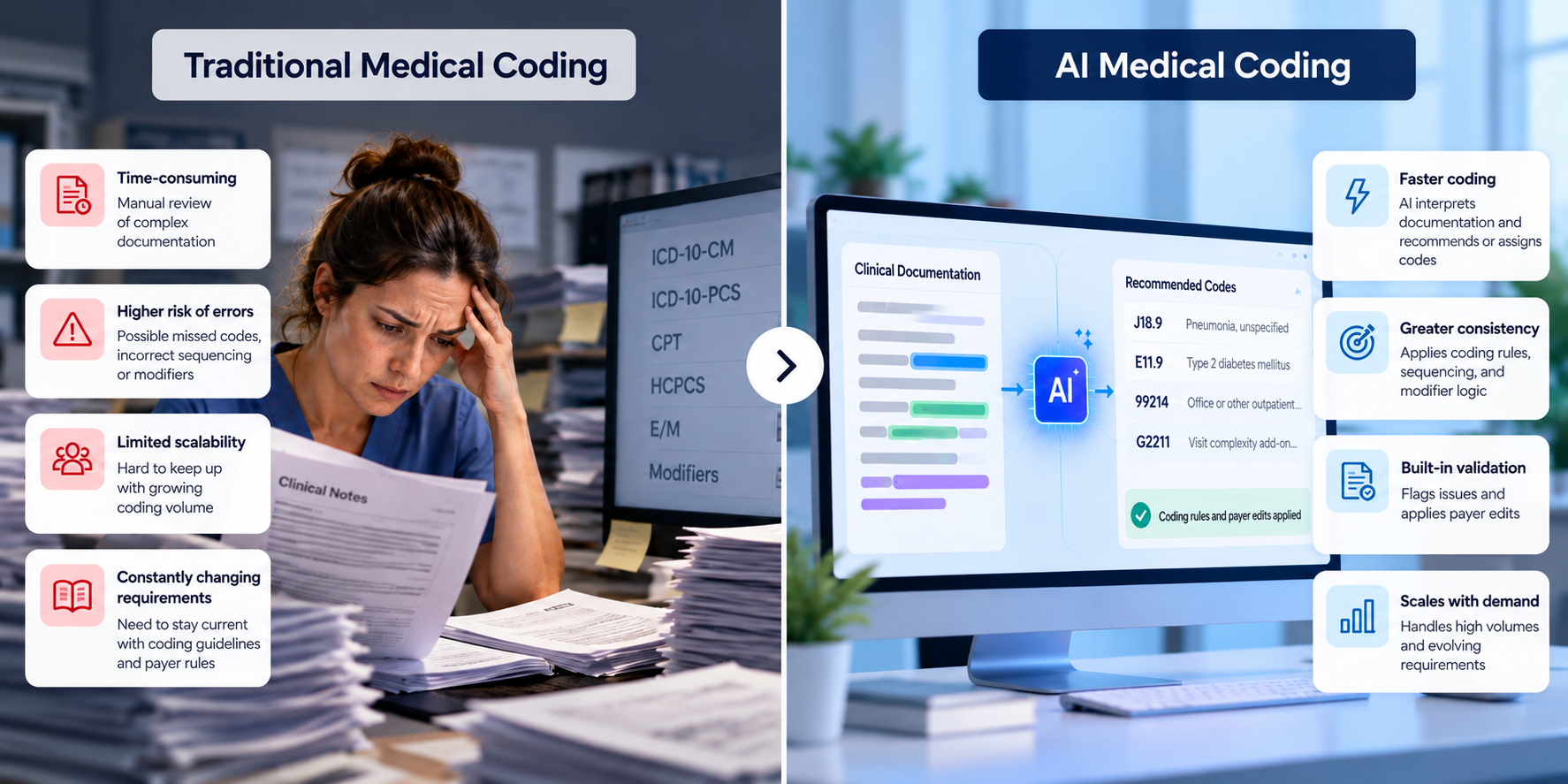
Traditional Medical Coding vs. AI Medical Coding
The main difference between traditional and AI medical coding is who performs the clinical interpretation and coding work. In traditional coding, a human coder makes the coding decisions. With AI medical coding, software performs some or all of the interpretation, code selection, and validation.
Can AI Replace Medical Coders?
AI can replace some of the work medical coders perform, but not every coding scenario requires or is suitable for full automation.
This is where CombineHealth sits on the medical coding automation spectrum: a self-learning autonomous medical coding software that codes up to 85% of eligible encounters without routine coder intervention, at 98%+ accuracy. Rather than replacing coders, it absorbs the high-volume routine work so coding teams can focus on exceptions, audits, and the complex cases where their expertise adds the most.
AI adoption for medical coding is already growing. The U.S. GAO's July 2026 report on AI for medical notes and coding says that the share of surveyed clinicians using AI to assist with clinical documentation or medical coding increased from 21% in 2024 to 28% in 2026.
However, AI-assisted systems still rely on coders to review and finalize codes, while autonomous medical coding systems can independently code qualifying encounters and route exceptions for review.
As coding automation increases, the coder's role shifts toward complex cases, exceptions, audits, and quality oversight rather than reviewing every encounter.
So, instead of asking whether AI can replace medical coders entirely, healthcare organizations should evaluate how much coding work AI can complete accurately without routine coder intervention. Automation rate, accuracy, exception rate, and coding quality provide a more useful measure.
Types of AI Medical Coding
AI medical coding ranges from tools that assist coders with code selection to autonomous systems that independently code qualifying encounters. The main difference between these approaches is how much of the coding decision the software makes and how much requires human review.
What AI Medical Coding Technologies Are Used in 2026?
AI medical coding systems typically combine multiple technologies, including natural language processing (NLP), machine learning, deep learning, clinical language models, large language models (LLMs), retrieval, and rules-based logic. The exact combination varies by software and by how much of the coding workflow it automates.
Rules Engines and Expert Systems
Rules engines apply predefined coding logic rather than learning it from clinical data. They can enforce coding guidelines, NCCI edits, code hierarchies, sequencing requirements, payer edits, and organization-specific rules.
Rules-based logic remains important even in advanced AI systems because a clinically plausible code is not automatically a compliant coding decision.
Natural Language Processing (NLP)
NLP enables AI to process clinical documentation written in natural language. It can identify diagnoses, procedures, medications, anatomy, laterality, acuity, negation, and other information relevant to coding.
For example, NLP helps distinguish between simply finding the term pneumonia and understanding that the documentation says “no evidence of pneumonia.”
Clinical Language Understanding (CLU/NLU)
Clinical language understanding goes beyond extracting medical terms to interpreting their meaning in context. It helps systems understand relationships such as whether a condition is current or historical, confirmed or suspected, present or negated.
For example, “history of CHF” and “acute decompensated CHF treated today” mention the same condition but have very different coding implications.
CLU or clinical NLU is best understood as a clinical-language capability rather than a separate type of AI medical coding system.
Machine Learning and Deep Learning
Machine-learning models learn patterns between clinical documentation and coding decisions from historical data. Given enough coded encounters, they can estimate which codes are likely to apply to a new encounter.
Deep-learning models can capture more complex relationships across clinical documentation and are particularly useful for medical coding's multi-label nature, where a single encounter may require several codes.
Transformer-Based Clinical Language Models
Transformer models can analyze clinical language in context rather than treating individual words or phrases independently. Domain-specific models trained or adapted for healthcare can be used to extract clinical concepts, represent encounter context, and support code prediction.
These models also form part of the technological foundation behind many newer generative AI systems.
Large Language Models (LLMs)
LLMs can reason across larger amounts of clinical text and support tasks such as information extraction, code recommendations, documentation-gap identification, guideline interpretation, and coding explanations.
However, an LLM alone is not necessarily a production-ready AI medical coding software. Medical coding also requires authoritative coding knowledge, validation, safeguards, and workflow controls around the model.
Retrieval and Retrieval-Augmented Generation (RAG)
Retrieval allows an AI system to bring relevant external knowledge into a coding decision instead of relying solely on information stored in the model.
Depending on the system, that knowledge could include coding guidelines, payer policies, LCDs/NCDs, specialty rules, or organization-specific policies.
This allows the AI to combine clinical reasoning with authoritative coding knowledge when making or validating a decision.
Multi-Stage AI Reasoning
More advanced systems can break coding into multiple stages rather than asking one model to produce a code directly.
For example, the AI medical coding software may first interpret the clinical encounter, generate candidate codes, validate them against coding and payer rules, and then make the final coding decision.
How Does AI Medical Coding Work?
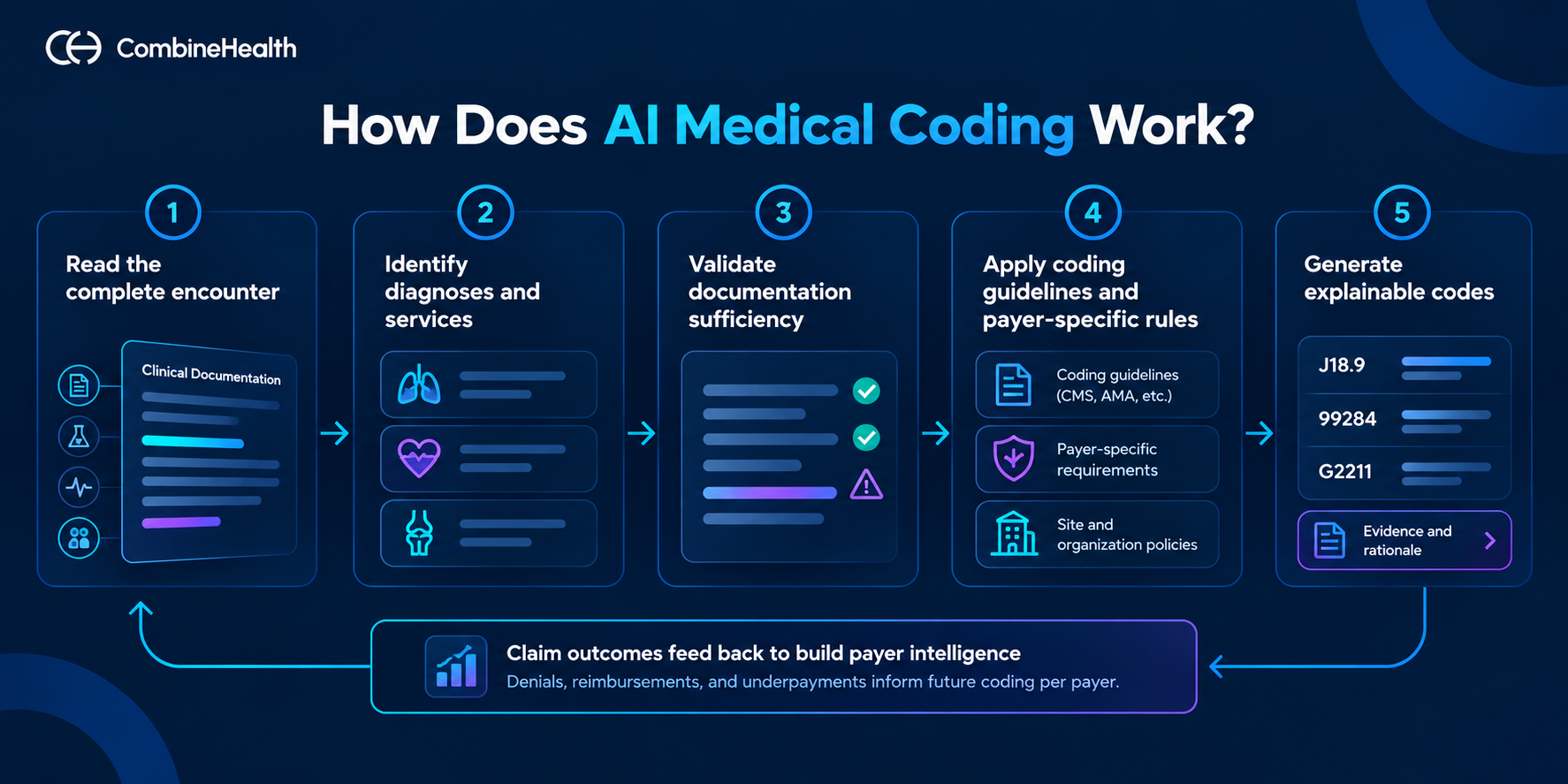
AI medical coding works by turning clinical documentation into structured coding decisions. Depending on the software, the system can interpret the encounter, identify codable diagnoses and services, assign codes, apply coding rules, validate documentation, and either finalize the coding or route the case for review.
CombineHealth runs this full workflow end to end. The self-learning autonomous medical coding software ingests the complete encounter, interprets the documentation, generates and validates the code set against coding and payer-specific rules, checks documentation sufficiency, and finalizes qualifying encounters.
Then, it goes a step further than most systems by incorporating downstream claim outcomes (denials, reimbursements, underpayments) so each decision sharpens the next. Every code carries an explainable rationale traceable to the source note.
1. Ingest the Clinical Encounter
The AI first collects the information needed to code the encounter. This can include physician notes, H&Ps, discharge summaries, procedure notes, orders, medications, labs, imaging, demographics, place of service, and other structured EHR data.
2. Interpret the Clinical Documentation
NLP, clinical language models, machine learning, or LLMs can turn unstructured documentation into clinical meaning.
The system needs to distinguish, for example, between a current and historical condition, recognize negation, connect symptoms with diagnoses, and understand which findings and treatments are relevant to coding.
3. Identify Billable Diagnoses and Services
The system identifies the diagnoses, procedures, services, and coding attributes documented in the encounter.
These can include primary and secondary diagnoses, procedures, laterality, severity, acuity, E/M complexity, and modifiers.
4. Generate Candidate Codes
The AI maps the clinical information to potential ICD-10-CM, ICD-10-PCS, CPT, HCPCS, E/M, or modifier assignments.
Different systems may use machine-learning predictions, language models, coding ontologies, rules, or a combination of approaches to generate these candidates.
5. Apply Coding Rules and Guidelines
A clinically plausible code still needs to satisfy coding requirements.
The system can apply ICD-10 and CPT guidance, sequencing rules, NCCI edits, bundling rules, E/M coding requirements, modifier logic, specialty rules, and organization-specific coding policies.
6. Check Documentation Sufficiency
AI can also evaluate whether the documentation adequately supports the proposed coding decision.
If required specificity or supporting documentation is missing, the system can flag the gap for review or, depending on the workflow, surface a CDI alert or query opportunity.
7. Validate the Complete Code Set
The system checks the proposed codes together rather than evaluating each code in isolation.
This can include identifying conflicting codes, incorrect sequencing, missing modifiers, unsupported diagnoses, missing codes, or other inconsistencies before coding is finalized.
8. Apply Payer-Specific Requirements
Some AI medical coding systems add payer-specific requirements on top of standard coding rules.
These can include payer-specific edits, modifier requirements, medical-necessity policies, documentation requirements, and provider billing rules.
9. Finalize the Coding or Route It for Review
What happens next depends on the level of automation.
In AI-assisted coding, the system sends its recommendations to a coder for approval. In autonomous coding, qualifying encounters can be finalized without routine coder intervention, while exceptions are routed for review.
10. Learn From Historical Coding Data
Machine-learning systems can learn patterns from previously coded encounters, such as relationships between clinical documentation and final code assignments.
This helps improve code prediction, but it primarily answers: “How have similar encounters been coded before?”
11. Incorporate Downstream Claim Outcomes
Some systems can go further by incorporating what happens after coding, including denials, reimbursements, underpayments, and payer edits.
This creates a different feedback loop: the system analyzes how coding decisions perform after claim submission and uses those payer outcomes to inform future coding decisions.
Historical coding data helps the system learn from previous coding decisions. Outcome learning can help it understand how those decisions perform once the claim reaches the payer.
AI-Assisted vs. AI-Automated Medical Coding
AI-assisted medical coding helps a coder make coding decisions, while AI-automated medical coding can make and execute some coding decisions without routine human approval. The key question is whether a coder must review every encounter before the codes are finalized.
Where Does Autonomous Medical Coding Fit?
Autonomous medical coding is the highest level of AI-automated coding. It means the system can independently interpret, code, and validate qualifying encounters within a defined scope without routine coder intervention.
The broader distinction between assisted and autonomous AI is also reflected in the AMA's CPT Appendix S taxonomy. It distinguishes assistive, augmentative, and autonomous AI based on what the software does and how independently it produces clinically meaningful outputs. Autonomous software independently generates interpretations without concurrent physician/QHP involvement.
Not every automated coding function is autonomous. For example, software that automatically applies a modifier after a coder selects the primary codes is performing medical coding automation, but it is not independently coding the encounter.
A useful way to think about the progression is:
How Accurate Is AI Medical Coding?
There is no single accuracy rate for AI medical coding. Performance varies by software, specialty, encounter complexity, code type, and the metric used to calculate accuracy. A reported “98% accuracy,” for example, means little without knowing what was measured.
CombineHealth Case study
CombineHealth's accuracy has been measured exactly this way in production, per dimension, against a validation standard.
In a parallel study across 1,000+ emergency-department charts, it matched credentialed coders at ~98% accuracy while cutting turnaround time in half.
And for Brault, an established emergency-medicine RCM organization, CombineHealth sustained 98%+ accuracy across every major coding dimension — CPT, E/M, ICD, modifiers, MIPS, CDI, and provider assignment, validated through recurring production audits, not a one-time pre-go-live score.
AI coding accuracy can be evaluated in several ways:
- Code-level accuracy: Whether individual codes assigned by the AI are correct.
- Encounter-level accuracy: Whether the complete code set for an encounter is correct.
- Precision: Of the codes the AI assigned, how many were correct.
- Recall: Of all codes that should have been assigned, how many the AI identified.
- Exact match: Whether the AI-generated code set exactly matches the validated code set.
Accuracy should also be evaluated for specific types of errors, including missed codes, unsupported codes, incorrect modifiers, sequencing errors, overcoding, and undercoding.
For healthcare organizations evaluating AI medical coding, the most useful question is therefore not simply “What is your accuracy rate?” but “How is accuracy calculated, on which encounters, and against what standard?”
Accuracy also does not show how much coding work the system can automate. A software could be highly accurate on a narrow subset of encounters while still requiring human review for most charts. That is why accuracy needs to be evaluated alongside automation rate and other coding-quality metrics.
Important KPIs of AI Medical Coding
AI medical coding should be measured on more than accuracy. Healthcare organizations should also track how much work the system automates, how often cases require review, how quickly coding is completed, and whether coding quality translates into better claim outcomes.
How Do AI Medical Coding and CDI Work Together?
AI medical coding and clinical documentation improvement (CDI) can work together by identifying documentation gaps while the encounter is being coded. Instead of treating coding and CDI as separate workflows, AI can evaluate whether the clinical documentation contains the specificity and evidence needed to support the appropriate codes.
This is a core part of how CombineHealth works: it evaluates documentation sufficiency while it codes, surfacing missing specificity and medical-necessity gaps as CDI alerts or queries before the claim goes out.
In a 400-bed hospital deployment, that approach surfaced 5× more CDI opportunities than the manual workflow, the kind of gaps that quietly drive downcoding and denials when they're caught only after the fact.
For example, the AI may identify that the clinical evidence points to a more specific diagnosis, but the documentation does not support assigning it yet. Depending on the workflow, the gap can then trigger:
- a CDI alert that can be tracked for provider education; or
- a CDI query when provider clarification is required before coding can be completed.
This creates an integrated workflow:
Clinical documentation → AI coding review → documentation gap identified → CDI alert or query → documentation clarified → coding completed
AI can also track recurring documentation gaps across providers or encounter types, helping CDI teams identify patterns and target provider education.
The key advantage is that CDI happens during the coding decision, when missing documentation can still affect code assignment, rather than only being analyzed after coding is complete.
What Is Explainable AI Medical Coding?
Explainable AI medical coding shows why the AI assigned or recommended a code, rather than providing the code alone. It connects the coding decision to the clinical documentation and coding logic that support it.
Explainability is built into every CombineHealth coding decision.
Each code is linked to the clinical evidence and coding or payer rule that supports the decision. For E/M coding, the system can also show how the documented problems, data, and risk support the assigned level. A complete audit trail records the documentation reviewed, codes assigned, and logic applied.
That's what makes autonomous coding defensible: because the reasoning is visible and traceable, coding and compliance teams can validate the software's work and defend it in a payer audit, even when a coder isn't reviewing every chart.
Depending on the system, an AI medical coding explanation can show:
- the clinical evidence supporting a diagnosis or procedure;
- the documentation used to determine an E/M level;
- the coding guideline or rule applied;
- why a modifier was added;
- why one code was selected over another; and
- documentation gaps or conflicts that affected the decision.
For example, instead of simply assigning 99284, an explainable system can show the documented problems, data, and risk that support the E/M level.
Explainability also supports AI medical coding audits. An audit trail can record the documentation reviewed, codes assigned, supporting evidence, rules applied, and any changes made during review. This gives coding teams a way to validate AI-generated decisions and investigate patterns when errors or disagreements occur.
For autonomous coding in particular, explainability becomes important because a coder is no longer reviewing every decision before it is finalized.
How Is AI Medical Coding Implemented?
AI medical coding is typically implemented by connecting the coding software to existing clinical and billing systems, validating its performance on real encounters, and gradually moving approved workflows into production. The exact implementation depends on the EHR, coding scope, specialty, and level of automation.
A typical implementation includes:
- Connect clinical data: The software receives the documentation and encounter data required for coding through APIs, HL7/FHIR feeds, file transfers, or other integrations.
- Configure the coding workflow: Coding guidelines, organization-specific rules, specialties, payer requirements, and exception criteria are configured for the organization.
- Validate on historical or live encounters: AI-generated codes are compared with validated coding decisions to measure accuracy, identify gaps, and test different encounter types.
- Run in parallel: Some organizations begin in an audit or shadow mode, where the AI codes encounters without immediately replacing the existing coding workflow.
- Move qualifying work into production: Once performance is validated, approved encounters can move through the AI coding workflow, with exceptions routed for review.
- Monitor performance: Accuracy, automation rate, overrides, exceptions, turnaround time, and coding-related denials can be tracked after go-live.
Implementation should therefore be evaluated on more than whether an AI medical coding software can integrate with the EHR. The larger question is whether it can move from a controlled pilot to reliable coding at production volume while maintaining coding quality.
How Does AI Medical Coding Work Across Different Specialties?
AI medical coding capabilities can vary significantly by specialty because different clinical settings have different documentation patterns, coding rules, code sets, and levels of complexity. A software that performs well for one specialty or encounter type should not automatically be assumed to perform equally well for another.
For example, specialty medical coding may require AI to handle:
- Emergency medicine: E/M levels, presenting symptoms, critical care, procedures, and facility or professional coding requirements.
- Orthopedics: Detailed anatomy, laterality, injury characteristics, procedures, and modifiers.
- Anesthesia: Procedure coding, time units, modifiers, and provider-specific billing requirements.
- Surgery: Operative documentation, procedure selection, bundling rules, modifiers, and global surgical considerations.
- Inpatient coding: Principal and secondary diagnoses, ICD-10-PCS procedures, sequencing, complications and comorbidities, and DRG-related coding.
- Outpatient and physician coding: ICD-10-CM diagnoses, CPT/HCPCS services, E/M levels, modifiers, and medical necessity requirements.
Specialty support therefore involves more than recognizing specialty terminology. The AI needs to interpret the relevant clinical documentation and apply the coding logic, documentation requirements, and workflow rules for that setting.
When evaluating AI medical coding software, organizations should ask for performance by specialty and encounter type, including accuracy, automation rate, and exception rate. An overall accuracy number can hide significant differences across the types of encounters the organization actually needs to code.
What Is Payer Intelligence in AI Medical Coding?
Payer intelligence in AI medical coding is the ability to account for payer-specific requirements and use downstream claim outcomes to inform future coding decisions. It adds payer context to standard coding guidelines so the system does not treat every payer the same way.
Payer intelligence is CombineHealth's core differentiator. The self-learning autonomous AI medical coding software applies each payer's rules before the claim is generated and continuously learns from real claim outcomes (denials, reimbursements, underpayments, and edits) to adapt its coding strategy per payer.
At a 400-bed Midwest hospital, that outcome-driven approach drove up to a 75% reduction in coding-related denials within three months. It's the difference between accurate codes and a measurably lower denial rate.
Payer intelligence can work at two levels:
1. Apply Known Payer Requirements to Medical Coding
The system can evaluate the clinical documentation against standard coding guidelines, organization-specific rules, and relevant payer requirements before producing a billing-ready coding decision.
For example, it may account for a payer-specific modifier, documentation requirement, medical necessity policy, or provider billing rule that affects how the encounter should be coded.
2. Learn From Downstream Claim Outcomes to Improve Medical Coding
Some AI medical coding solutions can go further by incorporating denials, reimbursements, underpayments, and payer edits after claims are submitted. These outcomes can reveal recurring payer patterns that published policies alone may not capture.
This creates a feedback loop: the system analyzes how coding decisions perform after submission and uses those payer outcomes to inform future coding decisions.
The distinction matters because payer policy and payer behavior are not the same thing. Published rules tell the system what a payer says it requires. Claim outcomes can reveal recurring patterns in how that payer actually adjudicates claims.
Over time, payer intelligence can therefore help AI medical coding become more responsive to payer-specific patterns instead of treating each denial or underpayment as an isolated event.
Compliance, Governance, and Risk in AI Medical Coding
Compliance, governance, and risk management are critical when AI is used to make or automate medical coding decisions. Healthcare organizations need controls to ensure AI-generated codes remain accurate, supported by documentation, aligned with coding requirements, and auditable over time.
Key safeguards include:
- Accuracy monitoring: Track missed codes, unsupported codes, overcoding, undercoding, and other coding errors.
- Human review criteria: Define which encounters can be automated and which should be routed for review.
- Audit trails: Record the documentation, evidence, rules, and AI decisions involved in each encounter.
- Coding updates: Keep the system current with changes to ICD-10, CPT, HCPCS, payer policies, and other applicable requirements.
- Performance monitoring: Watch accuracy, exception rates, overrides, and model drift for emerging coding risks.
- AI output validation: Use controls to reduce unsupported, inconsistent, or invalid coding decisions.
- Data security: Protect PHI and maintain appropriate privacy, security, and access controls.
Effective AI medical coding governance therefore goes beyond checking accuracy at implementation. It requires ongoing oversight of coding quality, compliance, system performance, and risk as the software operates in production.
As coding becomes more autonomous, oversight also changes: instead of reviewing every encounter, organizations need governance mechanisms that make automated decisions traceable, measurable, and auditable.
What Is the ROI of AI Medical Coding?
The ROI of AI medical coding depends on how much coding work the system automates and whether that automation lowers costs, speeds up coding, and improves downstream revenue outcomes. High coding accuracy alone does not guarantee a positive return.
For CombineHealth, that return shows up across the levers above.
By autonomously coding up to 85% of eligible encounters, CombineHealth lowers cost per chart and clears backlogs without adding coders; by catching coding and documentation issues before submission, it lifts captured revenue — a 400-bed hospital saw a 4% increase within three months; and its payer intelligence reduces the coding-related denials that quietly erode margin.
Accuracy is the floor as the ROI comes from how much it automates and how it moves downstream outcomes.
AI medical coding can create financial value through:
- Lower coding costs: Reduce routine manual or outsourced coding work.
- Faster turnaround time: Complete coding sooner so claims move into billing faster.
- Fewer coding-related denials: Catch coding and documentation issues before claim submission.
- Higher revenue capture: Identify supported diagnoses, procedures, specificity, or levels that might otherwise be missed.
- Less rework: Reduce time spent correcting coding errors and resolving preventable denials.
- Greater coding capacity: Handle more encounters without increasing coding resources at the same rate.
The business case comes down to how much value the software creates through automation, additional revenue capture, and avoided denial or rework costs compared with the cost of implementing and operating it.
That is why ROI should be evaluated using accuracy, automation rate, eligible coding volume, implementation and operating costs, turnaround time, denial reduction, and revenue impact together.
Two softwares can both report 98% accuracy and deliver very different returns. A software that accurately automates more of the organization's coding volume or produces stronger downstream revenue-cycle outcomes can create substantially more value.
How Can AI Medical Coding Reduce Claim Denials?
AI medical coding can help reduce claim denials by identifying coding, documentation, and payer-specific issues before the claim is submitted. More advanced systems can also use patterns from previous denials to inform future coding decisions.
Prevention-first is how CombineHealth is built. It validates codes, modifiers, sequencing, and payer-specific requirements before the claim is submitted, flags documentation gaps while there's still time to fix them, and feeds denial patterns back into future coding — so avoidable coding-related denials are prevented upstream rather than worked after the payer rejects the claim.
Medical coding accuracy alone does not eliminate reimbursement risk. In CMS's FY2025 Medicare FFS review, roughly 65% of improper payments involved insufficient or missing documentation, while another 15.3% involved medical necessity—showing why denial prevention needs to extend beyond selecting the correct code
AI can help prevent coding-related denials in several ways:
- Improve coding accuracy: Identify incorrect, missing, or unsupported codes before they reach the claim.
- Increase coding specificity: Capture supported details such as laterality, severity, acuity, and other attributes required for more specific coding.
- Catch documentation gaps: Identify when the clinical documentation does not sufficiently support a diagnosis, procedure, E/M level, or other coding decision.
- Validate modifiers and coding rules: Check modifier requirements, sequencing, bundling rules, NCCI edits, and other coding logic before submission.
- Apply payer-specific requirements: Account for payer-specific documentation, medical necessity, modifier, and billing requirements where supported.
- Learn from denial patterns: Systems with payer intelligence can identify recurring denial patterns and use those outcomes to inform future coding decisions.
The key difference is prevention versus correction. Traditional denial management addresses a coding-related denial after the payer has rejected the claim. AI medical coding can move part of that work upstream by identifying potential causes before the claim is submitted.
How to Evaluate AI Medical Coding Software
When evaluating AI medical coding software, look beyond headline accuracy and assess how much coding the software can automate, how its decisions are validated, how it handles exceptions, and whether it improves downstream outcomes.
Key questions to ask include when evaluating an AI medical coding software:
See AI Medical Coding in Action
AI medical coding is moving beyond code recommendations toward workflows that can interpret encounters, apply coding and payer requirements, identify documentation gaps, and automate qualifying cases.
The right software should deliver more than high accuracy—it should combine automation, explainability, payer intelligence, and measurable revenue-cycle impact.
Want to see how CombineHealth applies this approach to medical coding? Book a demo.
FAQs
1. What Percentage of Medical Coding Can AI Automate?
There is no universal automation rate for AI medical coding. It depends on specialty, encounter complexity, documentation quality, and the software's scope. Organizations should evaluate automation rate alongside accuracy and exception rate to understand how much coding work the AI can actually complete without routine coder review.
2. What Happens When AI Cannot Code an Encounter?
In autonomous medical coding workflows, encounters that fall outside defined automation criteria can be routed for review. This may include complex cases, insufficient documentation, conflicting clinical information, or other situations where the system cannot produce a sufficiently supported coding decision.
3. Can AI Medical Coding Identify Undercoding?
Yes. AI can evaluate clinical documentation for supported diagnoses, procedures, E/M levels, specificity, and other coding opportunities that may have been missed. Measuring undercoding is important because coding quality is not only about avoiding incorrect codes—it also involves capturing all supported coding and revenue opportunities.
4. Can AI Medical Coding Learn From Denials?
Some AI medical coding systems can incorporate downstream denial outcomes into future coding decisions. This allows the system to identify recurring payer patterns and understand how previous coding decisions performed after submission. However, outcome learning is not a capability of every AI coding software.
5. How Should Hospitals Pilot AI Medical Coding?
A pilot should test the AI on representative encounters across relevant specialties, payers, and complexity levels. Organizations should measure accuracy, automation rate, exception rate, turnaround time, coder overrides, and downstream claim outcomes before expanding the software into production.
6. How accurate is CombineHealth's AI medical coding?
CombineHealth delivers 98%+ coding accuracy at scale — measured per coding dimension against a validation standard and evaluated alongside automation rate, exception rate, and downstream outcomes rather than as a single headline number. For the emergency-medicine RCM organization Brault, it sustained 98%+ accuracy across every major coding dimension in recurring production audits.
7. What Percentage of Medical Coding Can CombineHealth Automate?
CombineHealth can autonomously code up to approximately 85% of eligible coding volume, depending on the specialty, encounter mix, documentation, and configured workflow. Qualifying encounters can be coded without routine coder intervention, while cases requiring additional review are routed as exceptions.
8. How Does CombineHealth Use Payer Intelligence in Medical Coding?
CombineHealth combines standard coding logic with payer-specific requirements and downstream claim outcomes. Denials, reimbursements, underpayments, and payer edits can feed payer intelligence, helping identify recurring payer patterns and inform future coding decisions rather than treating every claim outcome as an isolated event.
9. Does CombineHealth Integrate CDI With AI Medical Coding?
Yes. CombineHealth evaluates documentation sufficiency as part of the coding workflow. It can identify documentation gaps, surface CDI alerts for provider education, and identify cases requiring a CDI query for provider clarification, helping connect coding and CDI within the same workflow.
10. Has CombineHealth's autonomous coding been proven at scale?
Yes. Brault, one of the most established emergency-medicine RCM organizations, deployed CombineHealth after an earlier autonomous-coding vendor couldn't sustain accuracy in production. CombineHealth held 98%+ accuracy across every major coding dimension (CPT, E/M, ICD, modifiers, MIPS, CDI, provider assignment) in recurring production audits, kept turnaround under 12 hours through 2–3× volume spikes, and brought new sites live in about two weeks — and Brault is scaling it toward 5× its current autonomous-coding volume.
Recommended Reads







Explore Our
AI Workforce







Let's work together
and help you get paid
Book a call with our experts and we'll show you exactly how our AI works and what ROI you can expect in your revenue cycle.