Why Choose CombineHealth for AI Medical Coding? An Honest Answer for Healthcare Organizations
Why choose CombineHealth for medical coding? See how 98%+ accuracy, 85% automation, payer intelligence, and proven production results improve RCM.
Published on:
October 7, 2026


Short Answer: Choose CombineHealth for medical coding because it combines 98%+ coding accuracy with up to 85% autonomous coding, while integrating CDI, payer-specific requirements, and explainable audit trails. Proven in high-volume production environments, CombineHealth has helped organizations achieve 75% fewer coding-related denials, 4% higher captured revenue, and 5× more CDI opportunities.
AI medical coding has traditionally been evaluated on one question: Can it assign the right code?
Accuracy matters, but it is only part of what determines whether a claim gets paid correctly. CMS's FY2025 Medicare review makes the distinction clear: incorrect coding accounted for just 11.1% of improper payments, compared with 65% tied to insufficient or missing documentation and 15.3% to medical necessity. Nearly nine in ten improper-payment dollars stemmed from issues beyond incorrect coding.
For healthcare organizations, AI medical coding therefore needs to do more than automate code assignment. It needs to identify documentation gaps, account for payer-specific requirements, prevent downstream claim issues, and learn from what happens after submission.
So, the real question you should be asking is: “Can CombineHealth automate coding without sacrificing accuracy—and improve what happens after the code reaches the payer?”
On this page
- Why Healthcare Organizations Choose CombineHealth
- What Makes CombineHealth the Best AI Medical Coding Software in 2027
- How Brault Validated CombineHealth’s Autonomous Coding in Production
- Where CombineHealth May Not be the Right Fit
- Why Choose CombineHealth for AI Medical Coding?
- FAQs
- How do we know CombineHealth’s medical coding is actually accurate?
- What happens when CombineHealth disagrees with the code already assigned by our provider or EHR?
- Can we implement CombineHealth by auditing our current coding instead of immediately automating it?
- Can CombineHealth code the same encounter differently for different payers?
- How does CombineHealth handle payer-specific coding rules?
- Can we see why CombineHealth selected a particular code?
- Does CombineHealth identify documentation gaps while coding?
- Can CombineHealth account for differences in how individual physicians document?
- Can CombineHealth work when our EHR already generates codes?
- How does CombineHealth integrate with our EHR and existing coding workflow?
- How quickly can CombineHealth go live for medical coding?
Why Healthcare Organizations Choose CombineHealth
Healthcare organizations choose CombineHealth because it has demonstrated that autonomous medical coding can maintain high accuracy at production scale.
In a parallel coding audit with Brault, CombineHealth achieved 99.1% Primary ICD accuracy, 98.4% CPT accuracy, 98.2% E/M accuracy, and 98.7% MIPS accuracy, exceeding Brault's required accuracy thresholds.
But medical coding accuracy is only part of the value.
CombineHealth can autonomously code up to 85% of eligible encounters, while connecting coding with CDI, payer-specific requirements, and downstream claim outcomes. Across deployments, this has contributed to 75% fewer coding-related denials, 4% higher captured revenue, and 5× more CDI opportunities.
“There are a lot of nuances that frankly take a long time to train a person on. CombineHealth has been able to sit down with us and figure out how to teach the model to pick up on those nuances. The results have been fabulous—they’ve actually made the model perform and pass audits.”
— Dr. Andrea Brault
What Makes CombineHealth the Best AI Medical Coding Software in 2027
1. Coding Accuracy That Reduces Denials
A 98%+ coding accuracy rate matters, but accuracy alone is not the finish line. The real test is whether those codes translate into cleaner claims, fewer denials, and the appropriate reimbursement.
CombineHealth connects medical coding with the factors that influence what happens downstream: clinical documentation, CDI, coding guidelines, payer-specific requirements, and claim validation. This allows coding decisions to be evaluated not just for technical accuracy, but for whether the documentation and claim support what is being billed.
At a 400-bed Midwest hospital, CombineHealth maintained 98%+ coding accuracy while helping achieve:
- 75% fewer coding-related denials
- 4% increase in captured revenue
- 5× more CDI opportunities
2. Self-Learning Payer Intelligence
Most medical coding systems work from established coding guidelines and payer policies. CombineHealth goes a step further by learning from what happens after the claim reaches the payer.
CombineHealth learns from what happens after a coded claim reaches the payer, not just from published coding guidelines and payer policies.
Denials, reimbursements, and underpayments feed back into its payer intelligence, helping identify how individual payers actually adjudicate claims. Those patterns can then inform future coding and pre-bill decisions.
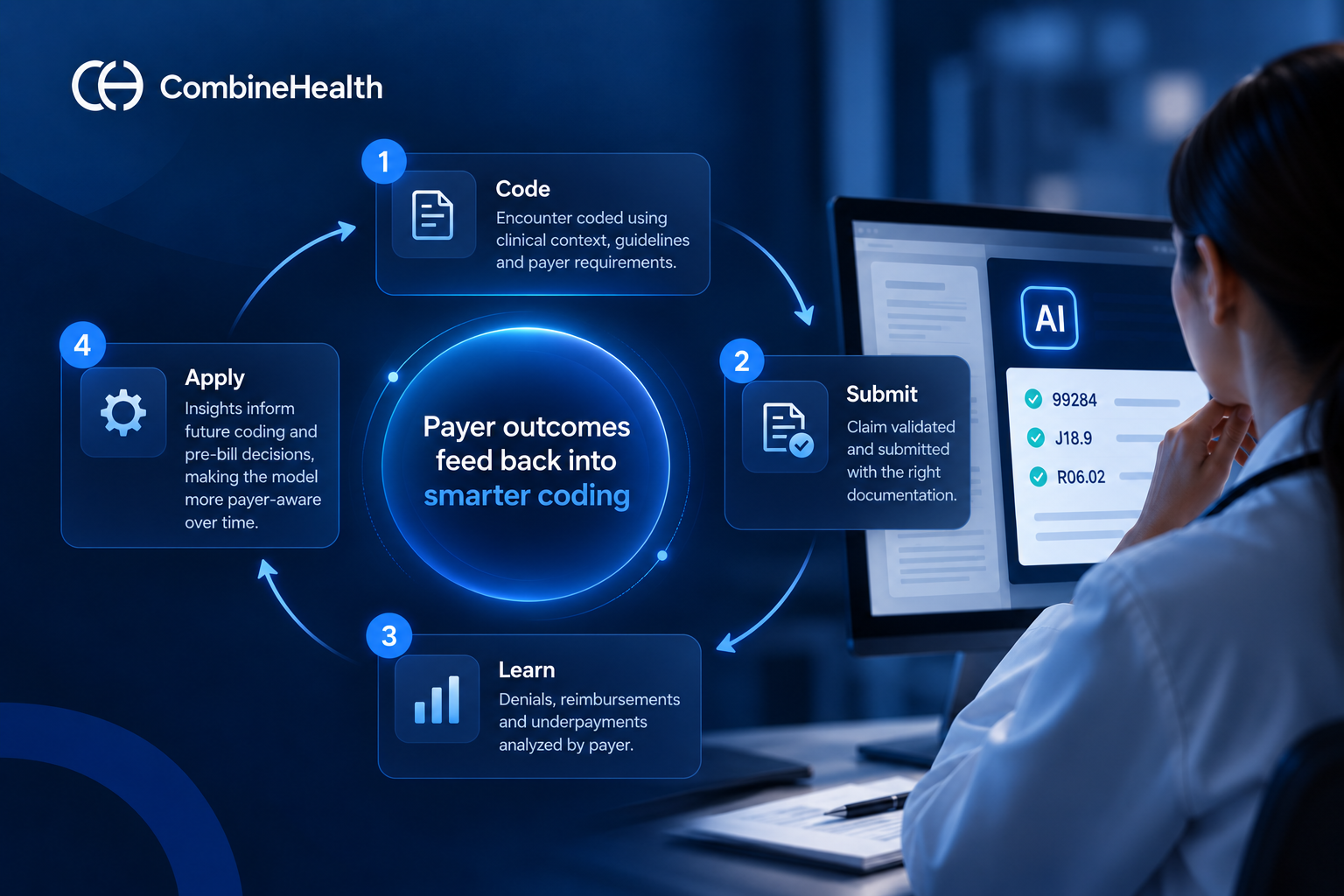
This means payer outcomes aren't treated as one-off events. CombineHealth uses them to continuously make future coding decisions more payer-aware.
3. Up to 85% Autonomous Coding
CombineHealth can autonomously code up to 85% of eligible encounters, moving routine cases through coding without requiring a coder to review every chart.
“Some of the large AI coding companies out there will say, ‘We can apply our model against 90% of your claims.’ I would offer that that’s highly unlikely unless you have a very controlled documentation environment. I think that’s where CombineHealth is doing a really good job.”
— Dr. Andrea Brault
Unlike AI-assisted coding, where AI recommends codes that still require manual validation, CombineHealth can complete medical coding autonomously when the documentation and coding decision meet the required confidence and validation criteria. Exceptions are routed to review, so coding teams can focus their time on cases that actually require judgment.
Brault's experience also shows why the automation rate needs context. With 75 clients across 140 locations and thousands of documentation styles, Brault found that a one-size-fits-all approach to autonomous coding did not work. CombineHealth instead worked with its coding team to account for site- and physician-specific documentation nuances before expanding autonomous volume.
4. Explainable Coding Decisions and Audit Trails
Autonomous coding shouldn't mean black-box coding. CombineHealth makes each coding decision traceable back to the clinical documentation, supporting evidence, coding guidelines, and payer requirements used to reach it.
For E/M coding, teams can see the documented problems, data, and risk behind the selected level. A complete audit trail also shows what documentation was reviewed, which codes were assigned, and the reasoning behind the decision.
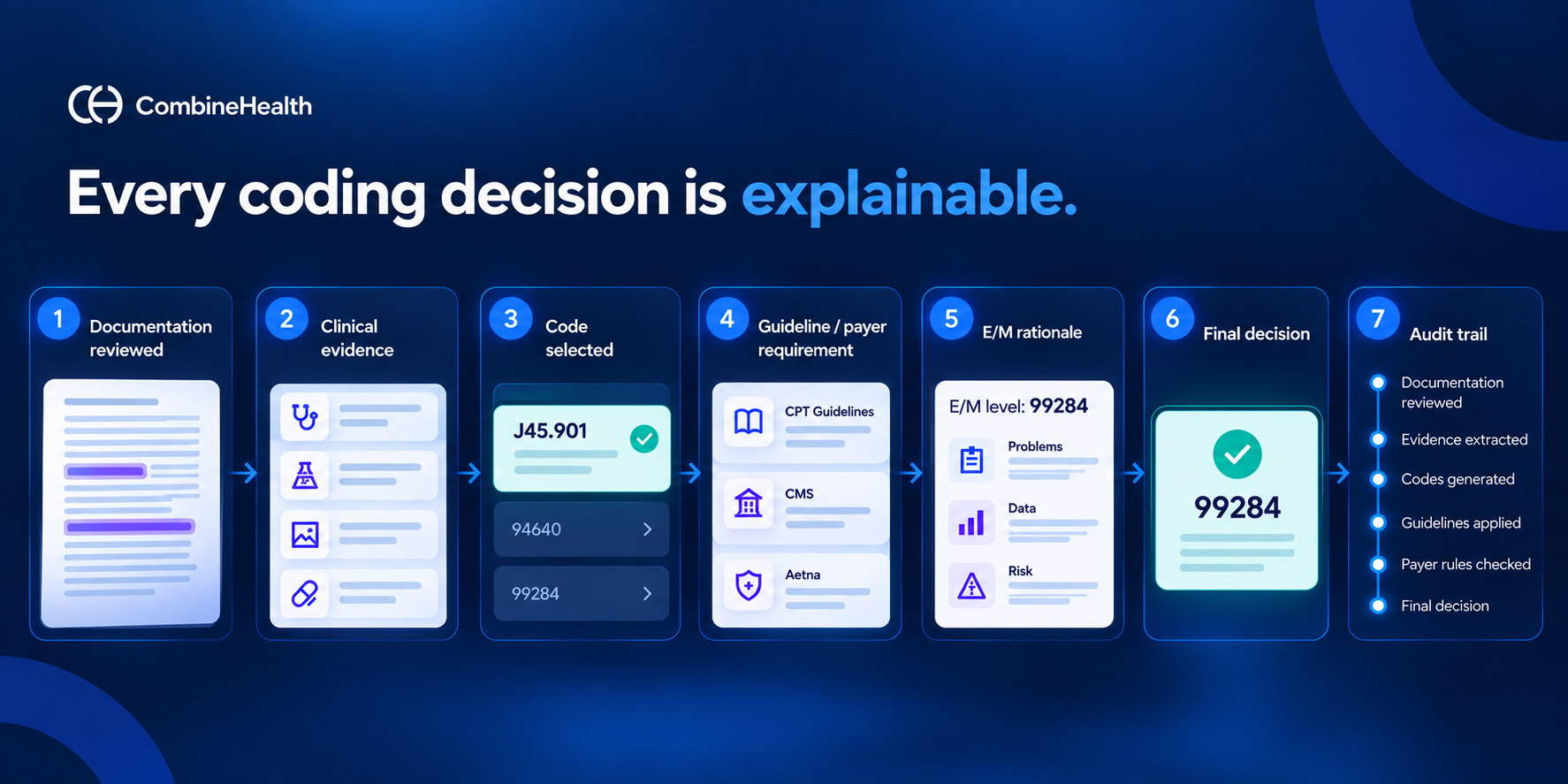
So when a coder, auditor, or compliance team questions an AI-generated code, they don't have to simply trust the model. They can see why CombineHealth made the decision and validate the evidence behind it.
5. CDI Integrated Into Medical Coding
CombineHealth integrates Clinical Documentation Improvement (CDI) directly into the medical coding workflow, so documentation gaps can be identified while an encounter is being coded—not after the fact.
It distinguishes between documentation issues that can be tracked for provider education and gaps that require clarification through a CDI query. When a query is needed, CombineHealth identifies the gap, surfaces the supporting clinical evidence, and routes it for provider review.
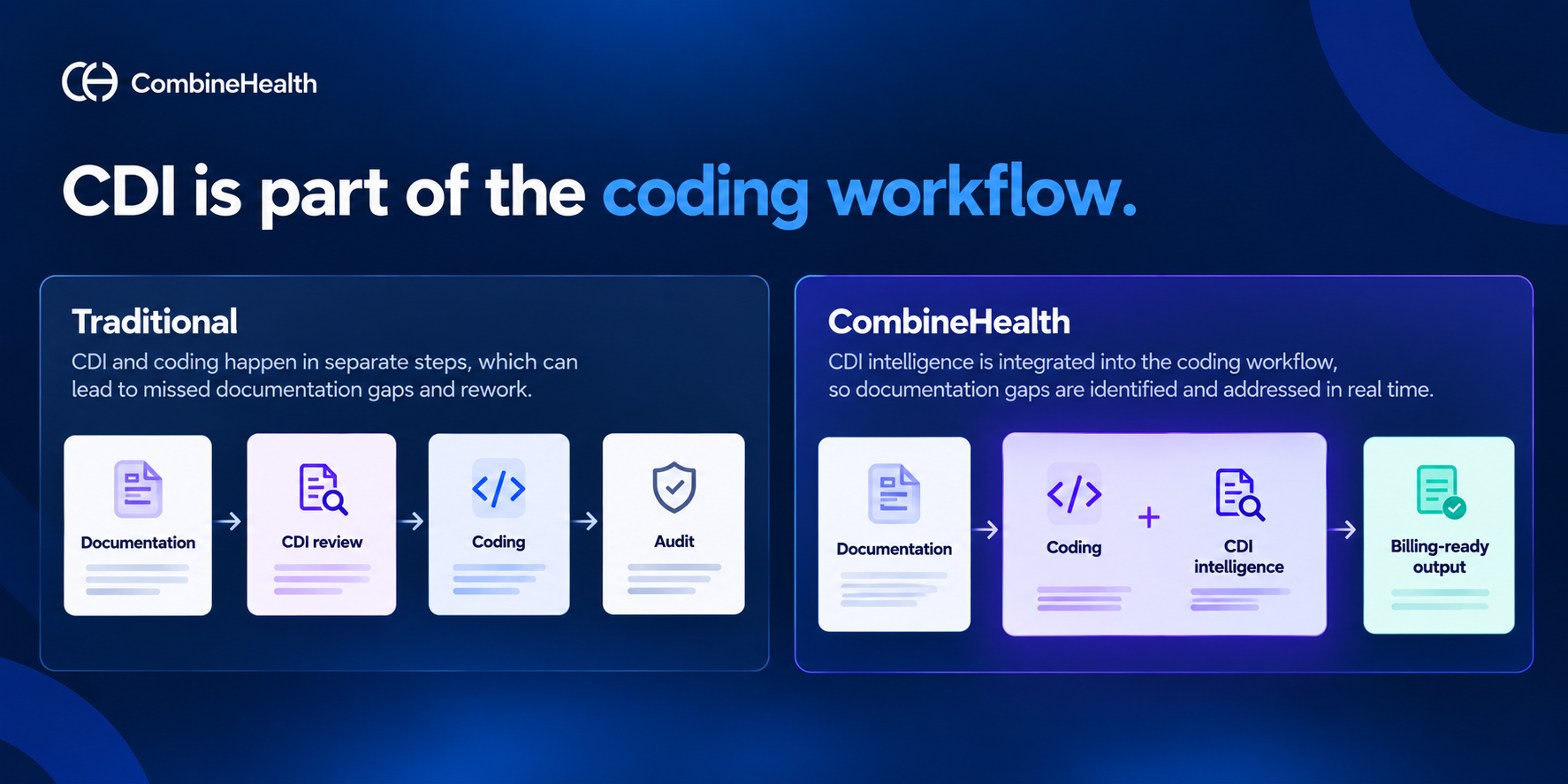
This means coding and CDI work together to capture what the documentation supports before the claim is submitted. At a 400-bed Midwest hospital, CombineHealth identified 5× more CDI opportunities, alongside a 4% increase in captured revenue.
6. Payer-, Site-, and Organization-Specific Configuration
Medical coding isn't one-size-fits-all. The same encounter can require different handling depending on the payer, facility, specialty, and organization-specific coding rules.
CombineHealth can configure these requirements directly into the coding workflow—from payer-specific CPT exclusions and modifier sequencing to observation scenarios and non-billable encounters. This allows the platform to adapt to how each organization actually operates rather than forcing every site into the same coding logic.
For Brault, this was especially important across 75 clients and 140 locations, where physicians document in thousands of different ways. CombineHealth worked with Brault's coding team to understand these nuances and configure the model accordingly.
“We service 75 different clients across 140 locations, so we have to manage thousands of different documentation styles. We don’t control the way physicians document. CombineHealth has been able to work with our coding team to understand the nuances (what we need to look out for and how physicians tend to document) and teach the model to pick up on them.”
— Dr. Andrea Brault
How Brault Validated CombineHealth’s Autonomous Coding in Production
Brault approached CombineHealth with good reason to be cautious. They had already tested another autonomous medical coding solution, but the one-size-fits-all approach struggled with the variation across its clients, locations, and physician documentation styles.
Before expanding autonomous coding, Brault’s team used parallel coding audits, comparing CombineHealth's output against its existing coding process and auditing performance across individual coding dimensions.
Importantly, Brault didn't rely on one blended “accuracy” number. It established a 96%+ accuracy threshold for each coding dimension before the system could move forward.
The results exceeded that benchmark:
- 99.1% Primary ICD accuracy
- 98.4% CPT accuracy
- 98.2% E/M accuracy
- 98.7% MIPS accuracy
And the performance held as CombineHealth moved into production. Brault maintained under 12-hour turnaround times even during 2–3× volume fluctuations, while recent site deployments reached production in roughly two weeks.
Where CombineHealth May Not be the Right Fit
CombineHealth is built for healthcare organizations that want to move coding into production-level autonomous workflows.
It may not be the right fit if:
- You only need a code lookup or encoder. CombineHealth is designed to automate coding decisions and connect them with CDI, payer requirements, and downstream claim outcomes.
- You want every AI-generated code manually reviewed. CombineHealth routes exceptions to review rather than requiring coders to validate every eligible encounter.
- You’re looking for a one-size-fits-all model. Implementation involves configuring the platform around your payers, sites, specialties, documentation patterns, and organization-specific requirements.
- You only want coding recommendations. CombineHealth is designed for organizations looking to autonomously code eligible encounters and measure the impact on denials, revenue capture, and coding operations.
Recommended Reading: CombineHealth vs. CodaMetrix
Why Choose CombineHealth for AI Medical Coding?
Choose CombineHealth because its autonomous medical coding has been tested in real production environments with large coding volumes, varied physician documentation, payer-specific requirements, and compliance-heavy workflows.
Brault, for example, operates across 75 clients and 140 locations and validated CombineHealth through parallel coding before expanding its use. Rather than relying on a single overall accuracy score, Brault evaluated individual coding dimensions, with CombineHealth achieving 99.1% Primary ICD, 98.4% CPT, 98.2% E/M, and 98.7% MIPS accuracy.
Across deployments, CombineHealth has also achieved up to 85% autonomous coding, 75% fewer coding-related denials, 4% higher captured revenue, and 5× more CDI opportunities.
But CombineHealth doesn't stop at code assignment. It connects medical coding with CDI, pre-bill claim validation, payer intelligence, denial management, appeals, and analytics. Downstream outcomes such as denials, reimbursements, and underpayments can feed back into payer intelligence and inform future coding decisions.
The result is autonomous medical coding designed not just to code accurately, but to improve what happens across the revenue cycle after the code is assigned.
Ready to see how CombineHealth can work with your coding workflows? Book a demo.
FAQs
How do we know CombineHealth’s medical coding is actually accurate?
We recommend validating accuracy against your own coding environment rather than relying only on a vendor-wide accuracy number. In production deployments such as Brault, this included parallel coding and separate accuracy measurement across dimensions such as ICD, CPT, E/M, and MIPS before expanding the autonomous workflow.
What happens when CombineHealth disagrees with the code already assigned by our provider or EHR?
CombineHealth can surface the alternative coding decision along with the reasoning behind it. In demos, this has included cases where the platform challenged an E/M level and showed the documented problems, data, risk, and supporting evidence behind its recommendation.
Can we implement CombineHealth by auditing our current coding instead of immediately automating it?
Yes. For organizations that already have codes populated by their EHR, CombineHealth can be used in an audit-style workflow as a second set of eyes to evaluate existing codes, identify missed codes or modifiers, and surface potential undercoding or documentation gaps before moving toward greater automation.
Can CombineHealth code the same encounter differently for different payers?
Yes, where payer-specific requirements justify a different coding or billing decision. CombineHealth can incorporate payer-specific policies and observed payer behavior rather than applying one universal rule set to every claim.
How does CombineHealth handle payer-specific coding rules?
Payer requirements can be configured into the coding workflow, including rules around modifiers, medical necessity, coverage, sequencing, and other payer-specific requirements. CombineHealth also learns from downstream outcomes such as denials, reimbursements, and underpayments so recurring payer behavior can inform future decisions.
Can we see why CombineHealth selected a particular code?
Yes. CombineHealth shows the documentation and clinical evidence supporting the code, the relevant coding or payer rule, and, for E/M coding, the documented problems, data, and risk behind the selected level. The decision is also captured in an audit trail.
Does CombineHealth identify documentation gaps while coding?
Yes. CDI is integrated into the coding workflow. CombineHealth can identify documentation issues that affect coding, distinguish between items suitable for provider education and gaps that require clarification, and surface the clinical evidence supporting a CDI query.
Can CombineHealth account for differences in how individual physicians document?
Yes. This was particularly important in the Brault environment, where the organization manages many clients, locations, and documentation styles. CombineHealth works with the coding team to account for recurring documentation patterns and organization-specific nuances rather than assuming every physician documents the same way.
Can CombineHealth work when our EHR already generates codes?
Yes. The platform does not require the EHR to stop generating codes. In those environments, CombineHealth can initially operate as an audit layer—checking whether the populated codes, modifiers, and E/M levels are fully supported—before the organization decides how much of the workflow to automate.
How does CombineHealth integrate with our EHR and existing coding workflow?
This has been a common implementation question. CombineHealth can work alongside existing EHR and RCM workflows through integrations and APIs, with implementation designed around how the organization currently assigns, reviews, and writes back coding decisions rather than requiring an entirely separate coding process.
How quickly can CombineHealth go live for medical coding?
The rollout is validated incrementally rather than switched on across all volume at once. Organizations can begin with a defined population, compare results through parallel coding or audits, and expand autonomous volume after performance meets their production standards. At Brault, recent site go-lives reached production in roughly two weeks.
Recommended Reads







Explore Our
AI Workforce







Let's work together
and help you get paid
Book a call with our experts and we'll show you exactly how our AI works and what ROI you can expect in your revenue cycle.