What Is Medical Coding, and How AI Medical Coding Can Help Reduce Claim Denials
Understand all about medical coding, its various types, and how it works. Explore how AI medical coding can help reduce denials and increase claim reimbursements.
Published on:
January 5, 2026
Updated on:
August 10, 2026


Key Takeaways
• Medical coding turns each encounter into standardized codes (ICD-10, CPT/HCPCS, E/M) for billing and reporting.
• AI medical coding now assigns complete codes for high-confidence charts and routes the rest to coders — not just "assist."
• Accuracy varies by complexity: high on routine charts, lower on complex ones — so how a vendor measures accuracy matters more than the headline number.
• The 2026 differentiators: explainable, payer-aware coding that learns from denials — not black-box output.
• CombineHealth is a self-learning autonomous medical coding platform that uses Large Language models to read the medical chart and generate explainable ICD/CPT/E&M codes.Medical coding turns each encounter into standardized codes (ICD-10, CPT/HCPCS, E/M) for billing and reporting.
Imagine a busy clinic on Monday morning. Phones keep ringing, patients fill the waiting room, and staff scramble to keep up. After appointments, there's another mountain to climb—turning the details of every visit into the right code before submitting claims to insurance companies.
The harder problem is capturing why those codes make sense.
AI in medical coding changes the conversation.
And while AI in any context is often talked about in terms of speed and automation, in healthcare RCM, accuracy, compliance, and reimbursement depend on whether the clinical reasoning behind that code can be clearly defended.
In this article, we’ll break down how AI in medical coding works, why capturing clinical reasoning matters for reimbursement and compliance, and the real-world use cases where this approach is already reducing denials and rework.
.webp)
On this page
- What Is Medical Coding?
- What Are the Different Types of Medical Coding?
- How Is Computer-Assisted Coding Different from Autonomous Coding?
- How AI Can Be Used in Medical Coding
- How Accurate Is AI Medical Coding Compared With Human Coders?
- Can You See the Evidence Behind Every AI Coding Decision?
- How Does AI Coding Handle Payer Rules and Learn From Denials?
- What Happens When the AI Medical Coder Isn't Confident About a Chart?
- Can AI Code Inconsistent Documentation From Different EHRs?
- Real-World Use Case of AI in Medical Coding
- Ready to Streamline Your Medical Coding Workflows?
- FAQs
What Is Medical Coding?
Medical coding is the process of translating details from a patient's visit into standard codes. These codes are used for insurance billing, reporting, and tracking patient outcomes over time. Each diagnosis, procedure, or service gets its own code, which allows hospitals, clinics, and insurance companies to communicate clearly.
For health centers and hospitals, accurate coding isn't just about crossing T's and dotting I's. It's about getting reimbursed fairly and on time, avoiding claim rejections, and following the rules set out by insurance programs like Medicare and Medicaid.
What Are the Different Types of Medical Coding?
Medical coding is generally divided into three main types: ICD coding, CPT coding, and HCPCS coding. ICD codes identify diagnoses, diseases, conditions, and injuries. CPT codes describe medical procedures and services performed by healthcare providers. HCPCS codes cover additional healthcare services, supplies, equipment, and certain medications not fully represented by CPT. Medical coding can also vary by care setting, including professional, outpatient facility, and inpatient coding, each with different coding rules and requirements.
At a high level, medical coding answers three core questions:
- What condition does the patient have?
- What services or procedures were performed?
- How complex was the medical decision-making involved?
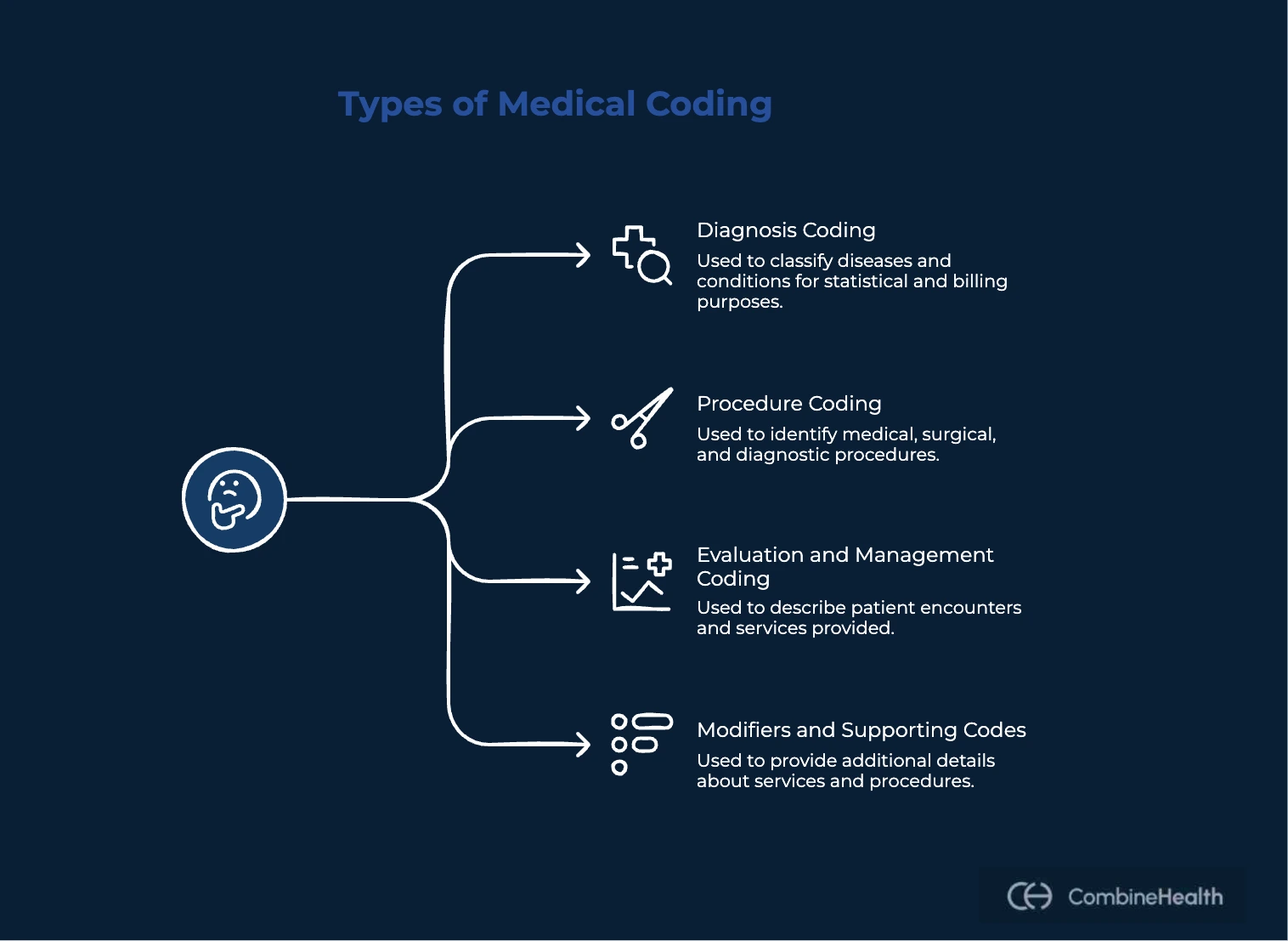
To answer these questions consistently across the healthcare system, coders rely mainly on the following standardized coding systems, each designed for a specific purpose:
Diagnosis Coding (ICD-10-CM)
Diagnosis codes describe why the patient was treated.
The ICD-10-CM (International Classification of Diseases, 10th Revision, Clinical Modification) system is used to document:
- Patient conditions and symptoms
- Acute vs. chronic illnesses
- Severity, laterality, and complications
Example:
Two patients with the same condition may require different ICD-10 codes depending on severity or associated risk factors. This makes diagnosis coding foundational not just for billing, but also for risk adjustment, quality reporting, and population health analysis.
Procedure Coding (CPT & HCPCS)
Procedure codes describe what was done during the encounter.
- CPT (Current Procedural Terminology) codes capture most physician services and procedures, such as office visits, surgeries, and diagnostic tests.
- HCPCS Level II codes are primarily used for supplies, durable medical equipment, and certain non-physician services.
Procedure coding requires careful alignment with documentation. Even when the correct service is provided, missing details—such as technique, duration, or approach—can affect whether a code is valid or reimbursable.
Evaluation and Management (E/M) Coding
E/M coding captures how complex the clinical decision-making was.
Unlike diagnosis and procedure coding, E/M coding depends heavily on clinical reasoning. It reflects:
- The number and complexity of problems addressed
- The amount and complexity of data reviewed or interpreted
- The level of risk to the patient
Two visits with similar diagnoses may result in very different E/M levels depending on the provider’s thought process, risk assessment, and data interpretation. This makes E/M coding one of the most judgment-driven and most scrutinized areas of medical coding.
Modifiers and Supporting Codes
Modifiers provide additional context about how a service was performed.
They are used to indicate:
- Distinct or separate procedures
- Professional vs. technical components
- Increased complexity or unusual circumstances
When applied correctly, modifiers ensure accurate reimbursement. When applied incorrectly or without clear justification, they are a common source of denials and audits.
Additional coding systems include DRG codes for inpatient reimbursement, NDC codes for pharmaceuticals, and specialty-specific codes like dental (CDT) or mental health coding systems. Each type serves a unique function in the healthcare revenue cycle, ensuring comprehensive documentation and appropriate reimbursement for all services provided.
How Is Computer-Assisted Coding Different from Autonomous Coding?
Many healthcare organizations lump all “AI coding tools” into one category. In reality, there’s a meaningful difference between computer-assisted coding (CAC) and autonomous coding, and that difference directly affects accuracy, scalability, and compliance.
Computer-assisted coding is designed to support human coders, but it doesn't reason through the encounter end to end.
In a CAC workflow:
- The system scans clinical documentation using rules and NLP
- It suggests possible ICD-10, CPT, or HCPCS codes
- A human coder reviews, edits, accepts, or rejects those suggestions
- Final responsibility always rests with the coder
Autonomous coding takes a fundamentally different approach.
Instead of suggesting codes for human selection, autonomous systems:
- Analyze the full encounter record
- Apply coding guidelines and payer rules directly
- Generate codes independently
- Provide explicit rationale and evidence for each decision
- Escalate uncertainty to human reviewers when needed
So, Which Is Better: CAC or Autonomous Medical Coding?
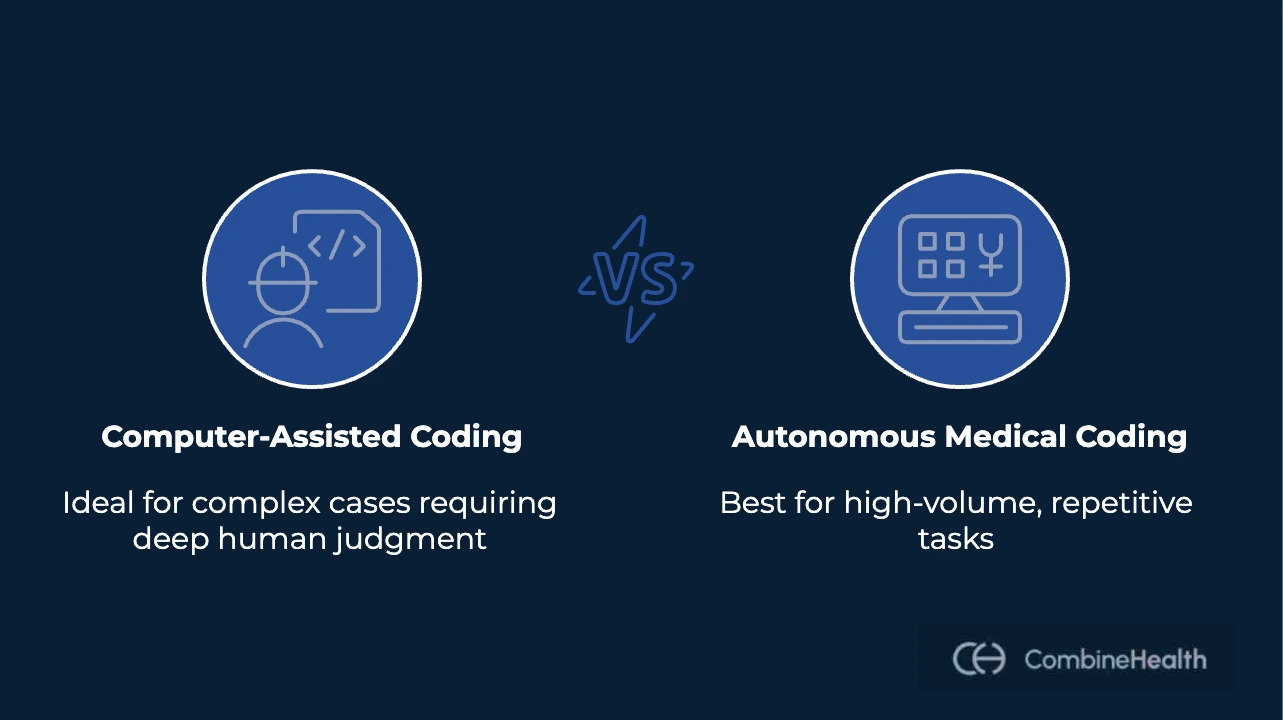
Neither approach is universally “better," but they solve different problems:
CAC is ideal to use when:
- Case volume is manageable
- Encounters are consistently complex
- Deep human judgment is required for most charts
However, autonomous medical coding is better when:
- Volume is high and repetitive
- Coding rules are well-defined
- Consistency and turnaround time matter
- Human review can be focused on exceptions
How AI Can Be Used in Medical Coding
In the past, coding relied solely on coding specialists for carefully reading notes and matching them to the right code.
Now, technology like artificial intelligence (AI) has stepped in to help. The process can be faster, more accurate, and even run 24/7. AI-powered systems analyze records, check for common errors, and prompt humans for input only when needed.
Let's walk you through how AI integrates into the coding workflow of a modern-day RCM system:
Automated Code Assignment
AI can automatically assign diagnosis and procedure codes by analyzing clinical documentation, structured data, and supporting evidence within the medical record.
Unlike basic keyword-based tools, modern AI models evaluate:
- Clinical context across the entire encounter
- Relationships between diagnoses, procedures, and medical decision-making
- Documentation elements required by coding guidelines and payer policies
This allows AI to generate codes that align not only with what was documented, but with how the care was delivered and why certain decisions were made. For high-volume encounters, automated code assignment reduces turnaround time while maintaining consistency across similar cases.
Recommended Reading: Real-world use-cases of AI in RCM workflows
Routing Complex or High-Risk Cases for Human Review
Not every encounter can (and should) be fully automated, and good AI systems are built to recognize that.
AI can score encounters based on complexity, risk, or uncertainty and automatically route specific cases to human coders for review. These may include:
- High-severity or high-dollar claims
- Encounters with ambiguous documentation
- Cases involving modifiers, trauma, or multiple specialties
By separating straightforward cases from those that require expert judgment, AI helps coding teams focus their time where it adds the most value—without slowing down the entire workflow.
Real-Time Clinical Documentation Improvement (CDI) Review
AI can identify documentation gaps before coding and billing occur.
During or immediately after an encounter, AI can flag:
- Missing specificity or incomplete diagnoses
- Unsupported levels of service
- Missing documentation for independent interpretation or risk factors
This enables real-time or near-real-time CDI feedback, reducing the need for retrospective queries and minimizing downstream denials. When clinical reasoning is captured early, coding decisions become clearer and more defensible later in the revenue cycle.
Integration With Widely Used EHRs
For AI in medical coding to be effective at scale, it must integrate seamlessly with existing systems.
Modern AI tools are designed to:
- Read encounter notes directly from the EHR
- Analyze structured and unstructured data in place
- Return codes, rationale, and flags without requiring duplicate workflows
Tight integration ensures that AI fits into established coding and documentation processes rather than forcing teams to adopt parallel systems. This is especially important for maintaining adoption, accuracy, and audit readiness.
How Accurate Is AI Medical Coding Compared With Human Coders?
AI medical coding accuracy depends on chart complexity. Most AI medical coding vendors claim roughly 90–95% accuracy on routine encounters but 70–75% on complex ones, while human-plus-AI (hybrid) workflows reach about 96–98%. That's why the headline number matters less than how it's measured and on which charts.
Every vendor claims "95%+". What to Actually Measure?
- Claim-line accuracy (each CPT with its supporting ICD codes), not a whole-claim average.
- Accuracy by specialty and by complexity — routine vs. ambiguous.
- Performance on your charts, in a pilot — not a vendor's demo data.
CombineHealth reports claim-line accuracy and can be measured against your own medical coders on your historical charts — see the pilot section below.
Can You See the Evidence Behind Every AI Coding Decision?
Explainable AI medical coding shows the evidence behind each code — the documentation it relied on, the guideline it applied, and the medical-decision-making logic — so a coder can validate it and you can defend it in an audit. Tools that output a code with no reasoning are the ones to avoid.
Most AI coders are black boxes; CombineHealth isn't. The self-learning autonomous medical coding platform shows line-by-line rationale, the chart evidence, AMA guideline references, and the MDM breakdown behind every ICD/CPT/E&M decision — so every code is auditable.
How Does AI Coding Handle Payer Rules and Learn From Denials?
Strong AI medical coding applies payer-specific rules — LCDs, NCDs, and commercial edits — before the claim goes out, and learns from real payer outcomes (denials, underpayments, edits) to code better next time. That's what closes the gap when "our codes are correct but this payer still denies." When guidelines and payer requirements conflict, the safe path is compliant coding that still satisfies the payer's documentation requirement.
CombineHealth is payer-aware and payer-outcome-aware — she applies each payer's rules pre-bill and turns downstream outcomes into feedback that improves future coding, so denial patterns get fixed upstream.
What Happens When the AI Medical Coder Isn't Confident About a Chart?
A well-designed AI coder scores its confidence on every chart. High-confidence, well-documented charts are coded autonomously; low-confidence, ambiguous, or high-risk charts route to a human coder. It should also tell the difference between a documentation gap (needs a physician query) and an undercoding opportunity (needs a higher, supported code).
When does a clinical documentation gap trigger a query vs. education?
A gap that blocks the optimal code on this chart warrants a physician query; a recurring pattern across a provider's charts warrants education. And you decide the confidence threshold at which charts can be auto-submitted without review.
CombineHealth uses confidence-based escalation, distinguishes documentation gaps from undercoding opportunities, and generates physician queries when the note can't support the optimal code — with the autonomy threshold configurable to your comfort level
Can AI Code Inconsistent Documentation From Different EHRs?
Physicians document the same thing many ways, and health systems pull charts from multiple EHRs in different formats. AI coding handles this by reading the full encounter — notes, PDFs, and structured EHR data — and interpreting the clinical meaning before assigning codes, so coding stays consistent regardless of documentation style or source system.
CombineHealth reads documentation from the source system in whatever form it arrives (notes, PDFs, EHR data) and applies the same coding logic across it — keeping output consistent across providers, specialties, and EHRs.
.webp)
Real-World Use Case of AI in Medical Coding
To understand how AI in medical coding works beyond theory, it helps to look at how it’s applied inside real revenue cycle workflows. At CombineHealth, medical coding automation is built around a simple principle: codes should reflect not just what was documented, but the clinical reasoning that justified the care.
That principle is operationalized through CombineHealth’s AI medical coding platform, which supports coding, auditing, and CDI across multiple specialties.
How CombineHealth's Medical Coding Automation Works
CombineHealth is designed to work the way experienced medical coders do, by reasoning through the encounter, not scanning for keywords.
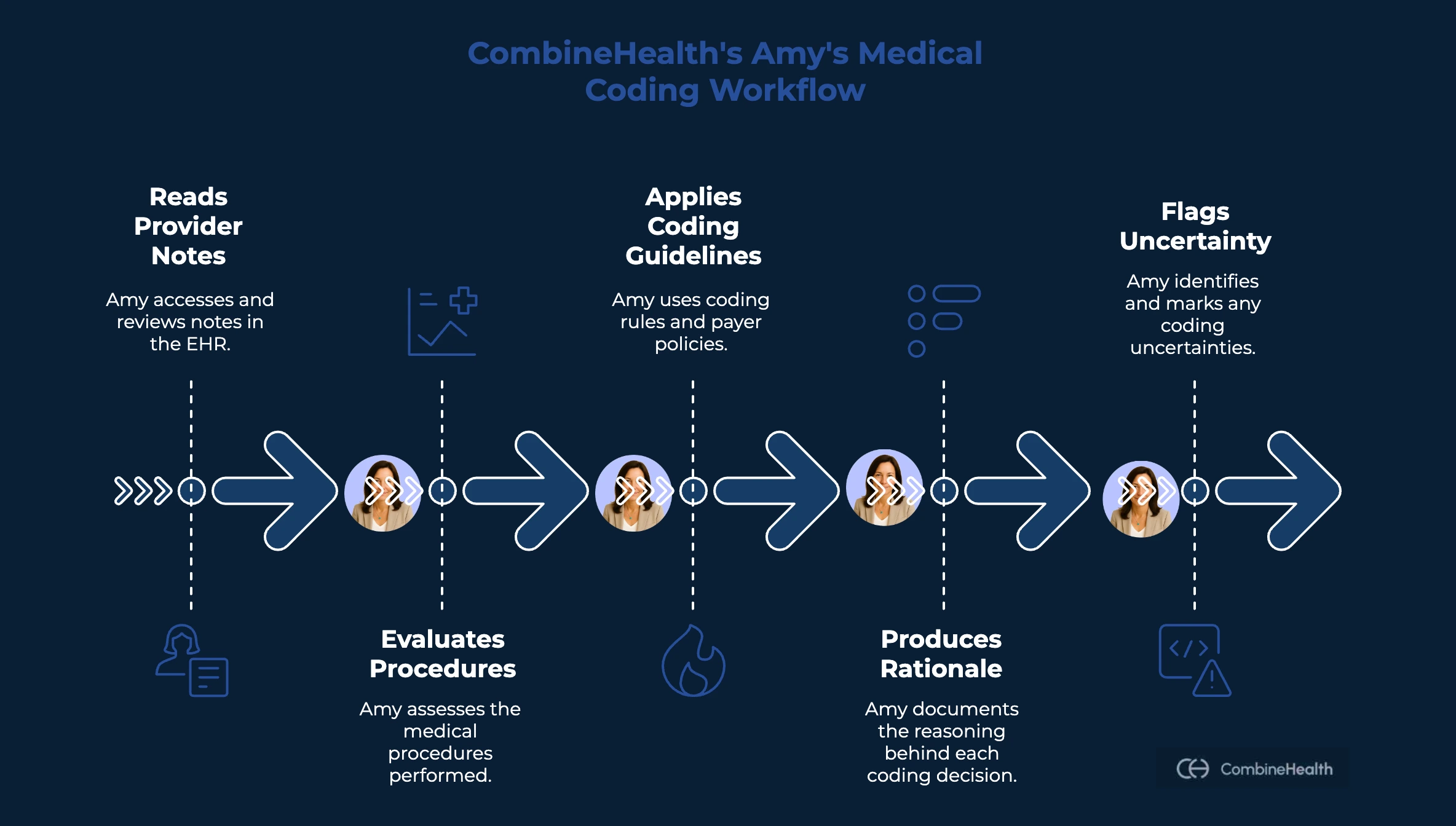
CombineHealth’s medical coding workflow:
- Reads provider-authored notes directly from the EHR
- Evaluates procedures performed, tests ordered, and resources used
- Applies coding guidelines and payer rules consistently
- Produces line-by-line rationale for each coding decision
- Flags uncertainty instead of guessing
Use Case: AI Medical Coding in the Emergency Department
The emergency department is one of the most challenging environments for medical coding. That's because ED encounters are:
- Primarily acute, not longitudinal
- Highly dependent on cognitive effort that may not be fully documented
- Influenced by trauma rules, imaging interpretation, and morbid conditions
- Documented under extreme time pressure, often with ambiguity or gaps
When CombineHealth engineers implemented AI-driven medical coding for an ED customer, they focused on teaching the system to recognize nuance before automation.
Case Study:CombineHealth codes alongside ED coders and coded charts with 97% accuracy, while surfacing 5x more documentation gaps!
Step 1: Generating Billable Codes (CPT / HCPCS)
The first step is identifying what care was actually delivered.
CombineHealth evaluates:
- Provider-authored clinical notes
- Procedures performed
- Facility resources used
- Tests ordered and independently interpreted
Rather than assuming everything mentioned is billable, CombineHealth determines which elements reflect true patient care delivered during the encounter.
Step 2: Generating Non-Billable Codes (ICD-10)
Once billable services are identified, CombineHealth generates ICD-10 codes to tell the clinical story that justifies those charges.
Here, CombineHealth works from first principles:
- What symptoms did the patient present with?
- What acute conditions required intervention?
- Which chronic conditions complicated care or increased risk?
After assigning ICD-10 codes, CombineHealth performs a second validation pass:
Does each CPT or HCPCS code have clear clinical justification within the ICD set?
Recommended Read: Evaluating a medical coding solution
Ready to Streamline Your Medical Coding Workflows?
Medical coding may not be the most exciting part of running a clinic, but it's one of the most important healthcare operations. More than just translating notes into numbers, it keeps revenue flowing and helps ensure you're getting paid for the services you delivered.
If you're looking to streamline your coding process and eliminate errors, book a demo with us to see how CombineHealth can help!
FAQs
What is medical coding, and why is it important for clinics?
Medical coding is the process of turning details from patient visits into standardized codes used for insurance billing, reporting, and tracking outcomes. Accurate coding ensures clinics are reimbursed fairly and on time while reducing claim denials and administrative headaches.
How can coding errors impact clinic revenue?
Even small errors in medical coding may lead to denied claims, delayed payments, or extra paperwork. Consistent, correct coding is essential to avoid revenue loss and maintain efficient operations.
How is AI changing the medical coding process?
AI-powered coding tools automate much of the coding workflow by analyzing records, flagging errors, and handling routine cases. This reduces manual effort, speeds up payments, and lowers overall claim denials, leaving staff free to focus on patient care.
What types of medical codes are most commonly used?
The two main code sets are ICD codes for diagnoses and CPT codes for procedures. These standardized systems help clinics, hospitals, and insurers communicate clearly and manage billing accurately.
What can clinics do to improve their coding practices?
Clinics should invest in regular staff training, use automation tools where possible, maintain organized electronic health records, monitor key billing metrics, and keep up to date with changing payer rules to ensure maximum accuracy and efficiency.
Our codes are correct but certain payers keep denying. What are we missing?
Usually payer-specific rules or documentation the payer requires but the note doesn't clearly support. Payer-aware coding applies each payer's edits before submission and learns from denial patterns, so correct-but-denied claims get fixed at the source.
How can we keep up with growing coding volume without hiring?
AI throughput isn't limited by headcount. It codes high-confidence charts autonomously and routes the rest to your existing coders, so volume can grow — or a team can shrink — without output collapsing.
Why does our team still review almost every chart?
That's a sign of a high exception rate — often a tool that flags too much or can't judge confidence. A system with reliable confidence scoring auto-handles well-documented charts and escalates only genuinely ambiguous ones.
Our AI gives a code but doesn't explain how. Is there a better approach?
Yes — look for explainable AI that shows the documentation, guideline, and reasoning behind each code. Black-box output can't be validated quickly or defended in an audit; a visible rationale can.
How do we test AI coding on our actual charts before deploying?
Run a pilot on a sample of your historical charts, measure claim-line accuracy against your coders, and track denial and turnaround impact. Insist on real-world charts, not demo data, and set success metrics up front.
How do we know when AI coding is reliable enough to submit without review?
Set a confidence threshold: above it, well-documented charts auto-submit; below it, charts route to a coder. Start conservative, watch accuracy and denials, and raise the threshold as the results prove out.
Recommended Reads







Explore Our
AI Workforce







Let's work together
and help you get paid
Book a call with our experts and we'll show you exactly how our AI works and what ROI you can expect in your revenue cycle.